 Add to Chrome
 Add to Firefox
 Add to Edge
Learning Structural Illumination for Unsupervised Low-light Enhancement
Aug 08, 2026
Existing unsupervised low-light image enhancement (LLIE) methods often estimate illumination directly from the entire low-light input, without separating its spatially varying illumination pattern, termed relative illumination structure, from the absolute exposure level or preventing unreliable low signal-to-noise ratio regions from biasing the estimate. Moreover, fixed exposure targets impose a scene-agnostic enhancement criterion, limiting adaptation across diverse lighting conditions. Inspired by the spatial propagation of light, we propose a Relative Illumination Structure Estimation (RISE) framework that decouples relative illumination structure from absolute exposure and infers it from reliable bright regions, enabling interpretable and robust enhancement. For scene-adaptive exposure adjustment, we further propose a Dual-Metering Exposure Reference derived from each input, allowing RISE to adapt the enhancement strength to individual scenes and generalize across diverse lighting conditions. Extensive benchmark and real-world generalization experiments show that RISE achieves state-of-the-art performance among unsupervised LLIE methods while producing visually natural results.

Dunhuang Grottoes Painting Dataset and Benchmark
Jul 11, 2019

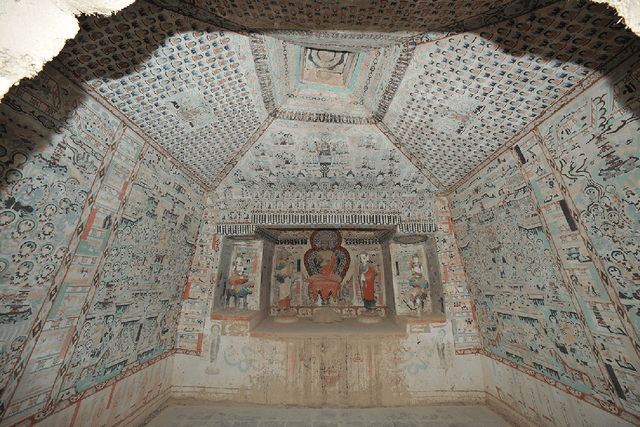

This document introduces the background and the usage of the Dunhuang Grottoes Dataset and the benchmark. The documentation first starts with the background of the Dunhuang Grotto, which is widely recognised as an priceless heritage. Given that digital method is the modern trend for heritage protection and restoration. Follow the trend, we release the first public dataset for Dunhuang Grotto Painting restoration. The rest of the documentation details the painting data generation. To enable a data driven fashion, this dataset provided a large number of training and testing example which is sufficient for a deep learning approach. The detailed usage of the dataset as well as the benchmark is described.