 Add to Chrome
 Add to Firefox
 Add to Edge
Index SLM Technical Report
Jul 10, 2026
We present Index-1.9B, a series of open small language models developed at Bilibili. The series comprises four models: Index-1.9B-Base, a foundation model with 1.9 billion non-embedding parameters pre-trained on 2.8 trillion predominantly Chinese and English tokens; Index-1.9B-Pure, a control variant trained with an identical recipe but with all instruction-like data strictly filtered from the corpus; Index-1.9B-Chat, aligned from the base model with supervised fine-tuning and direct preference optimization; and Index-1.9B-Character, which augments the chat model with retrieval-augmented generation for few-shot role-playing customization. Pre-training employs a Warmup-Stable-Decay learning-rate schedule in which the concentration of curated data is raised substantially during the decay phase, together with a Norm-Head output layer that stabilizes training under large learning rates. On a suite of standard benchmarks covering examination, reasoning, mathematics, and code, Index-1.9B-Base attains an average score of 64.92, competitive with or exceeding open models of several times its size. We further report controlled studies on model depth, learning-rate magnitude and scheduling, the interaction between learning-rate decay and data quality, and the effect of including instruction data during pre-training, and we document an unexplained surge in benchmark performance midway through the constant-learning-rate phase. All models, together with evaluation code, are released at https://github.com/bilibili/Index-1.9B.

GCAM: Gaussian and causal-attention model of food fine-grained recognition
Mar 18, 2024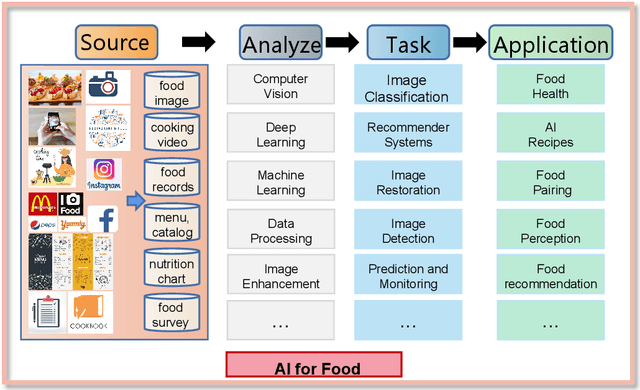
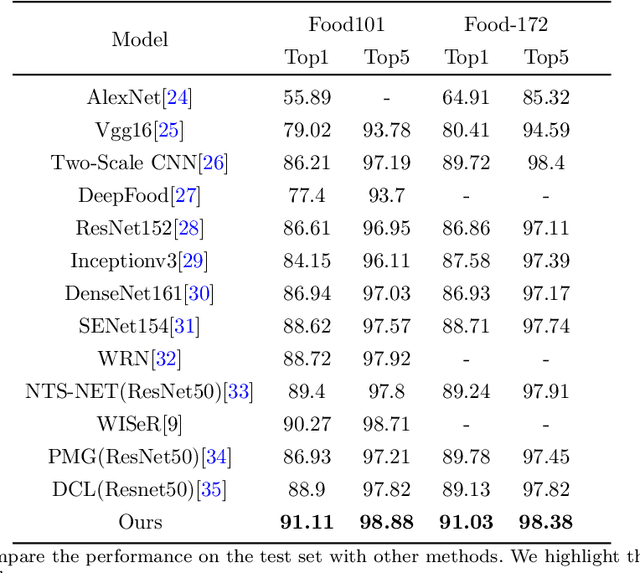
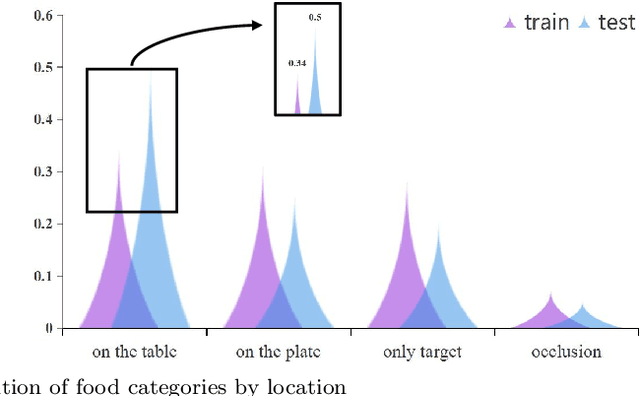
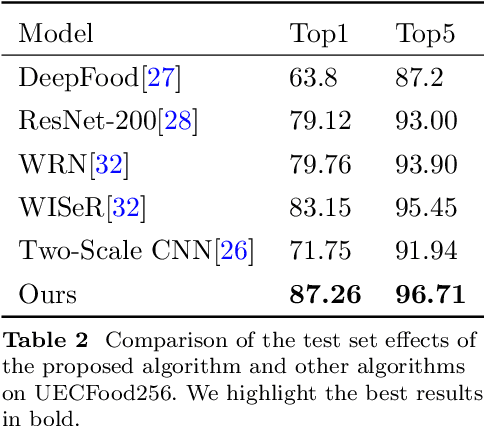
Currently, most food recognition relies on deep learning for category classification. However, these approaches struggle to effectively distinguish between visually similar food samples, highlighting the pressing need to address fine-grained issues in food recognition. To mitigate these challenges, we propose the adoption of a Gaussian and causal-attention model for fine-grained object recognition.In particular, we train to obtain Gaussian features over target regions, followed by the extraction of fine-grained features from the objects, thereby enhancing the feature mapping capabilities of the target regions. To counteract data drift resulting from uneven data distributions, we employ a counterfactual reasoning approach. By using counterfactual interventions, we analyze the impact of the learned image attention mechanism on network predictions, enabling the network to acquire more useful attention weights for fine-grained image recognition. Finally, we design a learnable loss strategy to balance training stability across various modules, ultimately improving the accuracy of the final target recognition. We validate our approach on four relevant datasets, demonstrating its excellent performance across these four datasets.We experimentally show that GCAM surpasses state-of-the-art methods on the ETH-FOOD101, UECFOOD256, and Vireo-FOOD172 datasets. Furthermore, our approach also achieves state-of-the-art performance on the CUB-200 dataset.