 Add to Chrome
 Add to Firefox
 Add to Edge
GLIER: Generative Legal Inference and Evidence Ranking for Legal Case Retrieval
Apr 26, 2026
The semantic gap between colloquial user queries and professional legal documents presents a fundamental challenge in Legal Case Retrieval (LCR). Existing dense retrieval methods typically treat LCR as a black-box semantic matching process, neglecting the explicit juridical logic that underpins legal relevance. To address this, we propose GLIER (Generative Legal Inference and Evidence Ranking), a framework that reformulates retrieval as an inference process over latent legal variables. GLIER decomposes the task into two interpretability-driven stages. First, a Joint Generative Inference module translates raw queries into latent legal indicators, including charges and legal elements, using a unified sequence-to-sequence strategy that jointly generates charges and elements to enforce logical consistency. Second, a Multi-View Evidence Fusion mechanism aggregates generative confidence with structural and lexical signals for precise ranking. Extensive experiments on LeCaRD and LeCaRDv2 demonstrate that GLIER outperforms strong baselines such as SAILER and KELLER. Notably, GLIER exhibits strong data efficiency, maintaining robust performance even when trained with only 10% of the data.

GenState-AI: State-Aware Dataset for Text-to-Video Retrieval on AI-Generated Videos
Mar 15, 2026Existing text-to-video retrieval benchmarks are dominated by real-world footage where much of the semantics can be inferred from a single frame, leaving temporal reasoning and explicit end-state grounding under-evaluated. We introduce GenState-AI, an AI-generated benchmark centered on controlled state transitions, where each query is paired with a main video, a temporal hard negative that differs only in the decisive end-state, and a semantic hard negative with content substitution, enabling fine-grained diagnosis of temporal vs. semantic confusions beyond appearance matching. Using Wan2.2-TI2V-5B, we generate short clips whose meaning depends on precise changes in position, quantity, and object relations, providing controllable evaluation conditions for state-aware retrieval. We evaluate two representative MLLM-based baselines, and observe consistent and interpretable failure patterns: both frequently confuse the main video with the temporal hard negative and over-prefer temporally plausible but end-state-incorrect clips, indicating insufficient grounding to decisive end-state evidence, while being comparatively less sensitive to semantic substitutions. We further introduce triplet-based diagnostic analyses, including relative-order statistics and breakdowns across transition categories, to make temporal vs. semantic failure sources explicit. GenState-AI provides a focused testbed for state-aware, temporally and semantically sensitive text-to-video retrieval, and will be released on huggingface.co.
RFKG-CoT: Relation-Driven Adaptive Hop-count Selection and Few-Shot Path Guidance for Knowledge-Aware QA
Dec 17, 2025Large language models (LLMs) often generate hallucinations in knowledge-intensive QA due to parametric knowledge limitations. While existing methods like KG-CoT improve reliability by integrating knowledge graph (KG) paths, they suffer from rigid hop-count selection (solely question-driven) and underutilization of reasoning paths (lack of guidance). To address this, we propose RFKG-CoT: First, it replaces the rigid hop-count selector with a relation-driven adaptive hop-count selector that dynamically adjusts reasoning steps by activating KG relations (e.g., 1-hop for direct "brother" relations, 2-hop for indirect "father-son" chains), formalized via a relation mask. Second, it introduces a few-shot in-context learning path guidance mechanism with CoT (think) that constructs examples in a "question-paths-answer" format to enhance LLMs' ability to understand reasoning paths. Experiments on four KGQA benchmarks show RFKG-CoT improves accuracy by up to 14.7 pp (Llama2-7B on WebQSP) over KG-CoT. Ablations confirm the hop-count selector and the path prompt are complementary, jointly transforming KG evidence into more faithful answers.
A Survey of Long-Document Retrieval in the PLM and LLM Era
Sep 09, 2025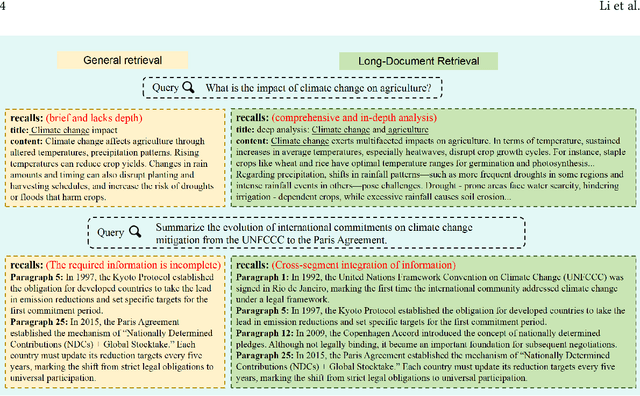
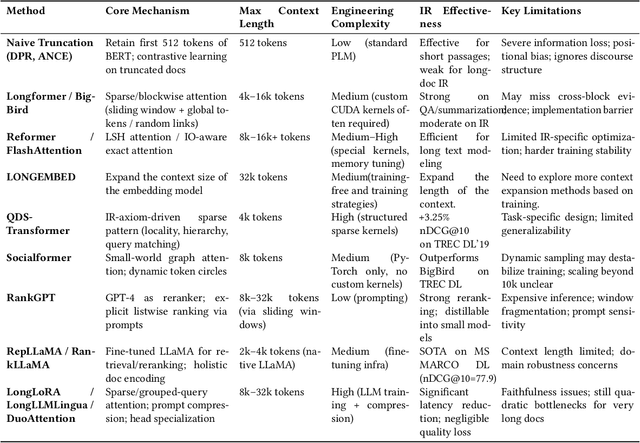
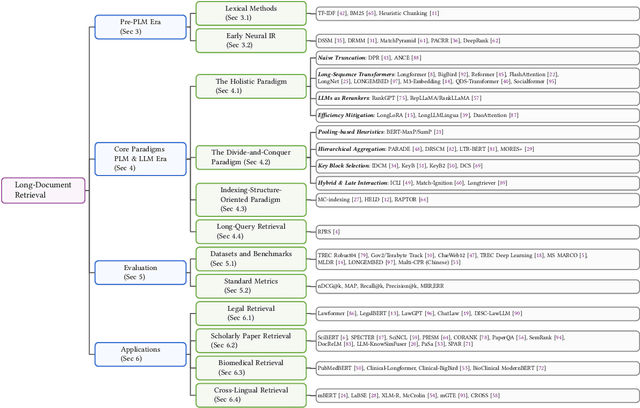
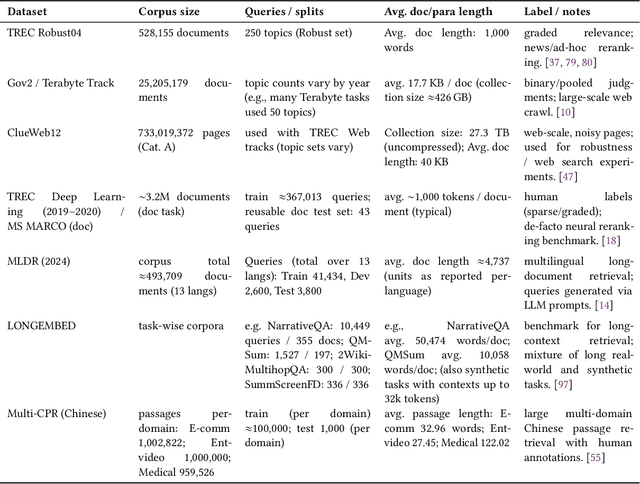
The proliferation of long-form documents presents a fundamental challenge to information retrieval (IR), as their length, dispersed evidence, and complex structures demand specialized methods beyond standard passage-level techniques. This survey provides the first comprehensive treatment of long-document retrieval (LDR), consolidating methods, challenges, and applications across three major eras. We systematize the evolution from classical lexical and early neural models to modern pre-trained (PLM) and large language models (LLMs), covering key paradigms like passage aggregation, hierarchical encoding, efficient attention, and the latest LLM-driven re-ranking and retrieval techniques. Beyond the models, we review domain-specific applications, specialized evaluation resources, and outline critical open challenges such as efficiency trade-offs, multimodal alignment, and faithfulness. This survey aims to provide both a consolidated reference and a forward-looking agenda for advancing long-document retrieval in the era of foundation models.