 Add to Chrome
 Add to Firefox
 Add to Edge
GenState-AI: State-Aware Dataset for Text-to-Video Retrieval on AI-Generated Videos
Mar 15, 2026
Existing text-to-video retrieval benchmarks are dominated by real-world footage where much of the semantics can be inferred from a single frame, leaving temporal reasoning and explicit end-state grounding under-evaluated. We introduce GenState-AI, an AI-generated benchmark centered on controlled state transitions, where each query is paired with a main video, a temporal hard negative that differs only in the decisive end-state, and a semantic hard negative with content substitution, enabling fine-grained diagnosis of temporal vs. semantic confusions beyond appearance matching. Using Wan2.2-TI2V-5B, we generate short clips whose meaning depends on precise changes in position, quantity, and object relations, providing controllable evaluation conditions for state-aware retrieval. We evaluate two representative MLLM-based baselines, and observe consistent and interpretable failure patterns: both frequently confuse the main video with the temporal hard negative and over-prefer temporally plausible but end-state-incorrect clips, indicating insufficient grounding to decisive end-state evidence, while being comparatively less sensitive to semantic substitutions. We further introduce triplet-based diagnostic analyses, including relative-order statistics and breakdowns across transition categories, to make temporal vs. semantic failure sources explicit. GenState-AI provides a focused testbed for state-aware, temporally and semantically sensitive text-to-video retrieval, and will be released on huggingface.co.

A Survey of Long-Document Retrieval in the PLM and LLM Era
Sep 09, 2025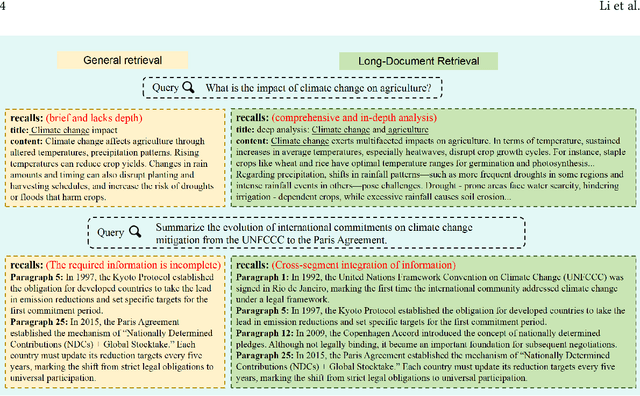
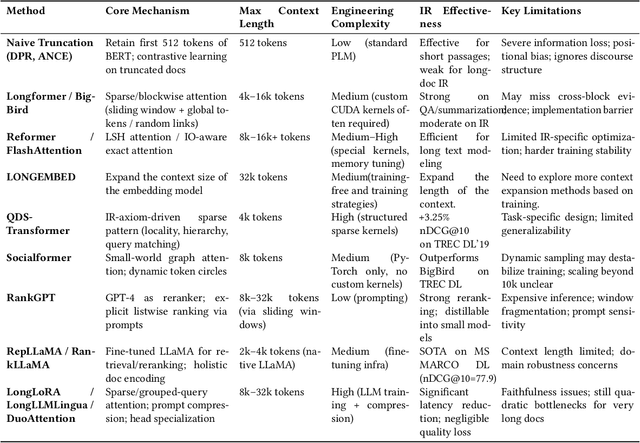
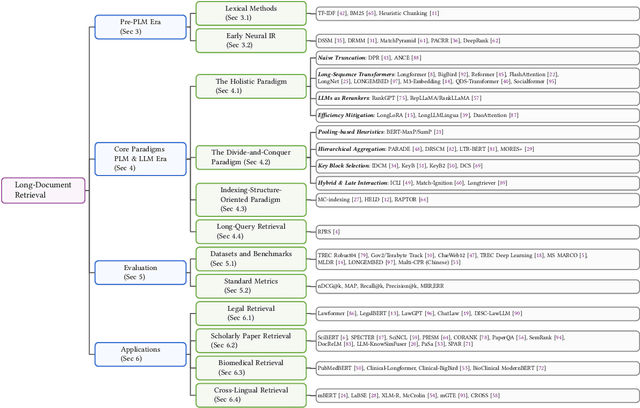
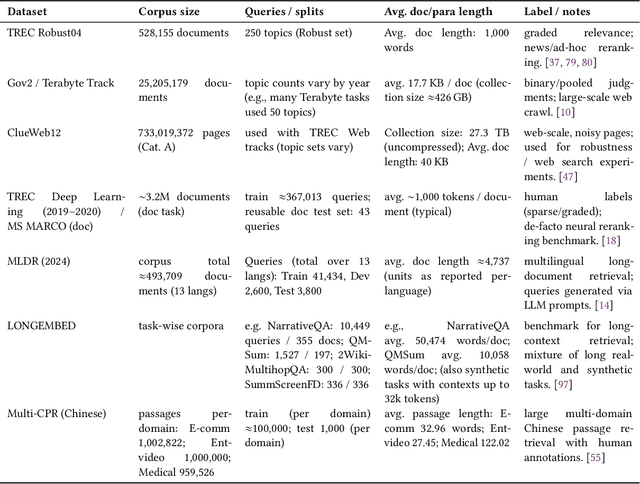
The proliferation of long-form documents presents a fundamental challenge to information retrieval (IR), as their length, dispersed evidence, and complex structures demand specialized methods beyond standard passage-level techniques. This survey provides the first comprehensive treatment of long-document retrieval (LDR), consolidating methods, challenges, and applications across three major eras. We systematize the evolution from classical lexical and early neural models to modern pre-trained (PLM) and large language models (LLMs), covering key paradigms like passage aggregation, hierarchical encoding, efficient attention, and the latest LLM-driven re-ranking and retrieval techniques. Beyond the models, we review domain-specific applications, specialized evaluation resources, and outline critical open challenges such as efficiency trade-offs, multimodal alignment, and faithfulness. This survey aims to provide both a consolidated reference and a forward-looking agenda for advancing long-document retrieval in the era of foundation models.