 Add to Chrome
 Add to Firefox
 Add to Edge
NTDH: Complex Reasoning for Comprehensive Affective Analysis
Aug 05, 2026
Comprehensive affective analysis is challenging for two reasons: it spans heterogeneous prediction tasks with continuous, ordinal, and multi-label outputs, and affective meaning is context-dependent, requiring conflicting cues to be reconciled rather than mapped directly to labels. Existing methods learn this mapping directly and do not model the reconciliation explicitly. We recast the task as a complex-reasoning problem, which yields one output interface across heterogeneous label spaces and a trajectory over which a verifiable reward can be optimised; to our knowledge, this is the first such treatment covering both sentiment and emotion. The obstacle is on the data side: affective reasoning traces must be synthesised, and generic synthesis is misaligned with the targets, tolerances, and phenomena of affect, and discards or leaks its failure cases. We propose NTDH, which addresses these four failures. Naturalisation sets the training answer to the gold label, so it is correct by construction. A Tolerance-aware gate checks each answer against the task's own scoring margin. Domain-aware strategies refine the reasoning using ideas from affective science. Directional Hints report only the type and direction of an error, without exposing the target. We train Qwen3-8B with SFT and then GRPO under the same tolerance used for verification (up to a more permissive construction gate on the multi-label subtask), and a component ablation quantifies the data-quality effect of each part. Using 16,302 training records, about 14x fewer than comparable instruction-tuned systems, the final policy improves over its SFT checkpoint on five of six official-test metrics and achieves the strongest EI-reg result among the compared systems, at a Pearson correlation of 0.862.

Experimental Results regarding multiple Machine Learning via Quaternions
Aug 03, 2023This paper presents an experimental study on the application of quaternions in several machine learning algorithms. Quaternion is a mathematical representation of rotation in three-dimensional space, which can be used to represent complex data transformations. In this study, we explore the use of quaternions to represent and classify rotation data, using randomly generated quaternion data and corresponding labels, converting quaternions to rotation matrices, and using them as input features. Based on quaternions and multiple machine learning algorithms, it has shown higher accuracy and significantly improved performance in prediction tasks. Overall, this study provides an empirical basis for exploiting quaternions for machine learning tasks.
StyleGAN3: Generative Networks for Improving the Equivariance of Translation and Rotation
Jul 08, 2023
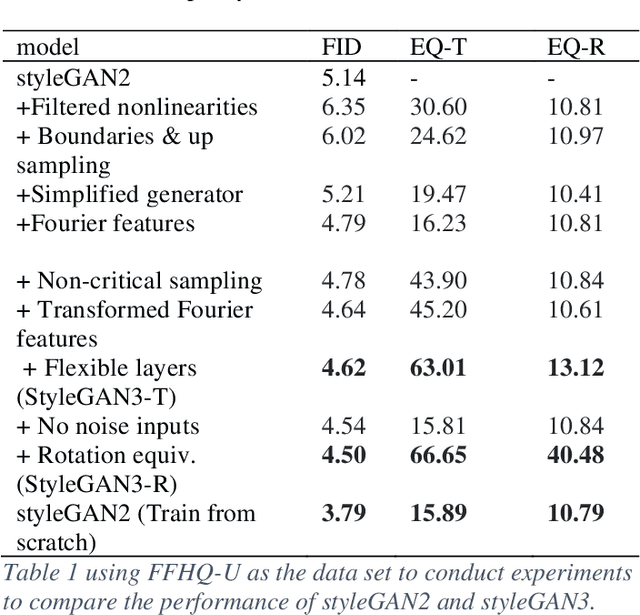
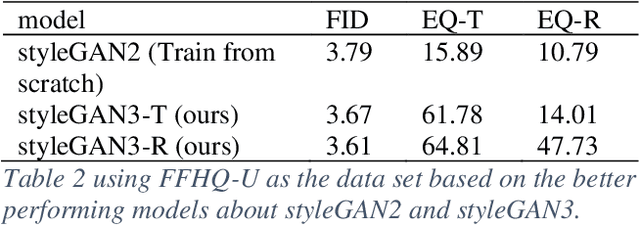
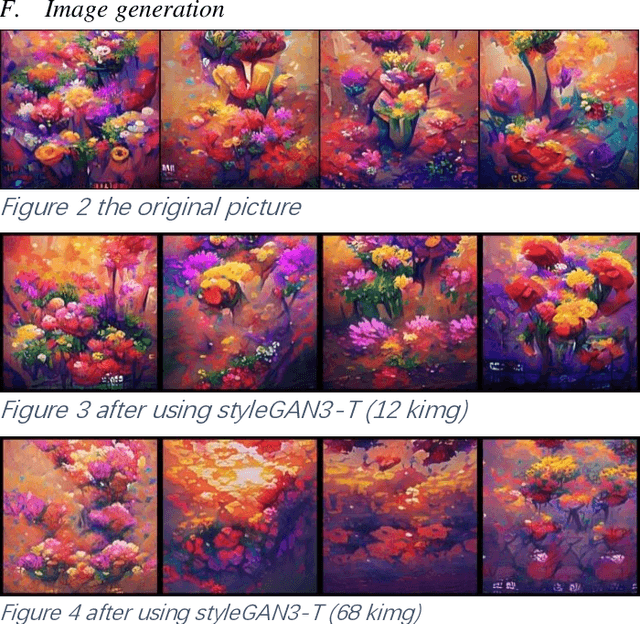
StyleGAN can use style to affect facial posture and identity features, and noise to affect hair, wrinkles, skin color and other details. Among these, the outcomes of the picture processing will vary slightly between different versions of styleGAN. As a result, the comparison of performance differences between styleGAN2 and the two modified versions of styleGAN3 will be the main focus of this study. We used the FFHQ dataset as the dataset and FID, EQ-T, and EQ-R were used to be the assessment of the model. In the end, we discovered that Stylegan3 version is a better generative network to improve the equivariance. Our findings have a positive impact on the creation of animation and videos.