 Add to Chrome
 Add to Firefox
 Add to Edge
gUFO: A Gentle Foundational Ontology for Semantic Web Knowledge Graphs
Mar 21, 2026
gUFO is a lightweight implementation of the Unified Foundational Ontology (UFO) suitable for Semantic Web OWL 2 DL applications. UFO is a mature foundational ontology with a rich axiomatization and that has been employed in a significant number of projects in research and industry. Moreover, it is currently in the process of standardization by the International Organization for Standardization as the ISO/IEC CD 21838-5. gUFO stands out from other foundational ontology implementations (such as those provided for BFO and DOLCE) given its unique support for a typology of types (operationalizing OntoClean guidelines), its reification patterns for intrinsic and relational aspects, and its support for situations and high-order types. gUFO provides well-founded patterns to address recurrent problems in Semantic Web knowledge graphs. In this paper, we present gUFO with its constituting categories, relations and constraints, discuss how it differs from the original UFO reference ontology, elaborate on its community adoption, and systematically position it in relation to existing OWL-based implementations of popular alternative foundational ontologies.

ONTrust: A Reference Ontology of Trust
Feb 07, 2026Trust has stood out more than ever in the light of recent innovations. Some examples are advances in artificial intelligence that make machines more and more humanlike, and the introduction of decentralized technologies (e.g. blockchains), which creates new forms of (decentralized) trust. These new developments have the potential to improve the provision of products and services, as well as to contribute to individual and collective well-being. However, their adoption depends largely on trust. In order to build trustworthy systems, along with defining laws, regulations and proper governance models for new forms of trust, it is necessary to properly conceptualize trust, so that it can be understood both by humans and machines. This paper is the culmination of a long-term research program of providing a solid ontological foundation on trust, by creating reference conceptual models to support information modeling, automated reasoning, information integration and semantic interoperability tasks. To address this, a Reference Ontology of Trust (ONTrust) was developed, grounded on the Unified Foundational Ontology and specified in OntoUML, which has been applied in several initiatives, to demonstrate, for example, how it can be used for conceptual modeling and enterprise architecture design, for language evaluation and (re)design, for trust management, for requirements engineering, and for trustworthy artificial intelligence (AI) in the context of affective Human-AI teaming. ONTrust formally characterizes the concept of trust and its different types, describes the different factors that can influence trust, as well as explains how risk emerges from trust relations. To illustrate the working of ONTrust, the ontology is applied to model two case studies extracted from the literature.
Mining Frequent Structures in Conceptual Models
Jun 11, 2024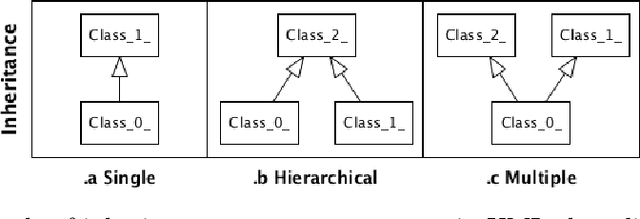
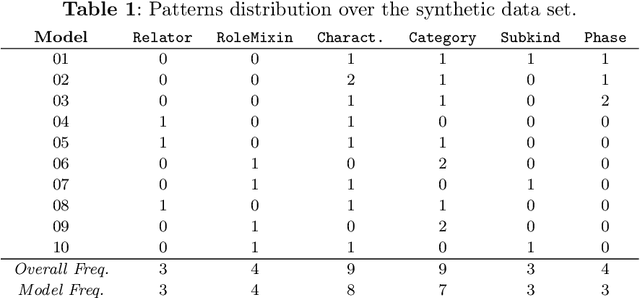
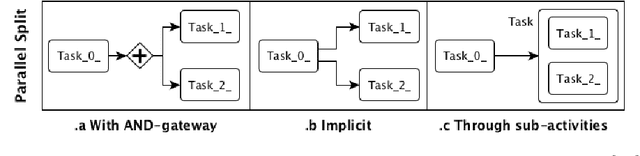
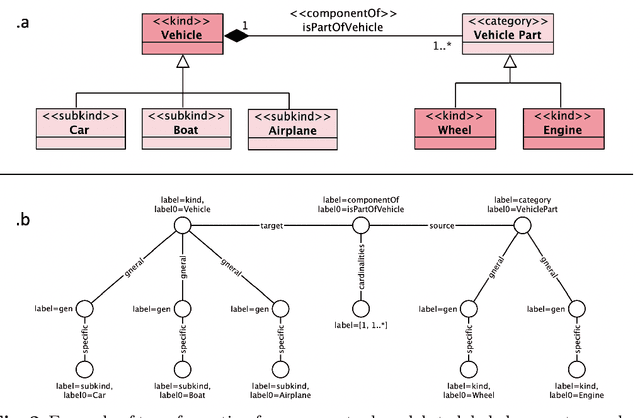
The problem of using structured methods to represent knowledge is well-known in conceptual modeling and has been studied for many years. It has been proven that adopting modeling patterns represents an effective structural method. Patterns are, indeed, generalizable recurrent structures that can be exploited as solutions to design problems. They aid in understanding and improving the process of creating models. The undeniable value of using patterns in conceptual modeling was demonstrated in several experimental studies. However, discovering patterns in conceptual models is widely recognized as a highly complex task and a systematic solution to pattern identification is currently lacking. In this paper, we propose a general approach to the problem of discovering frequent structures, as they occur in conceptual modeling languages. As proof of concept for our scientific contribution, we provide an implementation of the approach, by focusing on UML class diagrams, in particular OntoUML models. This implementation comprises an exploratory tool, which, through the combination of a frequent subgraph mining algorithm and graph manipulation techniques, can process multiple conceptual models and discover recurrent structures according to multiple criteria. The primary objective is to offer a support facility for language engineers. This can be employed to leverage both good and bad modeling practices, to evolve and maintain the conceptual modeling language, and to promote the reuse of encoded experience in designing better models with the given language.
Towards an ontology of portions of matter to support multi-scale analysis and provenance tracking
Jun 01, 2024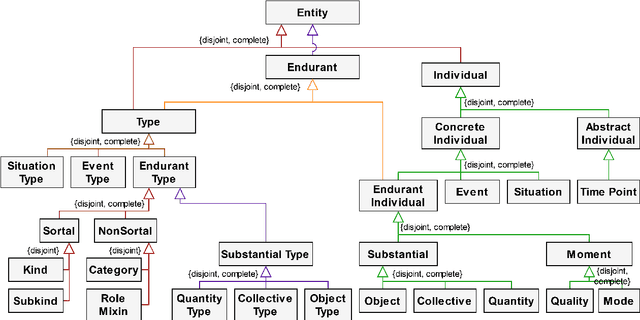
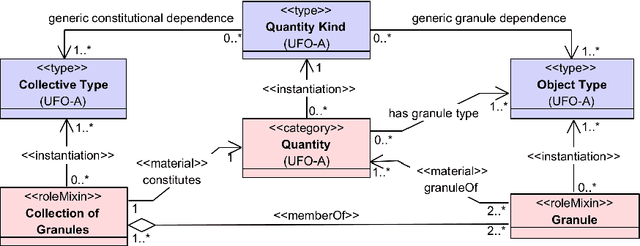
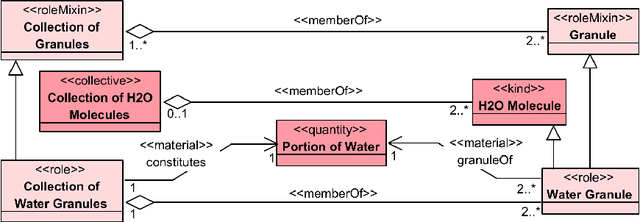
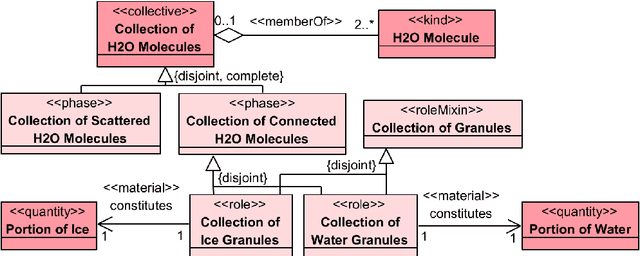
This paper presents an ontology of portions of matter with practical implications across scientific and industrial domains. The ontology is developed under the Unified Foundational Ontology (UFO), which uses the concept of quantity to represent topologically maximally self-connected portions of matter. The proposed ontology introduces the granuleOf parthood relation, holding between objects and portions of matter. It also discusses the constitution of quantities by collections of granules, the representation of sub-portions of matter, and the tracking of matter provenance between quantities using historical relations. Lastly, a case study is presented to demonstrate the use of the portion of matter ontology in the geology domain for an Oil & Gas industry application. In the case study, we model how to represent the historical relation between an original portion of rock and the sub-portions created during the industrial process. Lastly, future research directions are outlined, including investigating granularity levels and defining a taxonomy of events.