 Add to Chrome
 Add to Firefox
 Add to Edge
ONTrust: A Reference Ontology of Trust
Feb 07, 2026
Trust has stood out more than ever in the light of recent innovations. Some examples are advances in artificial intelligence that make machines more and more humanlike, and the introduction of decentralized technologies (e.g. blockchains), which creates new forms of (decentralized) trust. These new developments have the potential to improve the provision of products and services, as well as to contribute to individual and collective well-being. However, their adoption depends largely on trust. In order to build trustworthy systems, along with defining laws, regulations and proper governance models for new forms of trust, it is necessary to properly conceptualize trust, so that it can be understood both by humans and machines. This paper is the culmination of a long-term research program of providing a solid ontological foundation on trust, by creating reference conceptual models to support information modeling, automated reasoning, information integration and semantic interoperability tasks. To address this, a Reference Ontology of Trust (ONTrust) was developed, grounded on the Unified Foundational Ontology and specified in OntoUML, which has been applied in several initiatives, to demonstrate, for example, how it can be used for conceptual modeling and enterprise architecture design, for language evaluation and (re)design, for trust management, for requirements engineering, and for trustworthy artificial intelligence (AI) in the context of affective Human-AI teaming. ONTrust formally characterizes the concept of trust and its different types, describes the different factors that can influence trust, as well as explains how risk emerges from trust relations. To illustrate the working of ONTrust, the ontology is applied to model two case studies extracted from the literature.

DOLCE: A Descriptive Ontology for Linguistic and Cognitive Engineering
Aug 03, 2023


DOLCE, the first top-level (foundational) ontology to be axiomatized, has remained stable for twenty years and today is broadly used in a variety of domains. DOLCE is inspired by cognitive and linguistic considerations and aims to model a commonsense view of reality, like the one human beings exploit in everyday life in areas as diverse as socio-technical systems, manufacturing, financial transactions and cultural heritage. DOLCE clearly lists the ontological choices it is based upon, relies on philosophical principles, is richly formalized, and is built according to well-established ontological methodologies, e.g. OntoClean. Because of these features, it has inspired most of the existing top-level ontologies and has been used to develop or improve standards and public domain resources (e.g. CIDOC CRM, DBpedia and WordNet). Being a foundational ontology, DOLCE is not directly concerned with domain knowledge. Its purpose is to provide the general categories and relations needed to give a coherent view of reality, to integrate domain knowledge, and to mediate across domains. In these 20 years DOLCE has shown that applied ontologies can be stable and that interoperability across reference and domain ontologies is a reality. This paper briefly introduces the ontology and shows how to use it on a few modeling cases.
* 25 pages, 7 figures
Repairing Ontologies via Axiom Weakening
Nov 09, 2017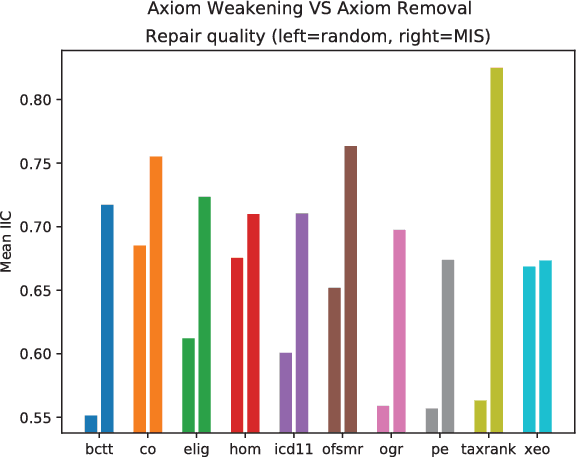
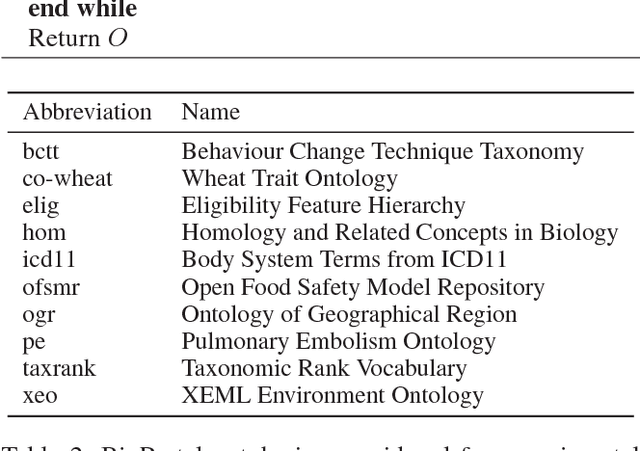
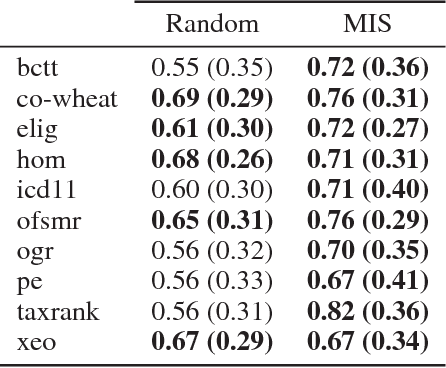
Ontology engineering is a hard and error-prone task, in which small changes may lead to errors, or even produce an inconsistent ontology. As ontologies grow in size, the need for automated methods for repairing inconsistencies while preserving as much of the original knowledge as possible increases. Most previous approaches to this task are based on removing a few axioms from the ontology to regain consistency. We propose a new method based on weakening these axioms to make them less restrictive, employing the use of refinement operators. We introduce the theoretical framework for weakening DL ontologies, propose algorithms to repair ontologies based on the framework, and provide an analysis of the computational complexity. Through an empirical analysis made over real-life ontologies, we show that our approach preserves significantly more of the original knowledge of the ontology than removing axioms.
Non-normal modalities in variants of Linear Logic
Sep 04, 2015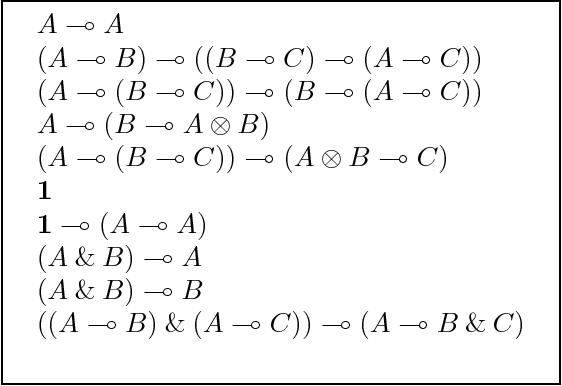
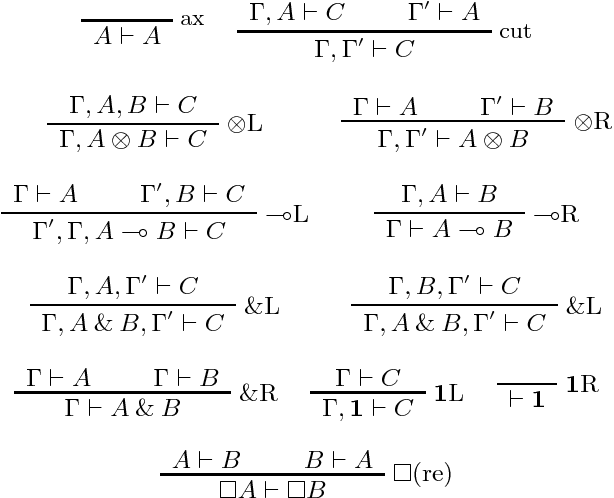
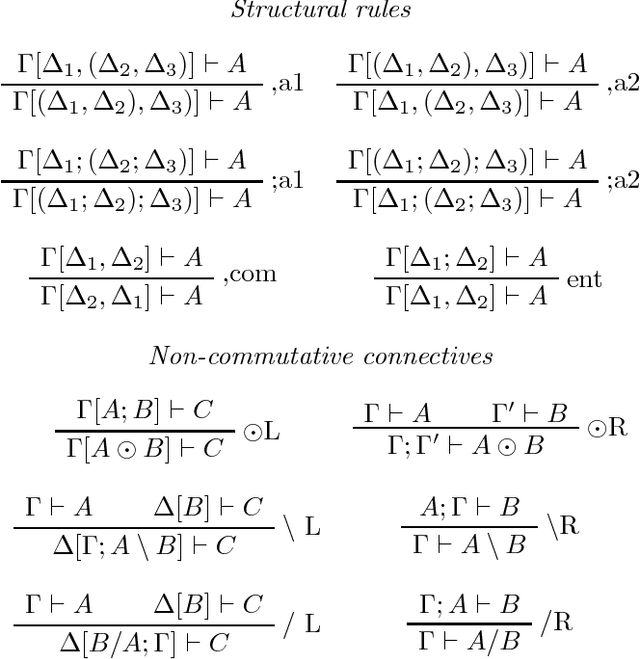
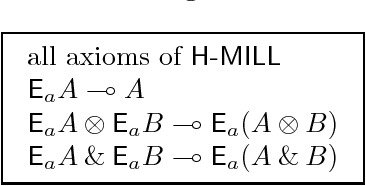
This article presents modal versions of resource-conscious logics. We concentrate on extensions of variants of Linear Logic with one minimal non-normal modality. In earlier work, where we investigated agency in multi-agent systems, we have shown that the results scale up to logics with multiple non-minimal modalities. Here, we start with the language of propositional intuitionistic Linear Logic without the additive disjunction, to which we add a modality. We provide an interpretation of this language on a class of Kripke resource models extended with a neighbourhood function: modal Kripke resource models. We propose a Hilbert-style axiomatization and a Gentzen-style sequent calculus. We show that the proof theories are sound and complete with respect to the class of modal Kripke resource models. We show that the sequent calculus admits cut elimination and that proof-search is in PSPACE. We then show how to extend the results when non-commutative connectives are added to the language. Finally, we put the logical framework to use by instantiating it as logics of agency. In particular, we propose a logic to reason about the resource-sensitive use of artefacts and illustrate it with a variety of examples.