 Add to Chrome
 Add to Firefox
 Add to Edge
gUFO: A Gentle Foundational Ontology for Semantic Web Knowledge Graphs
Mar 21, 2026
gUFO is a lightweight implementation of the Unified Foundational Ontology (UFO) suitable for Semantic Web OWL 2 DL applications. UFO is a mature foundational ontology with a rich axiomatization and that has been employed in a significant number of projects in research and industry. Moreover, it is currently in the process of standardization by the International Organization for Standardization as the ISO/IEC CD 21838-5. gUFO stands out from other foundational ontology implementations (such as those provided for BFO and DOLCE) given its unique support for a typology of types (operationalizing OntoClean guidelines), its reification patterns for intrinsic and relational aspects, and its support for situations and high-order types. gUFO provides well-founded patterns to address recurrent problems in Semantic Web knowledge graphs. In this paper, we present gUFO with its constituting categories, relations and constraints, discuss how it differs from the original UFO reference ontology, elaborate on its community adoption, and systematically position it in relation to existing OWL-based implementations of popular alternative foundational ontologies.

Towards an ontology of portions of matter to support multi-scale analysis and provenance tracking
Jun 01, 2024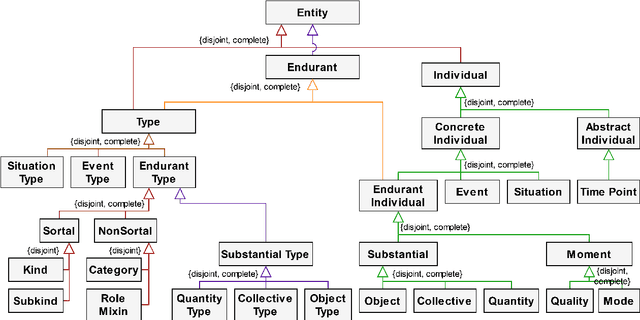
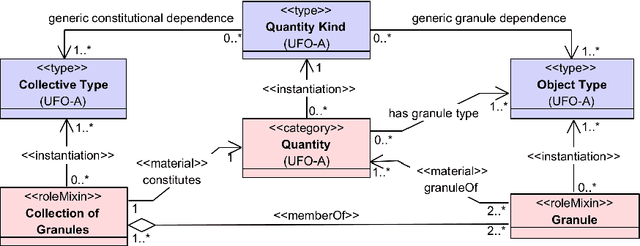
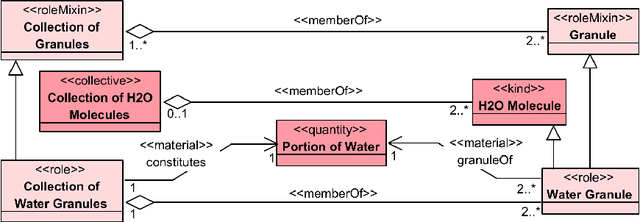
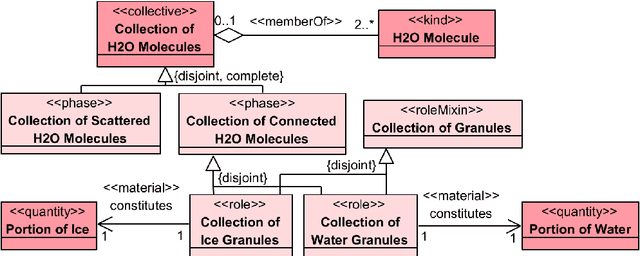
This paper presents an ontology of portions of matter with practical implications across scientific and industrial domains. The ontology is developed under the Unified Foundational Ontology (UFO), which uses the concept of quantity to represent topologically maximally self-connected portions of matter. The proposed ontology introduces the granuleOf parthood relation, holding between objects and portions of matter. It also discusses the constitution of quantities by collections of granules, the representation of sub-portions of matter, and the tracking of matter provenance between quantities using historical relations. Lastly, a case study is presented to demonstrate the use of the portion of matter ontology in the geology domain for an Oil & Gas industry application. In the case study, we model how to represent the historical relation between an original portion of rock and the sub-portions created during the industrial process. Lastly, future research directions are outlined, including investigating granularity levels and defining a taxonomy of events.