 Add to Chrome
 Add to Firefox
 Add to Edge
Robust 6-DoF Object Pose Tracking with Built-In Recovery under Occlusions and Rapid Object Motions
Jul 26, 2026
Real-time 6-DoF object pose tracking is essential for many robotics applications, and several approaches exist. Yet even today's approaches remain unreliable under temporary full occlusions and rapid object motions. Once tracking is lost, most methods struggle to detect the failure and recover automatically, often requiring manual re-initialization. In this paper, we address the problem of robust model-based 6-DoF tracking of unseen objects from RGB-D data, especially in scenarios with occlusion and fast motion. We propose a novel method that combines efficient learning-based keypoint matching with optimization-based alignment and introduces a novel failure detection and recovery module. Our system monitors pose reliability, detects tracking divergence or occlusions, and performs a global re-detection and pose estimation step that robustly verifies recovery candidates before resuming tracking. Our evaluation on standard tracking benchmarks and on a new dataset of occluded and fast-moving scenes shows that our method matches state-of-the-art accuracy on easy tracking sequences, maintains high tracking speed at 57.6 frames per second, and provides the most robust tracking performance under challenging conditions. Thus, we believe that our approach is a relevant step forward in robust 6-DoF object tracking from RGB-D data.

Gravity-aware Grasp Generation with Implicit Grasp Mode Selection for Underactuated Hands
Dec 19, 2023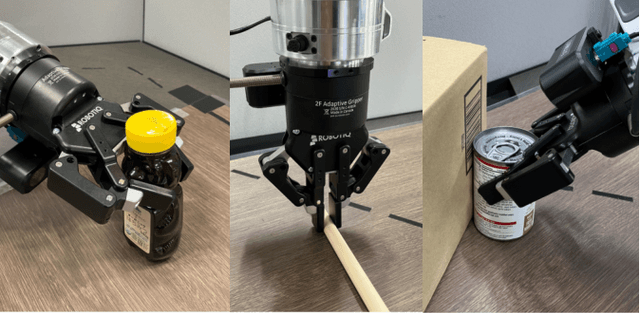
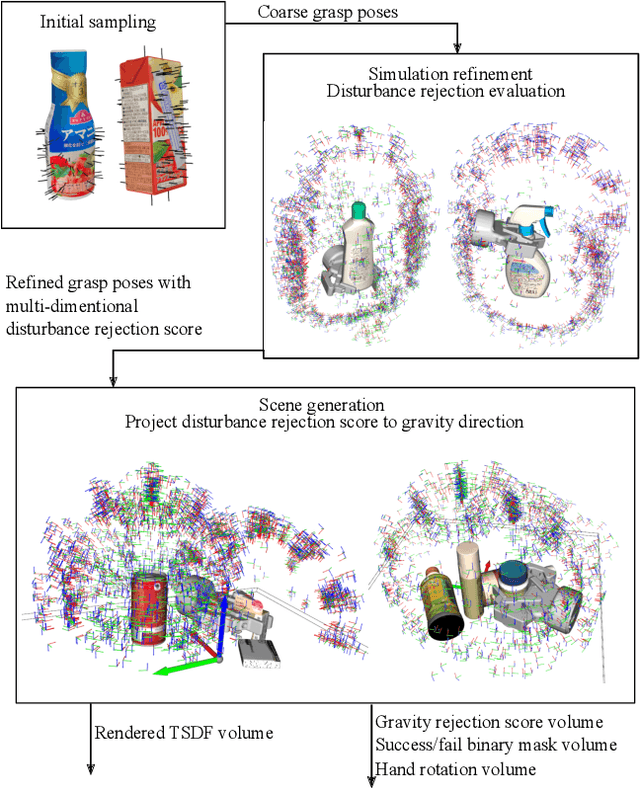
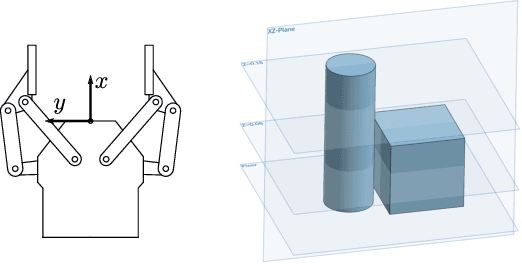
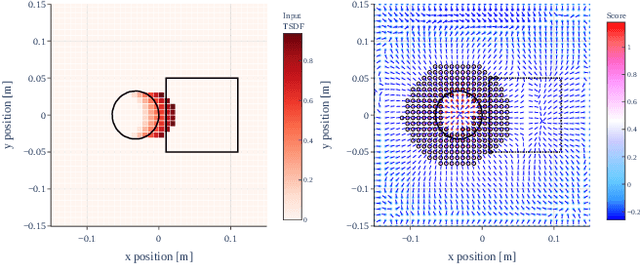
To overcome the mechanical limitation of parallel-jaw grippers, in this paper, we present a gravity-aware grasp generation that supports both precision grasp and power grasp of underactuated hands. We propose a novel approach to generate a large-scale dataset with a gravity-rejection score and experimentally confirm that the combination of that score and classical success/fail binary classification is powerful: the former encourages stable grasps, such as power grasps or grasping the center of mass, while the latter rejects invalid grasps, such as colliding with other objects or attempting to grasp parts that are too large for the gripper. We also propose a rotation representation that is continuous on SO(3) and considers the grasp's physical meaning. Our simulation and real robot evaluation experiments demonstrate significant improvements from the baseline works, especially for heavy objects.