 Add to Chrome
 Add to Firefox
 Add to Edge
Distilling Linearized Behavior for Effective Task Arithmetic
May 18, 2026
Task vector composition has emerged as a promising paradigm for editing pre-trained models, enabling model merging through addition and unlearning through subtraction. Fine-tuning in the tangent space of a pre-trained model (linear fine-tuning) has proven effective, as it produces task vectors that are naturally disentangled and resistant to interference. However, linearized models suffer from limited expressivity during training and incur higher computational costs at inference time, which restrict their practical applicability. In this work, we bridge the gap between linear and standard non-linear fine-tuning. We show that linearity with respect to weight perturbations, a property defined in parameter space, can be enforced through constraints in activation space during training. Concretely, we distill hidden representations from a curvature-regularized linearized teacher into a non-linear student trained via conventional fine-tuning. We find that the resulting model inherits key properties of linearized models for task arithmetic, enabling effective composition of task vectors and achieving strong performance across vision and language benchmarks without incurring any inference-time overhead.

Dataless Weight Disentanglement in Task Arithmetic via Kronecker-Factored Approximate Curvature
Feb 19, 2026Task Arithmetic yields a modular, scalable way to adapt foundation models. Combining multiple task vectors, however, can lead to cross-task interference, causing representation drift and degraded performance. Representation drift regularization provides a natural remedy to disentangle task vectors; however, existing approaches typically require external task data, conflicting with modularity and data availability constraints (e.g., privacy requirements). We propose a dataless approach by framing regularization against representation drift as a curvature matrix approximation problem. This allows us to leverage well-established techniques; in particular, we adopt Kronecker-Factored Approximate Curvature and obtain a practical regularizer that achieves state-of-the-art results in task addition and negation. Our method has constant complexity in the number of tasks and promotes robustness to task vector rescaling, eliminating the need for held-out tuning.
How to Train Your Metamorphic Deep Neural Network
May 07, 2025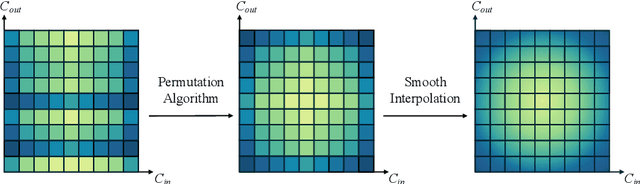
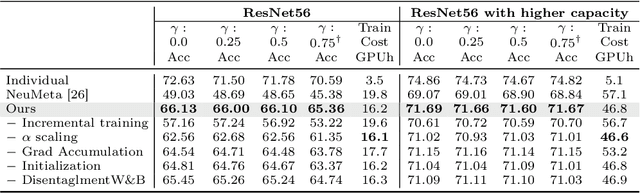
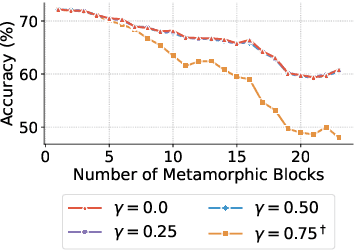
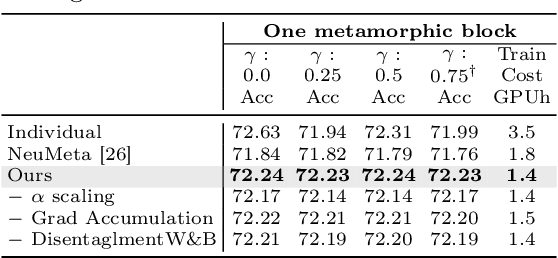
Neural Metamorphosis (NeuMeta) is a recent paradigm for generating neural networks of varying width and depth. Based on Implicit Neural Representation (INR), NeuMeta learns a continuous weight manifold, enabling the direct generation of compressed models, including those with configurations not seen during training. While promising, the original formulation of NeuMeta proves effective only for the final layers of the undelying model, limiting its broader applicability. In this work, we propose a training algorithm that extends the capabilities of NeuMeta to enable full-network metamorphosis with minimal accuracy degradation. Our approach follows a structured recipe comprising block-wise incremental training, INR initialization, and strategies for replacing batch normalization. The resulting metamorphic networks maintain competitive accuracy across a wide range of compression ratios, offering a scalable solution for adaptable and efficient deployment of deep models. The code is available at: https://github.com/TSommariva/HTTY_NeuMeta.