 Add to Chrome
 Add to Firefox
 Add to Edge
A Causal Framework for Mitigating Data Shifts in Healthcare
Mar 13, 2026
Developing predictive models that perform reliably across diverse patient populations and heterogeneous environments is a core aim of medical research. However, generalization is only possible if the learned model is robust to statistical differences between data used for training and data seen at the time and place of deployment. Domain generalization methods provide strategies to address data shifts, but each method comes with its own set of assumptions and trade-offs. To apply these methods in healthcare, we must understand how domain shifts arise, what assumptions we prefer to make, and what our design constraints are. This article proposes a causal framework for the design of predictive models to improve generalization. Causality provides a powerful language to characterize and understand diverse domain shifts, regardless of data modality. This allows us to pinpoint why models fail to generalize, leading to more principled strategies to prepare for and adapt to shifts. We recommend general mitigation strategies, discussing trade-offs and highlighting existing work. Our causality-based perspective offers a critical foundation for developing robust, interpretable, and clinically relevant AI solutions in healthcare, paving the way for reliable real-world deployment.

Causally Steered Diffusion for Automated Video Counterfactual Generation
Jun 17, 2025Adapting text-to-image (T2I) latent diffusion models for video editing has shown strong visual fidelity and controllability, but challenges remain in maintaining causal relationships in video content. Edits affecting causally dependent attributes risk generating unrealistic or misleading outcomes if these relationships are ignored. In this work, we propose a causally faithful framework for counterfactual video generation, guided by a vision-language model (VLM). Our method is agnostic to the underlying video editing system and does not require access to its internal mechanisms or finetuning. Instead, we guide the generation by optimizing text prompts based on an assumed causal graph, addressing the challenge of latent space control in LDMs. We evaluate our approach using standard video quality metrics and counterfactual-specific criteria, such as causal effectiveness and minimality. Our results demonstrate that causally faithful video counterfactuals can be effectively generated within the learned distribution of LDMs through prompt-based causal steering. With its compatibility with any black-box video editing system, our method holds significant potential for generating realistic "what-if" video scenarios in diverse areas such as healthcare and digital media.
Benchmarking Counterfactual Image Generation
Mar 29, 2024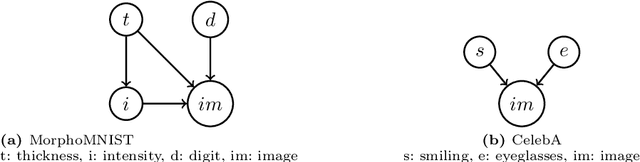
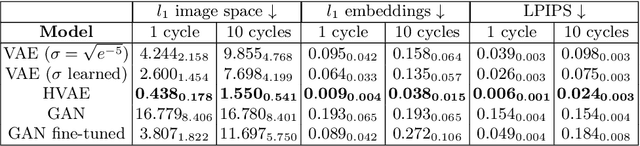
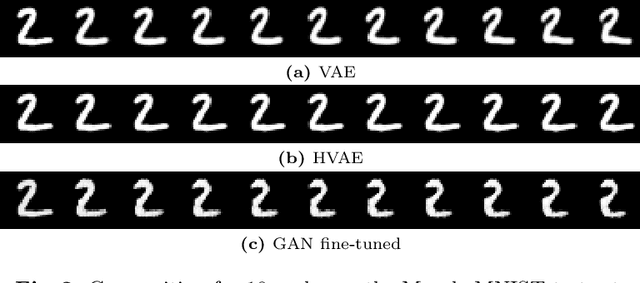
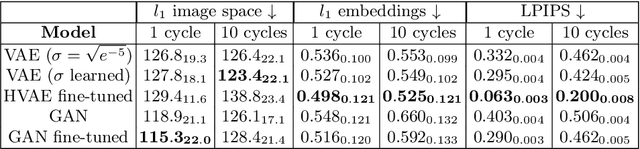
Counterfactual image generation is pivotal for understanding the causal relations of variables, with applications in interpretability and generation of unbiased synthetic data. However, evaluating image generation is a long-standing challenge in itself. The need to evaluate counterfactual generation compounds on this challenge, precisely because counterfactuals, by definition, are hypothetical scenarios without observable ground truths. In this paper, we present a novel comprehensive framework aimed at benchmarking counterfactual image generation methods. We incorporate metrics that focus on evaluating diverse aspects of counterfactuals, such as composition, effectiveness, minimality of interventions, and image realism. We assess the performance of three distinct conditional image generation model types, based on the Structural Causal Model paradigm. Our work is accompanied by a user-friendly Python package which allows to further evaluate and benchmark existing and future counterfactual image generation methods. Our framework is extendable to additional SCM and other causal methods, generative models, and datasets.