 Add to Chrome
 Add to Firefox
 Add to Edge
Explainable AI for Data-Driven Design of High-Dimensional Predictive Studies
May 21, 2026
Predictive modelling is important for health data analysis and data-driven clinical decision-making. However, predictive studies are challenging to design optimally by hand when tens or even hundreds of features require selection, transformation, or interaction modelling. While complex machine learning models offer high performance, their "black-box" nature limits the clinical trust, transparency, and interpretability required for decision-making. We developed and evaluated an Exploratory AI Recommender that provides data-driven recommendations to improve predictive performance of existing interpretable statistical models. The developed framework uses flexible AI modelling to capture complex data patterns and explainable AI techniques to translate the patterns into three recommendation types: feature exclusion, non-linear terms, and feature interactions. We evaluated the framework by comparing predictive performance of a baseline (i.e., no interactions or non-linear terms) Cox Proportional Hazards (CPH) model against an augmented CPH incorporating recommendations suggested by our method. The primary analysis predicts the time to the first occurrence of a fall or related injury in 245,614 patients. Our method recommended excluding 23 features, including non-linear terms for two features, and including 221 suggested feature interactions. The C-index improved from 0.805 (95% CI 0.798-0.812) to 0.815 (95% CI 0.809-0.822), and so did calibration (intercept: -0.006 to 0.003; slope: 1.063 to 0.950). All recommendations were supported by existing literature. The method also proved effective on two additional public datasets, demonstrating wider applicability. The proposed Exploratory AI Recommender demonstrates the potential of explainable AI and data-driven study design to improve the process of developing, and the performance of high-dimensional transparent predictive models.

A Causal Framework for Mitigating Data Shifts in Healthcare
Mar 13, 2026Developing predictive models that perform reliably across diverse patient populations and heterogeneous environments is a core aim of medical research. However, generalization is only possible if the learned model is robust to statistical differences between data used for training and data seen at the time and place of deployment. Domain generalization methods provide strategies to address data shifts, but each method comes with its own set of assumptions and trade-offs. To apply these methods in healthcare, we must understand how domain shifts arise, what assumptions we prefer to make, and what our design constraints are. This article proposes a causal framework for the design of predictive models to improve generalization. Causality provides a powerful language to characterize and understand diverse domain shifts, regardless of data modality. This allows us to pinpoint why models fail to generalize, leading to more principled strategies to prepare for and adapt to shifts. We recommend general mitigation strategies, discussing trade-offs and highlighting existing work. Our causality-based perspective offers a critical foundation for developing robust, interpretable, and clinically relevant AI solutions in healthcare, paving the way for reliable real-world deployment.
Rethinking Chronological Causal Discovery with Signal Processing
Feb 23, 2026Causal discovery problems use a set of observations to deduce causality between variables in the real world, typically to answer questions about biological or physical systems. These observations are often recorded at regular time intervals, determined by a user or a machine, depending on the experiment design. There is generally no guarantee that the timing of these recordings matches the timing of the underlying biological or physical events. In this paper, we examine the sensitivity of causal discovery methods to this potential mismatch. We consider empirical and theoretical evidence to understand how causal discovery performance is impacted by changes of sampling rate and window length. We demonstrate that both classical and recent causal discovery methods exhibit sensitivity to these hyperparameters, and we discuss how ideas from signal processing may help us understand these phenomena.
Tangent Space Causal Inference: Leveraging Vector Fields for Causal Discovery in Dynamical Systems
Oct 30, 2024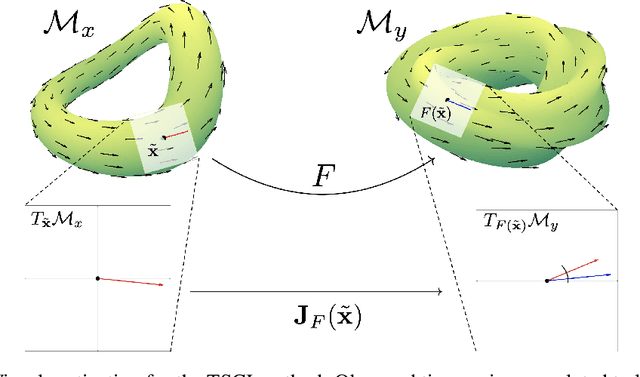
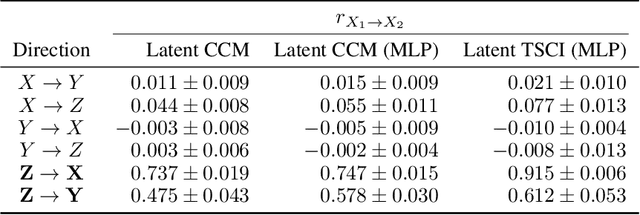
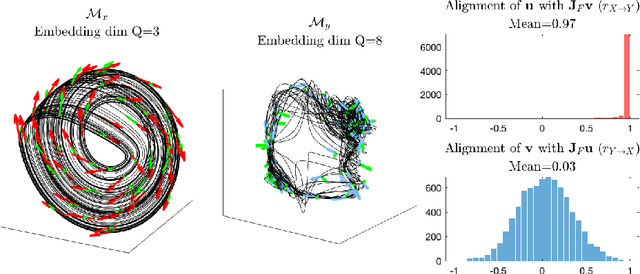
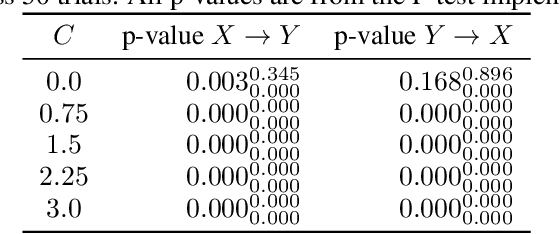
Causal discovery with time series data remains a challenging yet increasingly important task across many scientific domains. Convergent cross mapping (CCM) and related methods have been proposed to study time series that are generated by dynamical systems, where traditional approaches like Granger causality are unreliable. However, CCM often yields inaccurate results depending upon the quality of the data. We propose the Tangent Space Causal Inference (TSCI) method for detecting causalities in dynamical systems. TSCI works by considering vector fields as explicit representations of the systems' dynamics and checks for the degree of synchronization between the learned vector fields. The TSCI approach is model-agnostic and can be used as a drop-in replacement for CCM and its generalizations. We first present a basic version of the TSCI algorithm, which is shown to be more effective than the basic CCM algorithm with very little additional computation. We additionally present augmented versions of TSCI that leverage the expressive power of latent variable models and deep learning. We validate our theory on standard systems, and we demonstrate improved causal inference performance across a number of benchmark tasks.
On Counterfactual Interventions in Vector Autoregressive Models
Jun 27, 2024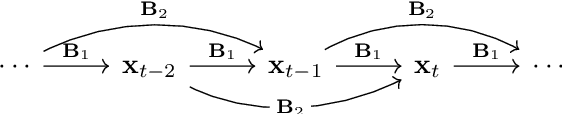

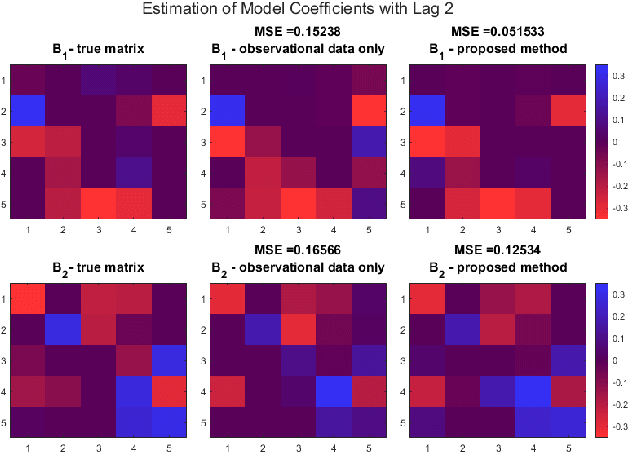
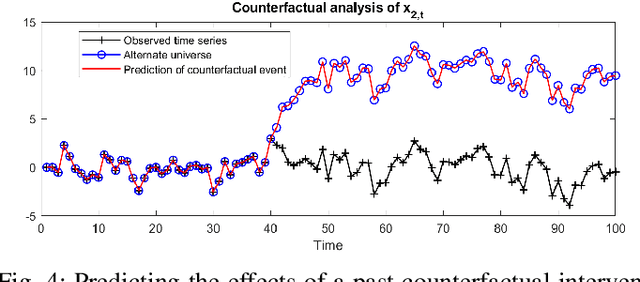
Counterfactual reasoning allows us to explore hypothetical scenarios in order to explain the impacts of our decisions. However, addressing such inquires is impossible without establishing the appropriate mathematical framework. In this work, we introduce the problem of counterfactual reasoning in the context of vector autoregressive (VAR) processes. We also formulate the inference of a causal model as a joint regression task where for inference we use both data with and without interventions. After learning the model, we exploit linearity of the VAR model to make exact predictions about the effects of counterfactual interventions. Furthermore, we quantify the total causal effects of past counterfactual interventions. The source code for this project is freely available at https://github.com/KurtButler/counterfactual_interventions.
Explainable Learning with Gaussian Processes
Mar 11, 2024The field of explainable artificial intelligence (XAI) attempts to develop methods that provide insight into how complicated machine learning methods make predictions. Many methods of explanation have focused on the concept of feature attribution, a decomposition of the model's prediction into individual contributions corresponding to each input feature. In this work, we explore the problem of feature attribution in the context of Gaussian process regression (GPR). We take a principled approach to defining attributions under model uncertainty, extending the existing literature. We show that although GPR is a highly flexible and non-parametric approach, we can derive interpretable, closed-form expressions for the feature attributions. When using integrated gradients as an attribution method, we show that the attributions of a GPR model also follow a Gaussian process distribution, which quantifies the uncertainty in attribution arising from uncertainty in the model. We demonstrate, both through theory and experimentation, the versatility and robustness of this approach. We also show that, when applicable, the exact expressions for GPR attributions are both more accurate and less computationally expensive than the approximations currently used in practice. The source code for this project is freely available under MIT license at https://github.com/KurtButler/2024_attributions_paper.
Dagma-DCE: Interpretable, Non-Parametric Differentiable Causal Discovery
Jan 05, 2024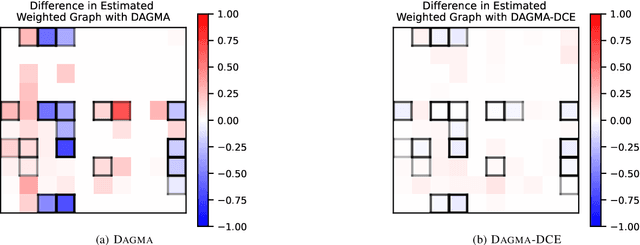
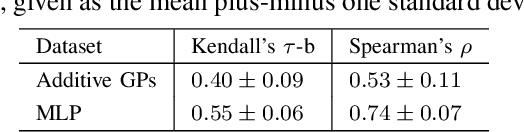
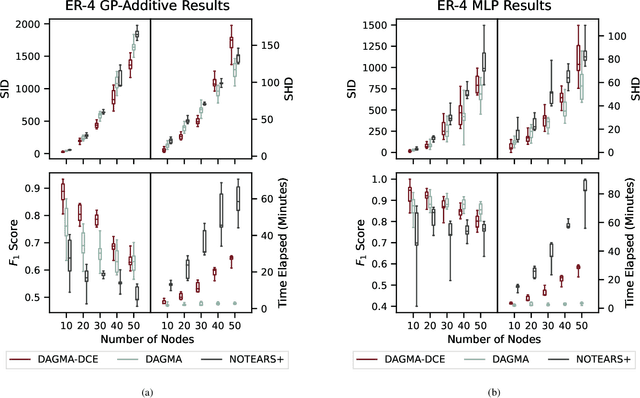
We introduce Dagma-DCE, an interpretable and model-agnostic scheme for differentiable causal discovery. Current non- or over-parametric methods in differentiable causal discovery use opaque proxies of ``independence'' to justify the inclusion or exclusion of a causal relationship. We show theoretically and empirically that these proxies may be arbitrarily different than the actual causal strength. Juxtaposed to existing differentiable causal discovery algorithms, \textsc{Dagma-DCE} uses an interpretable measure of causal strength to define weighted adjacency matrices. In a number of simulated datasets, we show our method achieves state-of-the-art level performance. We additionally show that \textsc{Dagma-DCE} allows for principled thresholding and sparsity penalties by domain-experts. The code for our method is available open-source at https://github.com/DanWaxman/DAGMA-DCE, and can easily be adapted to arbitrary differentiable models.