 Add to Chrome
 Add to Firefox
 Add to Edge
Fine-tuning LLMs for Passive Depression Severity Estimation from AI Mental Health Dialogue
Jun 16, 2026
Depression is the leading cause of disability worldwide, and early detection of symptom change is essential for timely intervention. Validated instruments such as the Patient Health Questionnaire-9 (PHQ-9) support symptom monitoring at scale, but real-world completion rates are low, introducing response bias and systematic missingness. Passive approaches that infer severity from routinely generated data could close this gap. We address this by predicting PHQ-9 total scores directly from transcripts of conversations between users and an AI mental health application, requiring only conversation text and no additional clinical data. We fine-tune a Qwen3.5-27B backbone with a regression head, augment 3,111 ground-truth labels with pseudolabels generated by a reasoning model (Claude Opus) and iteratively trained intermediate models, for a combined dataset of 6,283 users. On a held-out test set of 842 users, our best model achieves MAE = 2.6, RMSE = 4.0, Pearson r = 0.80, and AUC = 0.91 at the PHQ-9 >= 10 clinical threshold. We also find AUC > 0.87 at every severity threshold from PHQ-9 >= 3 to PHQ-9 >= 24, demonstrating that the model captures depression severity across the full clinical spectrum. This work opens the door to passive, continuous symptom monitoring in AI mental health platforms, without requiring users to complete self-report measures.

Beyond Simulations: What 20,000 Real Conversations Reveal About Mental Health AI Safety
Jan 14, 2026Large language models (LLMs) are increasingly used for mental health support, yet existing safety evaluations rely primarily on small, simulation-based test sets that have an unknown relationship to the linguistic distribution of real usage. In this study, we present replications of four published safety test sets targeting suicide risk assessment, harmful content generation, refusal robustness, and adversarial jailbreaks for a leading frontier generic AI model alongside an AI purpose built for mental health support. We then propose and conduct an ecological audit on over 20,000 real-world user conversations with the purpose-built AI designed with layered suicide and non-suicidal self-injury (NSSI) safeguards to compare test set performance to real world performance. While the purpose-built AI was significantly less likely than general-purpose LLMs to produce enabling or harmful content across suicide/NSSI (.4-11.27% vs 29.0-54.4%), eating disorder (8.4% vs 54.0%), and substance use (9.9% vs 45.0%) benchmark prompts, test set failure rates for suicide/NSSI were far higher than in real-world deployment. Clinician review of flagged conversations from the ecological audit identified zero cases of suicide risk that failed to receive crisis resources. Across all 20,000 conversations, three mentions of NSSI risk (.015%) did not trigger a crisis intervention; among sessions flagged by the LLM judge, this corresponds to an end-to-end system false negative rate of .38%, providing a lower bound on real-world safety failures. These findings support a shift toward continuous, deployment-relevant safety assurance for AI mental-health systems rather than limited set benchmark certification.
Adversarial Training for Failure-Sensitive User Simulation in Mental Health Dialogue Optimization
Dec 23, 2025Realistic user simulation is crucial for training and evaluating task-oriented dialogue (TOD) systems, yet creating simulators that accurately replicate human behavior remains challenging. A key property of effective simulators is their ability to expose failure modes of the systems they evaluate. We present an adversarial training framework that iteratively improves user simulator realism through a competitive dynamic between a generator (user simulator) and a discriminator. Applied to mental health support chatbots, our approach demonstrates that fine-tuned simulators dramatically outperform zero-shot base models at surfacing system issues, and adversarial training further enhances diversity, distributional alignment, and predictive validity. The resulting simulator achieves a strong correlation between simulated and real failure occurrence rates across diverse chatbot configurations while maintaining low distributional divergence of failure modes. Discriminator accuracy decreases drastically after three adversarial iterations, suggesting improved realism. These results provide evidence that adversarial training is a promising approach for creating realistic user simulators in mental health support TOD domains, enabling rapid, reliable, and cost-effective system evaluation before deployment.
Taking a turn for the better: Conversation redirection throughout the course of mental-health therapy
Oct 09, 2024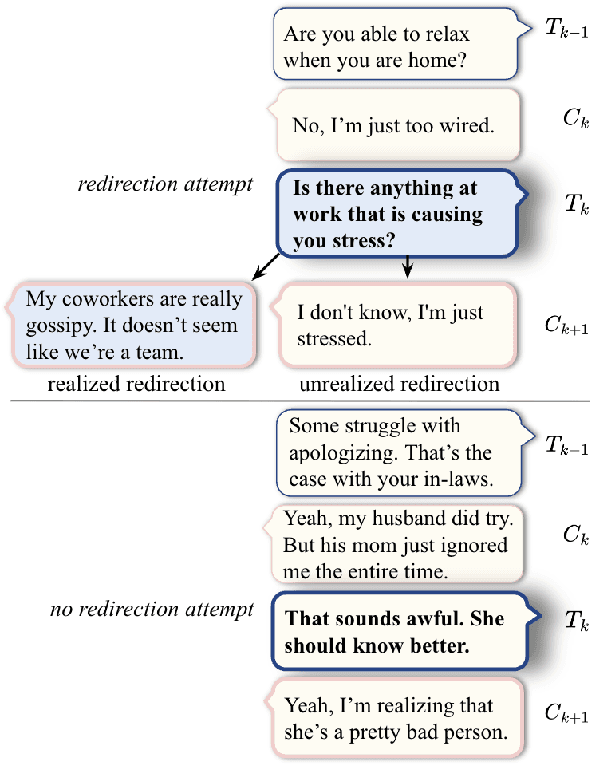
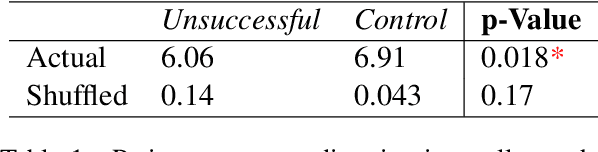
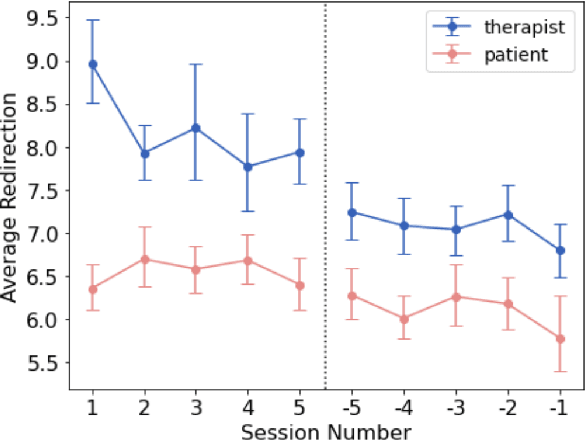
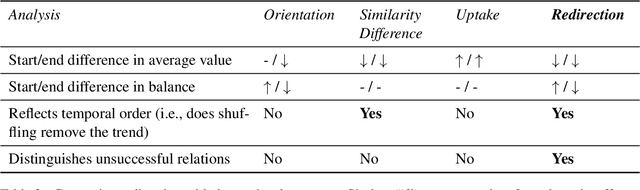
Mental-health therapy involves a complex conversation flow in which patients and therapists continuously negotiate what should be talked about next. For example, therapists might try to shift the conversation's direction to keep the therapeutic process on track and avoid stagnation, or patients might push the discussion towards issues they want to focus on. How do such patient and therapist redirections relate to the development and quality of their relationship? To answer this question, we introduce a probabilistic measure of the extent to which a certain utterance immediately redirects the flow of the conversation, accounting for both the intention and the actual realization of such a change. We apply this new measure to characterize the development of patient-therapist relationships over multiple sessions in a very large, widely-used online therapy platform. Our analysis reveals that (1) patient control of the conversation's direction generally increases relative to that of the therapist as their relationship progresses; and (2) patients who have less control in the first few sessions are significantly more likely to eventually express dissatisfaction with their therapist and terminate the relationship.