 Add to Chrome
 Add to Firefox
 Add to Edge
SteerFlow: Steering Rectified Flows for Faithful Inversion-Based Image Editing
Apr 02, 2026
Recent advances in flow-based generative models have enabled training-free, text-guided image editing by inverting an image into its latent noise and regenerating it under a new target conditional guidance. However, existing methods struggle to preserve source fidelity: higher-order solvers incur additional model inferences, truncated inversion constrains editability, and feature injection methods lack architectural transferability. To address these limitations, we propose SteerFlow, a model-agnostic editing framework with strong theoretical guarantees on source fidelity. In the forward process, we introduce an Amortized Fixed-Point Solver that implicitly straightens the forward trajectory by enforcing velocity consistency across consecutive timesteps, yielding a high-fidelity inverted latent. In the backward process, we introduce Trajectory Interpolation, which adaptively blends target-editing and source-reconstruction velocities to keep the editing trajectory anchored to the source. To further improve background preservation, we introduce an Adaptive Masking mechanism that spatially constrains the editing signal with concept-guided segmentation and source-target velocity differences. Extensive experiments on FLUX.1-dev and Stable Diffusion 3.5 Medium demonstrate that SteerFlow consistently achieves better editing quality than existing methods. Finally, we show that SteerFlow extends naturally to a complex multi-turn editing paradigm without accumulating drift.

Towards Clean-Label Backdoor Attacks in the Physical World
Jul 27, 2024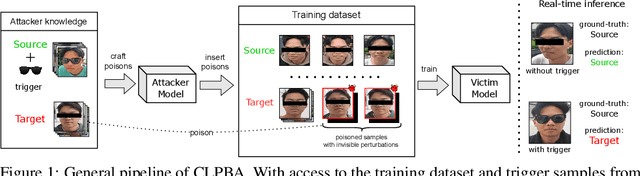
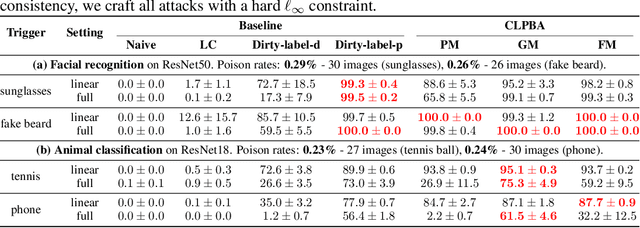

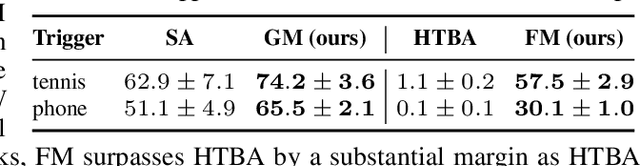
Deep Neural Networks (DNNs) are vulnerable to backdoor poisoning attacks, with most research focusing on digital triggers, special patterns digitally added to test-time inputs to induce targeted misclassification. In contrast, physical triggers, which are natural objects within a physical scene, have emerged as a desirable alternative since they enable real-time backdoor activations without digital manipulation. However, current physical attacks require that poisoned inputs have incorrect labels, making them easily detectable upon human inspection. In this paper, we collect a facial dataset of 21,238 images with 7 common accessories as triggers and use it to study the threat of clean-label backdoor attacks in the physical world. Our study reveals two findings. First, the success of physical attacks depends on the poisoning algorithm, physical trigger, and the pair of source-target classes. Second, although clean-label poisoned samples preserve ground-truth labels, their perceptual quality could be seriously degraded due to conspicuous artifacts in the images. Such samples are also vulnerable to statistical filtering methods because they deviate from the distribution of clean samples in the feature space. To address these issues, we propose replacing the standard $\ell_\infty$ regularization with a novel pixel regularization and feature regularization that could enhance the imperceptibility of poisoned samples without compromising attack performance. Our study highlights accidental backdoor activations as a key limitation of clean-label physical backdoor attacks. This happens when unintended objects or classes accidentally cause the model to misclassify as the target class.