 Add to Chrome
 Add to Firefox
 Add to Edge
SpecMind: Cognitively Inspired, Interactive Multi-Turn Framework for Postcondition Inference
Feb 25, 2026
Specifications are vital for ensuring program correctness, yet writing them manually remains challenging and time-intensive. Recent large language model (LLM)-based methods have shown successes in generating specifications such as postconditions, but existing single-pass prompting often yields inaccurate results. In this paper, we present SpecMind, a novel framework for postcondition generation that treats LLMs as interactive and exploratory reasoners rather than one-shot generators. SpecMind employs feedback-driven multi-turn prompting approaches, enabling the model to iteratively refine candidate postconditions by incorporating implicit and explicit correctness feedback, while autonomously deciding when to stop. This process fosters deeper code comprehension and improves alignment with true program behavior via exploratory attempts. Our empirical evaluation shows that SpecMind significantly outperforms state-of-the-art approaches in both accuracy and completeness of generated postconditions.

Towards Clean-Label Backdoor Attacks in the Physical World
Jul 27, 2024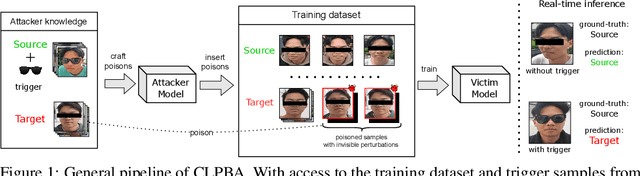
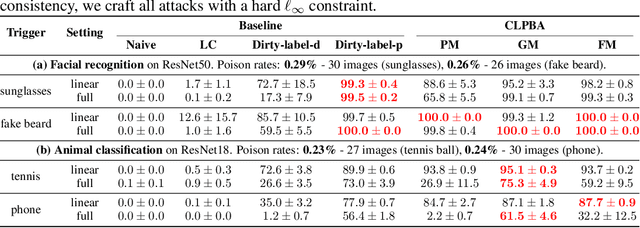

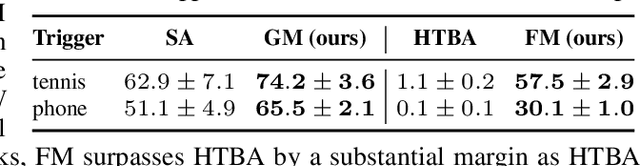
Deep Neural Networks (DNNs) are vulnerable to backdoor poisoning attacks, with most research focusing on digital triggers, special patterns digitally added to test-time inputs to induce targeted misclassification. In contrast, physical triggers, which are natural objects within a physical scene, have emerged as a desirable alternative since they enable real-time backdoor activations without digital manipulation. However, current physical attacks require that poisoned inputs have incorrect labels, making them easily detectable upon human inspection. In this paper, we collect a facial dataset of 21,238 images with 7 common accessories as triggers and use it to study the threat of clean-label backdoor attacks in the physical world. Our study reveals two findings. First, the success of physical attacks depends on the poisoning algorithm, physical trigger, and the pair of source-target classes. Second, although clean-label poisoned samples preserve ground-truth labels, their perceptual quality could be seriously degraded due to conspicuous artifacts in the images. Such samples are also vulnerable to statistical filtering methods because they deviate from the distribution of clean samples in the feature space. To address these issues, we propose replacing the standard $\ell_\infty$ regularization with a novel pixel regularization and feature regularization that could enhance the imperceptibility of poisoned samples without compromising attack performance. Our study highlights accidental backdoor activations as a key limitation of clean-label physical backdoor attacks. This happens when unintended objects or classes accidentally cause the model to misclassify as the target class.