 Add to Chrome
 Add to Firefox
 Add to Edge
Action100M: A Large-scale Video Action Dataset
Jan 15, 2026
Inferring physical actions from visual observations is a fundamental capability for advancing machine intelligence in the physical world. Achieving this requires large-scale, open-vocabulary video action datasets that span broad domains. We introduce Action100M, a large-scale dataset constructed from 1.2M Internet instructional videos (14.6 years of duration), yielding O(100 million) temporally localized segments with open-vocabulary action supervision and rich captions. Action100M is generated by a fully automated pipeline that (i) performs hierarchical temporal segmentation using V-JEPA 2 embeddings, (ii) produces multi-level frame and segment captions organized as a Tree-of-Captions, and (iii) aggregates evidence with a reasoning model (GPT-OSS-120B) under a multi-round Self-Refine procedure to output structured annotations (brief/detailed action, actor, brief/detailed caption). Training VL-JEPA on Action100M demonstrates consistent data-scaling improvements and strong zero-shot performance across diverse action recognition benchmarks, establishing Action100M as a new foundation for scalable research in video understanding and world modeling.

VL-JEPA: Joint Embedding Predictive Architecture for Vision-language
Dec 11, 2025We introduce VL-JEPA, a vision-language model built on a Joint Embedding Predictive Architecture (JEPA). Instead of autoregressively generating tokens as in classical VLMs, VL-JEPA predicts continuous embeddings of the target texts. By learning in an abstract representation space, the model focuses on task-relevant semantics while abstracting away surface-level linguistic variability. In a strictly controlled comparison against standard token-space VLM training with the same vision encoder and training data, VL-JEPA achieves stronger performance while having 50% fewer trainable parameters. At inference time, a lightweight text decoder is invoked only when needed to translate VL-JEPA predicted embeddings into text. We show that VL-JEPA natively supports selective decoding that reduces the number of decoding operations by 2.85x while maintaining similar performance compared to non-adaptive uniform decoding. Beyond generation, the VL-JEPA's embedding space naturally supports open-vocabulary classification, text-to-video retrieval, and discriminative VQA without any architecture modification. On eight video classification and eight video retrieval datasets, the average performance VL-JEPA surpasses that of CLIP, SigLIP2, and Perception Encoder. At the same time, the model achieves comparable performance as classical VLMs (InstructBLIP, QwenVL) on four VQA datasets: GQA, TallyQA, POPE and POPEv2, despite only having 1.6B parameters.
Sub-meter resolution canopy height maps using self-supervised learning and a vision transformer trained on Aerial and GEDI Lidar
Apr 17, 2023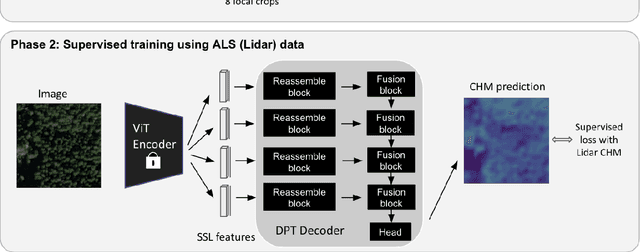
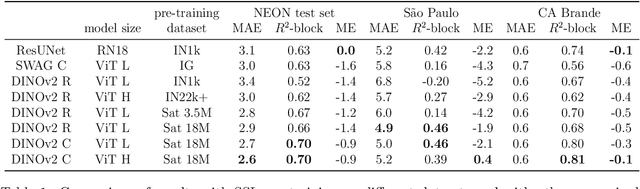
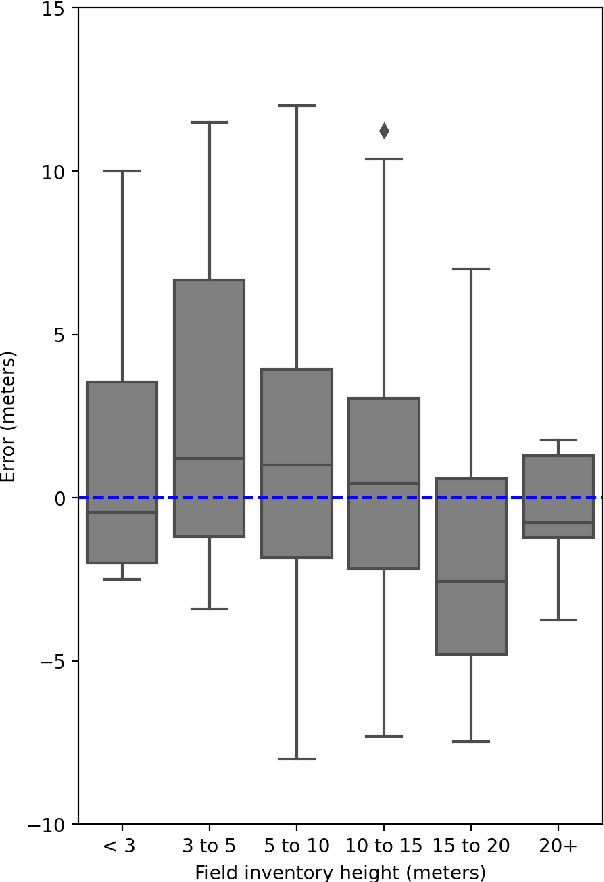
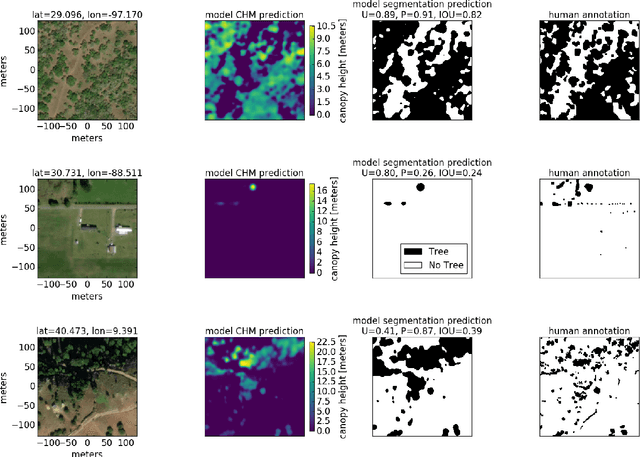
Vegetation structure mapping is critical for understanding the global carbon cycle and monitoring nature-based approaches to climate adaptation and mitigation. Repeat measurements of these data allow for the observation of deforestation or degradation of existing forests, natural forest regeneration, and the implementation of sustainable agricultural practices like agroforestry. Assessments of tree canopy height and crown projected area at a high spatial resolution are also important for monitoring carbon fluxes and assessing tree-based land uses, since forest structures can be highly spatially heterogeneous, especially in agroforestry systems. Very high resolution satellite imagery (less than one meter (1m) ground sample distance) makes it possible to extract information at the tree level while allowing monitoring at a very large scale. This paper presents the first high-resolution canopy height map concurrently produced for multiple sub-national jurisdictions. Specifically, we produce canopy height maps for the states of California and S\~{a}o Paolo, at sub-meter resolution, a significant improvement over the ten meter (10m) resolution of previous Sentinel / GEDI based worldwide maps of canopy height. The maps are generated by applying a vision transformer to features extracted from a self-supervised model in Maxar imagery from 2017 to 2020, and are trained against aerial lidar and GEDI observations. We evaluate the proposed maps with set-aside validation lidar data as well as by comparing with other remotely sensed maps and field-collected data, and find our model produces an average Mean Absolute Error (MAE) within set-aside validation areas of 3.0 meters.