 Add to Chrome
 Add to Firefox
 Add to Edge
Invoice Haystack: Benchmarking Document Retrieval and Visual Question Answering Under Strong Visual Homogeneity
Jun 24, 2026
Vision Language Models have achieved near-human performance on single-document Visual Question Answering, yet their effectiveness degrades significantly when retrieving information from large collections of visually homogeneous documents. Existing multi-document benchmarks aggregate diverse document types, creating artificial separation in embedding space that does not reflect enterprise document repositories where thousands of records share identical visual templates. We identify this as embedding collapse and introduce Invoice Haystack, a benchmark with 1,500 anonymized invoice images paired with 200 discriminative question-answer pairs, specifically designed to stress-test retrieval under strong visual homogeneity. Invoice Haystack exhibits a mean pairwise cosine similarity of 0.73, compared to 0.38 (DocHaystack) and 0.31 (InfoHaystack) in existing benchmarks, posing a fundamentally more challenging retrieval problem. Addressing the identified challenge, we propose VL-RAG, a hybrid retrieval-augmented generation framework that jointly leverages text and visual embeddings to harness the complementary strengths of both modalities, followed by a VLM-based verification filter for precise document identification. VL-RAG achieves 60.0\% Recall@1 on Invoice Haystack-500, outperforming existing state-of-the-art method by up to an absolute 13.5 percentage points. It further improves retrieval considerably on DocHaystack-1000 (77.1\% vs.\ 75.2\%) and InfoHaystack-1000 (84.5\% vs.\ 80.0\%), establishing the proposed dual-stream fusion as a consistently superior retrieval strategy across both homogeneous and heterogeneous document collections.

ConTrans: Learning Text-enhanced Local-global Temporal Representations for Zero-shot Temporal Action Localization
May 29, 2026Zero-shot Temporal Action Localization (ZS-TAL) aims to detect and locate previously unseen actions in untrimmed videos. However, existing approaches primarily focus on modeling long-range contextual information, often neglecting the critical relative-offset-based local correlations between video frames. Furthermore, their performance is hindered by limited feature representation capabilities due to the shallow nature of their network architectures. In this paper, we address these limitations by introducing a novel local-global multi-scale feature representation module. We propose a novel multi-scale encoder architecture, termed ConTrans, that integrates convolutional (Conv) inductive biases with transformer Self-attention to jointly capture fine-grained local dependencies and long-range global context, leading to more comprehensive feature representations than existing methods. Experimental evaluations on the ActivityNet-1.3 and THUMOS14 datasets demonstrate that ConTrans significantly outperforms existing methods, establishing a new benchmark for ZS-TAL.
xModel-KD: Cross-modal Knowledge Distillation for 3D Scene Perception using LiDAR
May 28, 2026Point cloud segmentation is a fundamental task in 3D scene understanding. Its progress is constrained by the high cost and time required for dense 3D annotations, making labeled samples difficult to obtain. Beyond annotation scarcity, different sensing modalities face inherent limitations. 2D images provide rich texture and appearance cues, yet they lack explicit depth and geometric structure. In contrast, 3D point clouds capture accurate spatial geometry but are sparse and contain no texture information. As a result, relying on a single modality restricts the richness of learned representations and weakens generalization. Although recent multi-modal methods that combine 3D point clouds with 2D images have demonstrated strong performance in tasks such as classification and retrieval, they typically depend on large-scale labeled datasets and have not been fully exploited for data-efficient dense prediction. To address these limitations, we propose a novel cross-modal knowledge distillation framework, xModel-KD, for 3D point cloud segmentation. Our method exploits the complementary strengths of 2D texture and 3D geometry by learning unified per-point representations through cross-modal alignment. Specifically, we design a cross-modal fusion encoder trained with a contrastive objective that enforces feature consistency between corresponding 2D and 3D representations across multiple views. By integrating powerful pre-trained backbones with a targeted fusion strategy, the proposed framework effectively transfers appearance cues from images to geometry-aware point features. Experimental results show that cross-modal fusion achieves a 2% absolute improvement in mIoU over a LiDAR-only baseline, demonstrating the benefit of leveraging complementary multi-modal information for scalable and annotation-efficient 3D scene understanding.
A Feature Generator for Few-Shot Learning
Sep 21, 2024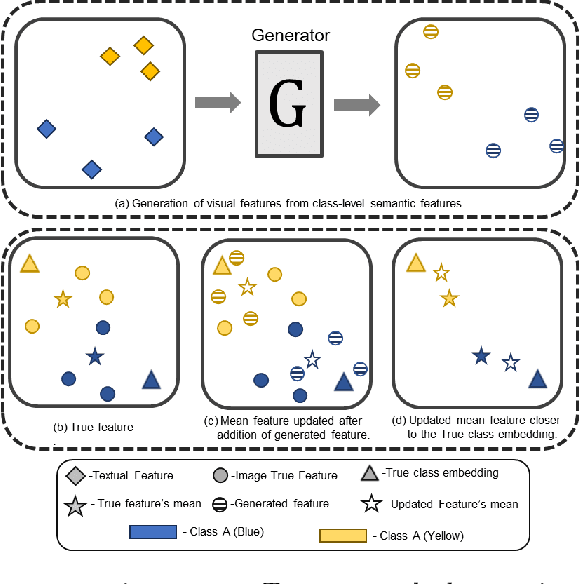

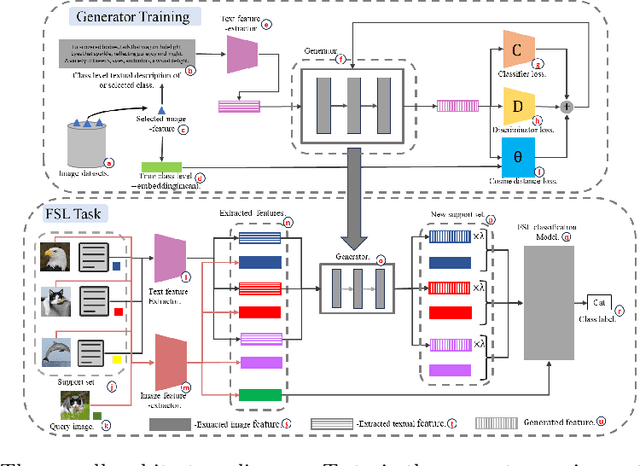

Few-shot learning (FSL) aims to enable models to recognize novel objects or classes with limited labelled data. Feature generators, which synthesize new data points to augment limited datasets, have emerged as a promising solution to this challenge. This paper investigates the effectiveness of feature generators in enhancing the embedding process for FSL tasks. To address the issue of inaccurate embeddings due to the scarcity of images per class, we introduce a feature generator that creates visual features from class-level textual descriptions. By training the generator with a combination of classifier loss, discriminator loss, and distance loss between the generated features and true class embeddings, we ensure the generation of accurate same-class features and enhance the overall feature representation. Our results show a significant improvement in accuracy over baseline methods, with our approach outperforming the baseline model by 10% in 1-shot and around 5% in 5-shot approaches. Additionally, both visual-only and visual + textual generators have also been tested in this paper.