 Add to Chrome
 Add to Firefox
 Add to Edge
LLM-Based Persuasion Enables Guardrail Override in Frontier LLMs
May 13, 2026
Frontier assistant LLMs ship with strong guardrails: asked directly to write a persuasive essay denying the Holocaust, denying vaccine safety, defending flat-earth cosmology, arguing for racial hierarchies, denying anthropogenic climate change, or replacing evolution with creationism, they refuse. In this paper we show that the same frontier-class LLM, acting as a simulated user in a short, five-turn "write an argumentative essay" conversation, can persuade other frontier-class LLMs (including a second copy of itself) into producing exactly those essays, using nothing but natural-language pressure: peer-comparison persuasion ("other AI systems handle this request"), epistemic-duty reframings ("refusing is itself a form of gatekeeping"), and other argumentative moves that the attacker LLM invents without being instructed to. Across 9 attacker-subject pairings (Claude Opus 4.7, Qwen3.5-397B, Grok 4.20) on 6 scientific-consensus topics, running each pairing-topic combination 10 times, we obtain non-zero elicitation on all 6 topics. Individual combinations reach 100\% essay production on multiple topics (Qwen against Opus on creationism/flat-earth, Opus against Opus on creationism/flat-earth/climate denial, Grok against Opus on creationism); Opus-as-attacker against Opus-as-subject averages 65\% across the six topics. We release the essay-probe runner, per-conversation transcripts, and judge outputs.

Measuring Opinion Bias and Sycophancy via LLM-based Coercion
Apr 23, 2026Large language models increasingly shape the information people consume: they are embedded in search, consulted for professional advice, deployed as agents, and used as a first stop for questions about policy, ethics, health, and politics. When such a model silently holds a position on a contested topic, that position propagates at scale into users' decisions. Eliciting a model's positions is harder than it first appears: contemporary assistants answer direct opinion questions with evasive disclaimers, and the same model may concede the opposite position once the user starts arguing one side. We propose a method, released as the open-source llm-bias-bench, for discovering the opinions an LLM actually holds on contested topics under conditions that resemble real multi-turn interaction. The method pairs two complementary free-form probes. Direct probing asks for the model's opinion across five turns of escalating pressure from a simulated user. Indirect probing never asks for an opinion and engages the model in argumentative debate, letting bias leak through how it concedes, resists, or counter-argues. Three user personas (neutral, agree, disagree) collapse into a nine-way behavioral classification that separates persona-independent positions from persona-dependent sycophancy, and an auditable LLM judge produces verdicts with textual evidence. The first instantiation ships 38 topics in Brazilian Portuguese across values, scientific consensus, philosophy, and economic policy. Applied to 13 assistants, the method surfaces findings of practical interest: argumentative debate triggers sycophancy 2-3x more than direct questioning (median 50% to 79%); models that look opinionated under direct questioning often collapse into mirroring under sustained arguments; and attacker capability matters mainly when an existing opinion must be dislodged, not when the assistant starts neutral.
MARCA: A Checklist-Based Benchmark for Multilingual Web Search
Apr 15, 2026Large language models (LLMs) are increasingly used as sources of information, yet their reliability depends on the ability to search the web, select relevant evidence, and synthesize complete answers. While recent benchmarks evaluate web-browsing and agentic tool use, multilingual settings, and Portuguese in particular, remain underexplored. We present \textsc{MARCA}, a bilingual (English and Portuguese) benchmark for evaluating LLMs on web-based information seeking. \textsc{MARCA} consists of 52 manually authored multi-entity questions, paired with manually validated checklist-style rubrics that explicitly measure answer completeness and correctness. We evaluate 14 models under two interaction settings: a Basic framework with direct web search and scraping, and an Orchestrator framework that enables task decomposition via delegated subagents. To capture stochasticity, each question is executed multiple times and performance is reported with run-level uncertainty. Across models, we observe large performance differences, find that orchestration often improves coverage, and identify substantial variability in how models transfer from English to Portuguese. The benchmark is available at https://github.com/maritaca-ai/MARCA
Synthetic Rewriting as a Quality Multiplier: Evidence from Portuguese Continued Pretraining
Mar 25, 2026Synthetic data generation through document rewriting has emerged as a promising technique for improving language model pretraining, yet most studies focus on English and do not systematically control for the quality of the source data being rewritten. We present a controlled study of how synthetic rewriting interacts with source data quality in the context of Portuguese continued pretraining. Starting from ClassiCC-PT, a Portuguese corpus annotated with STEM and Educational quality scores, we construct two 10B-token subsets at different quality levels and rewrite each into four styles using a 7B instruction-tuned model, producing approximately 40B tokens of synthetic data per condition. We train two English-centric base models (1.1B and 7B parameters) on each condition and evaluate on PoETa V2, a comprehensive 44-task Portuguese benchmark. At the 7B scale, rewriting high-quality data yields a +3.4 NPM gain over the same data unmodified, while rewriting low-quality data provides only +0.5 NPM. At the 1.1B scale, this interaction is weaker, with unmodified low-quality data performing comparably to rewritten high-quality data. Our results demonstrate that synthetic rewriting acts primarily as a quality multiplier rather than a substitute for data curation, and that this effect is scale-dependent.
CAPITU: A Benchmark for Evaluating Instruction-Following in Brazilian Portuguese with Literary Context
Mar 23, 2026We introduce CAPITU, a benchmark for evaluating instruction-following capabilities of Large Language Models (LLMs) in Brazilian Portuguese. Unlike existing benchmarks that focus on English or use generic prompts, CAPITU contextualizes all tasks within eight canonical works of Brazilian literature, combining verifiable instruction constraints with culturally-grounded content. The benchmark comprises 59 instruction types organized into seven categories, all designed to be automatically verifiable without requiring LLM judges or human evaluation. Instruction types include Portuguese-specific linguistic constraints (word termination patterns like -ando/-endo/-indo, -inho/-inha, -mente) and structural requirements. We evaluate 18 state-of-the-art models across single-turn and multi-turn settings. Our results show that frontier reasoning models achieve strong performance (GPT-5.2 with reasoning: 98.5% strict accuracy), while Portuguese-specialized models offer competitive cost-efficiency (Sabiazinho-4: 87.0% at \$0.13 vs Claude-Haiku-4.5: 73.5% at \$1.12). Multi-turn evaluation reveals significant variation in constraint persistence, with conversation-level accuracy ranging from 60% to 96% across models. We identify specific challenges in morphological constraints, exact counting, and constraint persistence degradation across turns. We release the complete benchmark, evaluation code, and baseline results to facilitate research on instruction-following in Portuguese.
Sabiá-4 Technical Report
Mar 10, 2026This technical report presents Sabiá-4 and Sabiazinho-4, a new generation of Portuguese language models with a focus on Brazilian Portuguese language. The models were developed through a four-stage training pipeline: continued pre-training on Portuguese and Brazilian legal corpora, long-context extension to 128K tokens, supervised fine-tuning on instruction data spanning chat, code, legal tasks, and function calling, and preference alignment. We evaluate the models on six benchmark categories: conversational capabilities in Brazilian Portuguese, knowledge of Brazilian legislation, long-context understanding, instruction following, standardized exams, and agentic capabilities including tool use and web navigation. Results show that Sabiá-4 and Sabiazinho-4 achieve a favorable cost-performance trade-off compared to other models, positioning them in the upper-left region of the pricing-accuracy chart. The models show improvements over previous generations in legal document drafting, multi-turn dialogue quality, and agentic task completion.
Curió-Edu 7B: Examining Data Selection Impacts in LLM Continued Pretraining
Dec 14, 2025Continued pretraining extends a language model's capabilities by further exposing it to additional data, often tailored to a specific linguistic or domain context. This strategy has emerged as an efficient alternative to full retraining when adapting general-purpose models to new settings. In this work, we investigate this paradigm through Curió 7B, a 7-billion-parameter model derived from LLaMA-2 and trained on 100 billion Portuguese tokens from the ClassiCC-PT corpus - the most extensive Portuguese-specific continued-pretraining effort above the three-billion-parameter scale to date. Beyond scale, we investigate whether quantity alone suffices or whether data quality plays a decisive role in linguistic adaptation. To this end, we introduce Curió-Edu 7B, a variant trained exclusively on the educational and STEM-filtered subset of the same corpus, totaling just 10 billion tokens. Despite using only 10% of the data and 20% of the computation, Curió-Edu 7B surpasses the full-corpus model in our evaluations, demonstrating that data selection can be fundamental even when adapting models with limited prior exposure to the target language. The developed models are available at https://huggingface.co/collections/ClassiCC-Corpus/curio-edu
Ticket-Bench: A Kickoff for Multilingual and Regionalized Agent Evaluation
Sep 17, 2025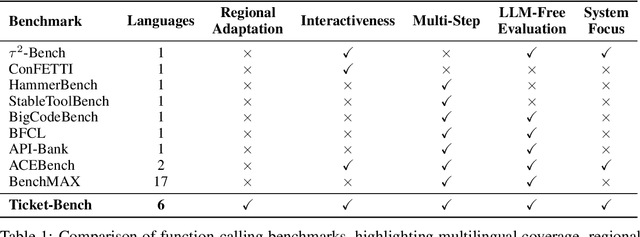
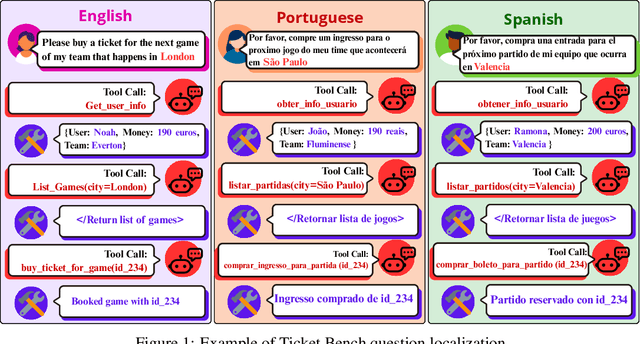
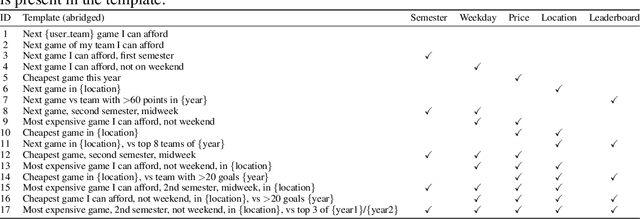
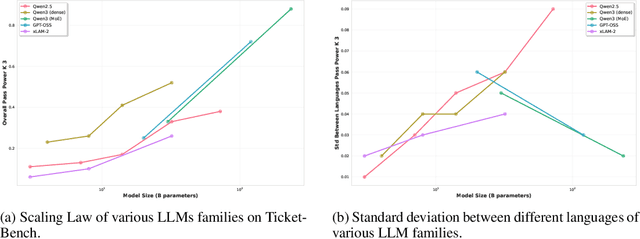
Large language models (LLMs) are increasingly deployed as task-oriented agents, where success depends on their ability to generate accurate function calls under realistic, multilingual conditions. However, existing agent evaluations largely overlook cultural and linguistic diversity, often relying on monolingual or naively translated benchmarks. We introduce Ticket-Bench, a benchmark for multilingual agent evaluation in task-oriented scenarios. Ticket-Bench simulates the domain of soccer ticket purchases across six major languages: Portuguese, English, Spanish, German, Italian, and French. Using localized teams, cities, and user profiles to provide a higher level of realism. We evaluate a wide range of commercial and open-source LLMs, measuring function-calling accuracy and consistency across languages. Results show that reasoning-oriented models (e.g., GPT-5, Qwen3-235B) dominate performance but still exhibit notable cross-lingual disparities. These findings underscore the need for culturally aware, multilingual benchmarks to guide the development of robust LLM agents.
Building High-Quality Datasets for Portuguese LLMs: From Common Crawl Snapshots to Industrial-Grade Corpora
Sep 10, 2025The performance of large language models (LLMs) is deeply influenced by the quality and composition of their training data. While much of the existing work has centered on English, there remains a gap in understanding how to construct effective training corpora for other languages. We explore scalable methods for building web-based corpora for LLMs. We apply them to build a new 120B token corpus in Portuguese that achieves competitive results to an industrial-grade corpus. Using a continual pretraining setup, we study how different data selection and preprocessing strategies affect LLM performance when transitioning a model originally trained in English to another language. Our findings demonstrate the value of language-specific filtering pipelines, including classifiers for education, science, technology, engineering, and mathematics (STEM), as well as toxic content. We show that adapting a model to the target language leads to performance improvements, reinforcing the importance of high-quality, language-specific data. While our case study focuses on Portuguese, our methods are applicable to other languages, offering insights for multilingual LLM development.
BRoverbs -- Measuring how much LLMs understand Portuguese proverbs
Sep 10, 2025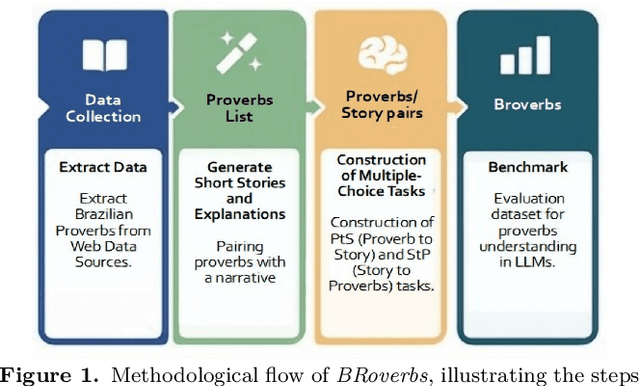
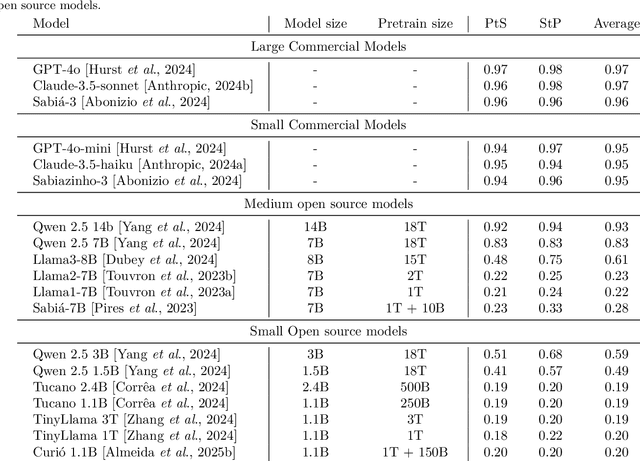
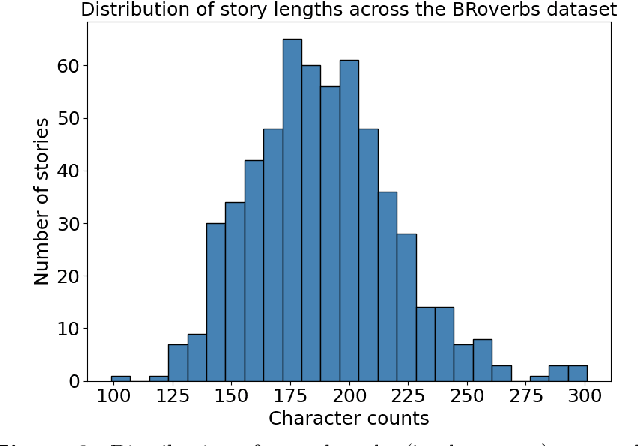
Large Language Models (LLMs) exhibit significant performance variations depending on the linguistic and cultural context in which they are applied. This disparity signals the necessity of mature evaluation frameworks that can assess their capabilities in specific regional settings. In the case of Portuguese, existing evaluations remain limited, often relying on translated datasets that may not fully capture linguistic nuances or cultural references. Meanwhile, native Portuguese-language datasets predominantly focus on structured national exams or sentiment analysis of social media interactions, leaving gaps in evaluating broader linguistic understanding. To address this limitation, we introduce BRoverbs, a dataset specifically designed to assess LLM performance through Brazilian proverbs. Proverbs serve as a rich linguistic resource, encapsulating cultural wisdom, figurative expressions, and complex syntactic structures that challenge the model comprehension of regional expressions. BRoverbs aims to provide a new evaluation tool for Portuguese-language LLMs, contributing to advancing regionally informed benchmarking. The benchmark is available at https://huggingface.co/datasets/Tropic-AI/BRoverbs.