 Add to Chrome
 Add to Firefox
 Add to Edge
A Unified 2D Framework for DeepLesion Detection, Segmentation and Short Report Generation
Aug 03, 2026
In previous work, we integrated large language models (LLMs) into the lesion segmentation model based on the ULS23 DeepLesion dataset, using short-form findings from the reports. In this study, we developed a unified 2D lesion analysis framework that integrates LLM-based reasoning, lesion bounding box detection, segmentation, and radiology report generation from the original DeepLesion dataset. In the testing phase, we achieved relatively high lesion bounding box detection accuracy with mAP50 of 70.1%, mAP50-95 of 46.4%; Lesion segmentation performance with a Dice score of 62.6%; short report generation accuracy with BLEU_1 score of 64.3%, BLEU_4 score of 49.6%, METEOR of 34.7%, and ROUGE_L of 60.1%. In this work, we address the challenging issue of segmentation in the original DeepLesion dataset and achieve a 28.5% Dice score improvement over the nnUNet lesion segmentation model. We also integrated spatial and anatomical context into the DeepLesion short report generation. We released the implementation, dataset, and models on Github. https://github.com/ruida/2D_DeepLesion_Foundation

CT-Bench: A Benchmark for Multimodal Lesion Understanding in Computed Tomography
Feb 16, 2026Artificial intelligence (AI) can automatically delineate lesions on computed tomography (CT) and generate radiology report content, yet progress is limited by the scarcity of publicly available CT datasets with lesion-level annotations. To bridge this gap, we introduce CT-Bench, a first-of-its-kind benchmark dataset comprising two components: a Lesion Image and Metadata Set containing 20,335 lesions from 7,795 CT studies with bounding boxes, descriptions, and size information, and a multitask visual question answering benchmark with 2,850 QA pairs covering lesion localization, description, size estimation, and attribute categorization. Hard negative examples are included to reflect real-world diagnostic challenges. We evaluate multiple state-of-the-art multimodal models, including vision-language and medical CLIP variants, by comparing their performance to radiologist assessments, demonstrating the value of CT-Bench as a comprehensive benchmark for lesion analysis. Moreover, fine-tuning models on the Lesion Image and Metadata Set yields significant performance gains across both components, underscoring the clinical utility of CT-Bench.
Decomposing Vision-based LLM Predictions for Auto-Evaluation with GPT-4
Mar 08, 2024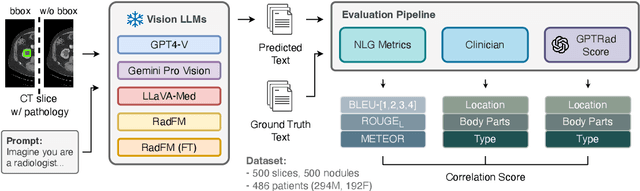
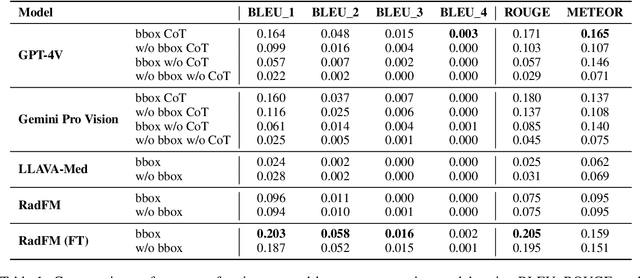
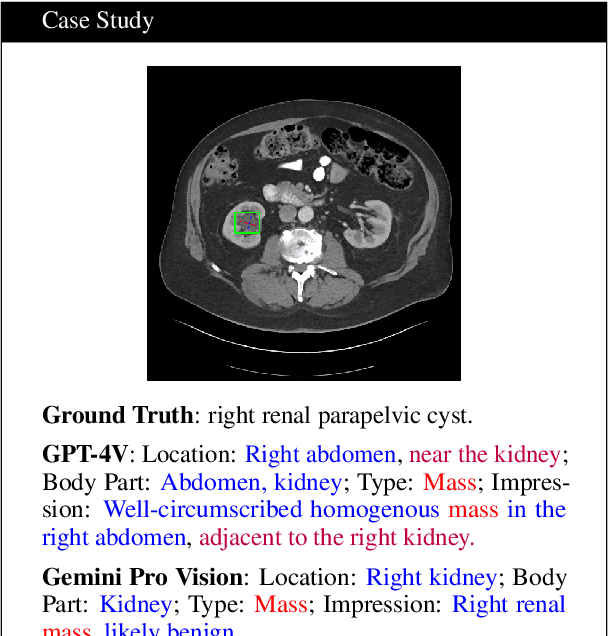
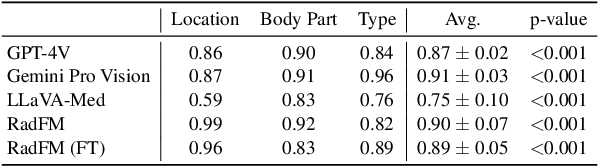
The volume of CT exams being done in the world has been rising every year, which has led to radiologist burn-out. Large Language Models (LLMs) have the potential to reduce their burden, but their adoption in the clinic depends on radiologist trust, and easy evaluation of generated content. Presently, many automated methods are available to evaluate the reports generated for chest radiographs, but such an approach is not available for CT presently. In this paper, we propose a novel evaluation framework to judge the capabilities of vision-language LLMs in generating accurate summaries of CT-based abnormalities. CT slices containing an abnormality (e.g., lesion) were input to a vision-based LLM (GPT-4V, LLaVA-Med, and RadFM), and it generated a free-text summary of the predicted characteristics of the abnormality. Next, a GPT-4 model decomposed the summary into specific aspects (body part, location, type, and attributes), automatically evaluated the characteristics against the ground-truth, and generated a score for each aspect based on its clinical relevance and factual accuracy. These scores were then contrasted against those obtained from a clinician, and a high correlation ( 85%, p < .001) was observed. Although GPT-4V outperformed other models in our evaluation, it still requires overall improvement. Our evaluation method offers valuable insights into the specific areas that need the most enhancement, guiding future development in this field.