 Add to Chrome
 Add to Firefox
 Add to Edge
What do people want to fact-check?
Feb 11, 2026
Research on misinformation has focused almost exclusively on supply, asking what falsehoods circulate, who produces them, and whether corrections work. A basic demand-side question remains unanswered. When ordinary people can fact-check anything they want, what do they actually ask about? We provide the first large-scale evidence on this question by analyzing close to 2{,}500 statements submitted by 457 participants to an open-ended AI fact-checking system. Each claim is classified along five semantic dimensions (domain, epistemic form, verifiability, target entity, and temporal reference), producing a behavioral map of public verification demand. Three findings stand out. First, users range widely across topics but default to a narrow epistemic repertoire, overwhelmingly submitting simple descriptive claims about present-day observables. Second, roughly one in four requests concerns statements that cannot be empirically resolved, including moral judgments, speculative predictions, and subjective evaluations, revealing a systematic mismatch between what users seek from fact-checking tools and what such tools can deliver. Third, comparison with the FEVER benchmark dataset exposes sharp structural divergences across all five dimensions, indicating that standard evaluation corpora encode a synthetic claim environment that does not resemble real-world verification needs. These results reframe fact-checking as a demand-driven problem and identify where current AI systems and benchmarks are misaligned with the uncertainty people actually experience.

Black-Box Access is Insufficient for Rigorous AI Audits
Jan 25, 2024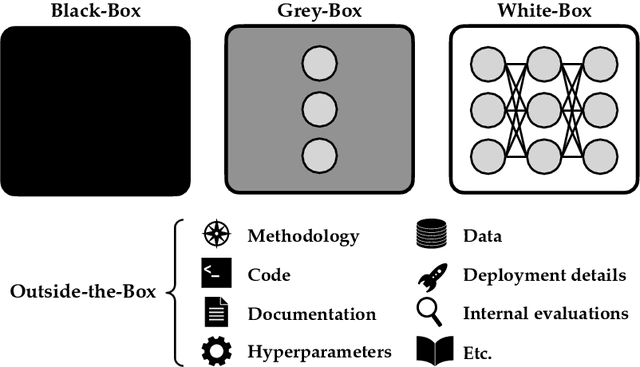
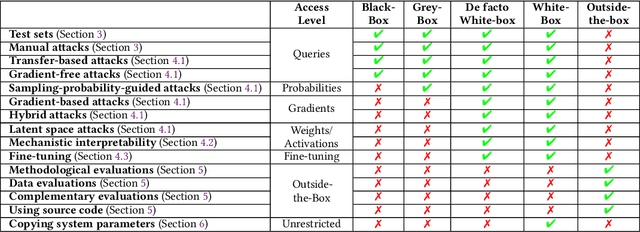
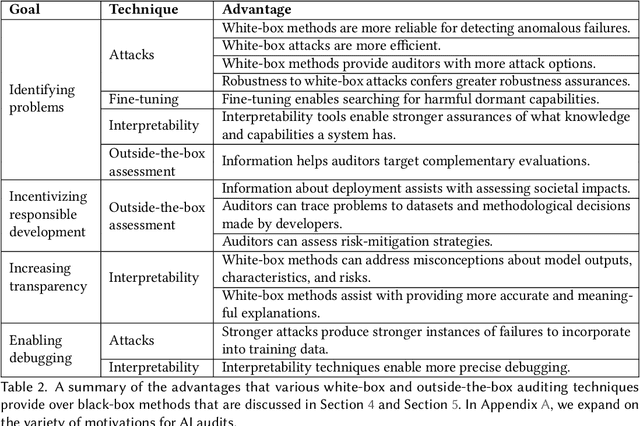
External audits of AI systems are increasingly recognized as a key mechanism for AI governance. The effectiveness of an audit, however, depends on the degree of system access granted to auditors. Recent audits of state-of-the-art AI systems have primarily relied on black-box access, in which auditors can only query the system and observe its outputs. However, white-box access to the system's inner workings (e.g., weights, activations, gradients) allows an auditor to perform stronger attacks, more thoroughly interpret models, and conduct fine-tuning. Meanwhile, outside-the-box access to its training and deployment information (e.g., methodology, code, documentation, hyperparameters, data, deployment details, findings from internal evaluations) allows for auditors to scrutinize the development process and design more targeted evaluations. In this paper, we examine the limitations of black-box audits and the advantages of white- and outside-the-box audits. We also discuss technical, physical, and legal safeguards for performing these audits with minimal security risks. Given that different forms of access can lead to very different levels of evaluation, we conclude that (1) transparency regarding the access and methods used by auditors is necessary to properly interpret audit results, and (2) white- and outside-the-box access allow for substantially more scrutiny than black-box access alone.