 Add to Chrome
 Add to Firefox
 Add to Edge
Bridging the Sim-to-Real Gap in Semiconductor Visual Program Synthesis via Input Binarization
Jun 01, 2026
Precise parametric control over circuit geometry is essential for semiconductor inspection, yet obtaining sufficient real training data remains costly. Although generative models such as diffusion models and Generative Adversarial Networks (GANs) can augment training data, they cannot guarantee the nanometer-scale geometric accuracy required for metrology tasks. We propose a visual program synthesis framework in which a Vision-Language Model (VLM) converts inspection images into editable Domain-Specific Language (DSL) code describing circuit geometries, enabling controlled generation of training data with exact parameter manipulation. Because the VLM is trained solely on synthetic DSL-rendered data, a domain gap arises when processing real Scanning Electron Microscope (SEM) images. We bridge this gap with an input binarization strategy that strips SEM-specific texture and noise, letting the model focus on geometric structure. On the MIIC dataset, binarized inputs improve the mean Dice coefficient from 0.4393 to 0.5256 over the raw-input baseline, demonstrating that simple texture abstraction substantially mitigates the sim-to-real gap.

DetRefiner: Model-Agnostic Detection Refinement with Feature Fusion Transformer
May 11, 2026Open-vocabulary object detection (OVOD) aims to detect both seen and unseen categories, yet existing methods often struggle to generalize to novel objects due to limited integration of global and local contextual cues. We propose DetRefiner, a simple yet effective plug-and-play framework that learns to fuse global and local features to refine open-vocabulary detection. DetRefiner processes global image features and patch-level image features from foundational models (e.g., DINOv3) through a lightweight Transformer encoder. The encoder produces a class vector capturing image-level attributes and patch vectors representing local region attributes, from which attribute reliability is inferred to recalibrate the base model's confidence. Notably, DetRefiner is trained independently of the base OVOD model, requiring neither access to its internal features nor retraining. At inference, it operates solely on the base detector's predictions, producing auxiliary calibration scores that are merged with the base detector's scores to yield the final refined confidence. Despite this simplicity, DetRefiner consistently enhances multiple OVOD models across COCO, LVIS, ODinW13, and Pascal VOC, achieving gains of up to +10.1 AP on novel categories. These results highlight that learning to fuse global and local representations offers a powerful and general mechanism for advancing open-world object detection. Our codes and models are available at https://github.com/hitachi-rd-cv/detrefiner.
LaSTR: Language-Driven Time-Series Segment Retrieval
Feb 28, 2026Effectively searching time-series data is essential for system analysis, but existing methods often require expert-designed similarity criteria or rely on global, series-level descriptions. We study language-driven segment retrieval: given a natural language query, the goal is to retrieve relevant local segments from large time-series repositories. We build large-scale segment--caption training data by applying TV2-based segmentation to LOTSA windows and generating segment descriptions with GPT-5.2, and then train a Conformer-based contrastive retriever in a shared text--time-series embedding space. On a held-out test split, we evaluate single-positive retrieval together with caption-side consistency (SBERT and VLM-as-a-judge) under multiple candidate pool sizes. Across all settings, LaSTR outperforms random and CLIP baselines, yielding improved ranking quality and stronger semantic agreement between retrieved segments and query intent.
A norm knockout method on indirect reciprocity to reveal indispensable norms
Mar 11, 2017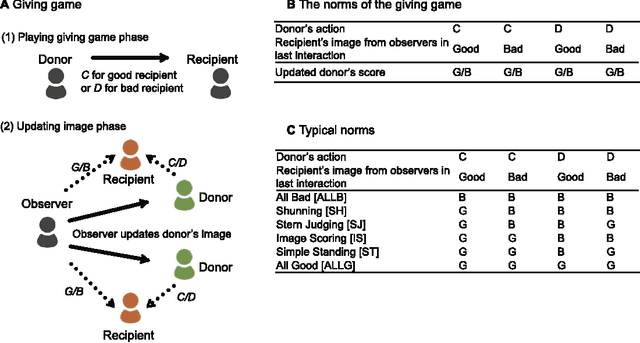
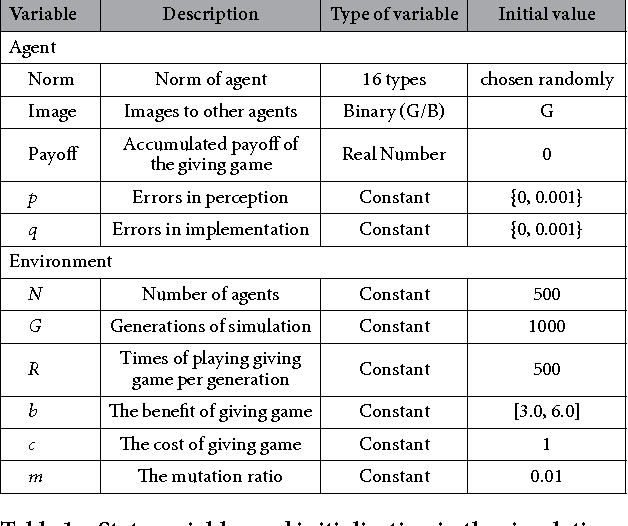
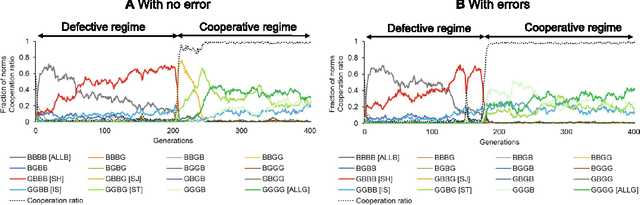
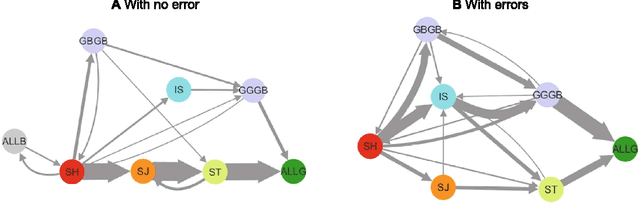
Although various norms for reciprocity-based cooperation have been suggested that are evolutionarily stable against invasion from free riders, the process of alternation of norms and the role of diversified norms remain unclear in the evolution of cooperation. We clarify the co-evolutionary dynamics of norms and cooperation in indirect reciprocity and also identify the indispensable norms for the evolution of cooperation. Inspired by the gene knockout method, a genetic engineering technique, we developed the norm knockout method and clarified the norms necessary for the establishment of cooperation. The results of numerical investigations revealed that the majority of norms gradually transitioned to tolerant norms after defectors are eliminated by strict norms. Furthermore, no cooperation emerges when specific norms that are intolerant to defectors are knocked out.
* 15 pages (incl. supplementary materials), 6 figures, 7 table