 Add to Chrome
 Add to Firefox
 Add to Edge
Bridging the Sim-to-Real Gap in Semiconductor Visual Program Synthesis via Input Binarization
Jun 01, 2026
Precise parametric control over circuit geometry is essential for semiconductor inspection, yet obtaining sufficient real training data remains costly. Although generative models such as diffusion models and Generative Adversarial Networks (GANs) can augment training data, they cannot guarantee the nanometer-scale geometric accuracy required for metrology tasks. We propose a visual program synthesis framework in which a Vision-Language Model (VLM) converts inspection images into editable Domain-Specific Language (DSL) code describing circuit geometries, enabling controlled generation of training data with exact parameter manipulation. Because the VLM is trained solely on synthetic DSL-rendered data, a domain gap arises when processing real Scanning Electron Microscope (SEM) images. We bridge this gap with an input binarization strategy that strips SEM-specific texture and noise, letting the model focus on geometric structure. On the MIIC dataset, binarized inputs improve the mean Dice coefficient from 0.4393 to 0.5256 over the raw-input baseline, demonstrating that simple texture abstraction substantially mitigates the sim-to-real gap.

Hypergraph Neural Networks Accelerate MUS Enumeration
Apr 10, 2026Enumerating Minimal Unsatisfiable Subsets (MUSes) is a fundamental task in constraint satisfaction problems (CSPs). Its major challenge is the exponential growth of the search space, which becomes particularly severe when satisfiability checks are expensive. Recent machine learning approaches reduce this cost for Boolean satisfiability problems but rely on explicit variable-constraint relationships, limiting their application domains. This paper proposes a domain-agnostic method to accelerate MUS enumeration using Hypergraph Neural Networks (HGNNs). The proposed method incrementally builds a hypergraph with constraints as vertices and MUSes enumerated until the current step as hyperedges, and employs an HGNN-based agent trained via reinforcement learning to minimize the number of satisfiability checks required to obtain an MUS. Experimental results demonstrate the effectiveness of our approach in accelerating MUS enumeration, showing that our method can enumerate more MUSes within the same satisfiability check budget compared to conventional methods.
LaSTR: Language-Driven Time-Series Segment Retrieval
Feb 28, 2026Effectively searching time-series data is essential for system analysis, but existing methods often require expert-designed similarity criteria or rely on global, series-level descriptions. We study language-driven segment retrieval: given a natural language query, the goal is to retrieve relevant local segments from large time-series repositories. We build large-scale segment--caption training data by applying TV2-based segmentation to LOTSA windows and generating segment descriptions with GPT-5.2, and then train a Conformer-based contrastive retriever in a shared text--time-series embedding space. On a held-out test split, we evaluate single-positive retrieval together with caption-side consistency (SBERT and VLM-as-a-judge) under multiple candidate pool sizes. Across all settings, LaSTR outperforms random and CLIP baselines, yielding improved ranking quality and stronger semantic agreement between retrieved segments and query intent.
Phase autoencoder for limit-cycle oscillators
Feb 28, 2024We present a phase autoencoder that encodes the asymptotic phase of a limit-cycle oscillator, a fundamental quantity characterizing its synchronization dynamics. This autoencoder is trained in such a way that its latent variables directly represent the asymptotic phase of the oscillator. The trained autoencoder can perform two functions without relying on the mathematical model of the oscillator: first, it can evaluate the asymptotic phase and phase sensitivity function of the oscillator; second, it can reconstruct the oscillator state on the limit cycle in the original space from the phase value as an input. Using several examples of limit-cycle oscillators, we demonstrate that the asymptotic phase and phase sensitivity function can be estimated only from time-series data by the trained autoencoder. We also present a simple method for globally synchronizing two oscillators as an application of the trained autoencoder.
QUBO Decision Tree: Annealing Machine Extends Decision Tree Splitting
Mar 17, 2023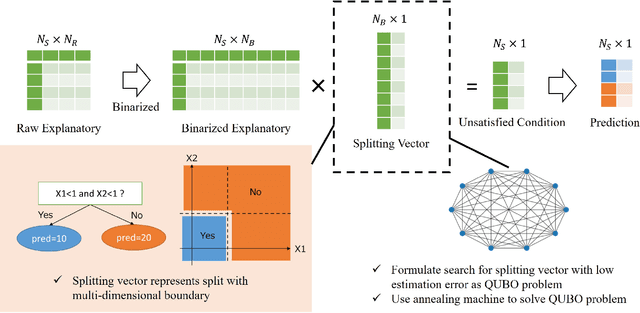
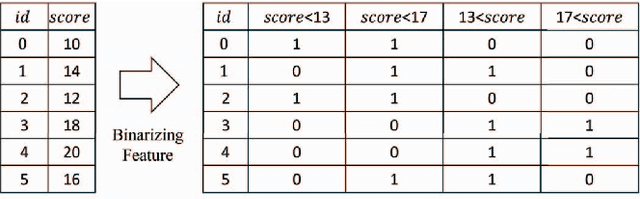
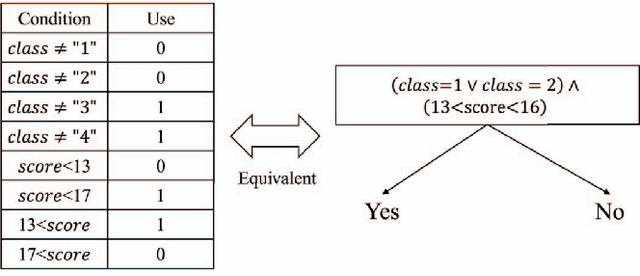
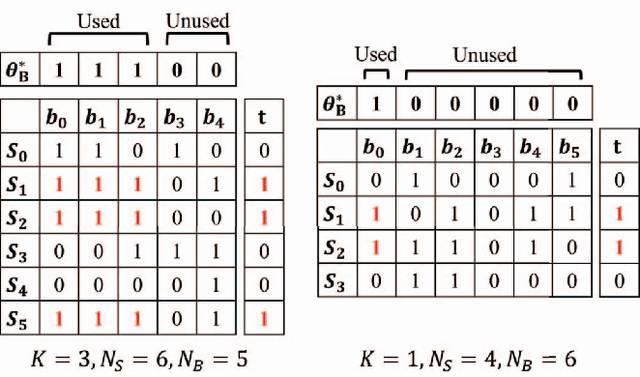
This paper proposes an extension of regression trees by quadratic unconstrained binary optimization (QUBO). Regression trees are very popular prediction models that are trainable with tabular datasets, but their accuracy is insufficient because the decision rules are too simple. The proposed method extends the decision rules in decision trees to multi-dimensional boundaries. Such an extension is generally unimplementable because of computational limitations, however, the proposed method transforms the training process to QUBO, which enables an annealing machine to solve this problem.
QUBO-inspired Molecular Fingerprint for Chemical Property Prediction
Mar 17, 2023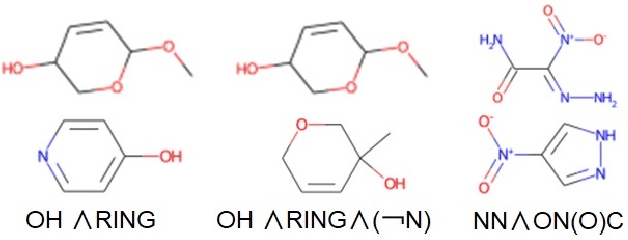
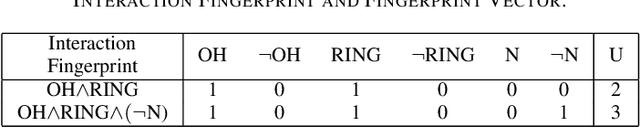
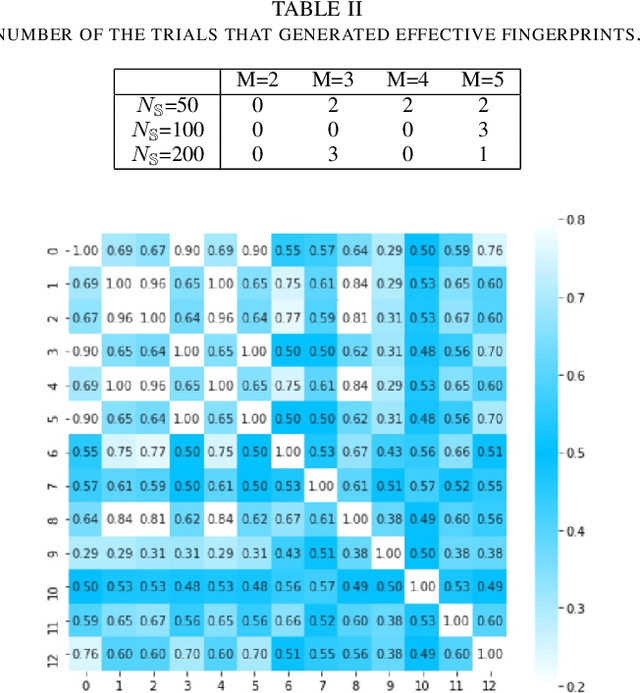
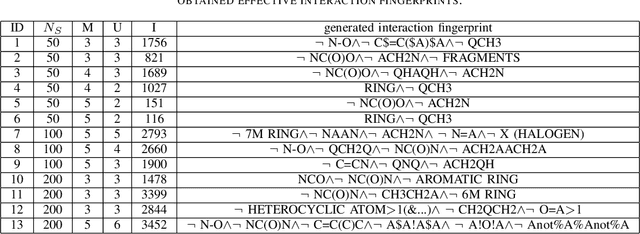
Molecular fingerprints are widely used for predicting chemical properties, and selecting appropriate fingerprints is important. We generate new fingerprints based on the assumption that a performance of prediction using a more effective fingerprint is better. We generate effective interaction fingerprints that are the product of multiple base fingerprints. It is difficult to evaluate all combinations of interaction fingerprints because of computational limitations. Against this problem, we transform a problem of searching more effective interaction fingerprints into a quadratic unconstrained binary optimization problem. In this study, we found effective interaction fingerprints using QM9 dataset.