 Add to Chrome
 Add to Firefox
 Add to Edge
Unlearnable phases of matter
Feb 11, 2026
We identify fundamental limitations in machine learning by demonstrating that non-trivial mixed-state phases of matter are computationally hard to learn. Focusing on unsupervised learning of distributions, we show that autoregressive neural networks fail to learn global properties of distributions characterized by locally indistinguishable (LI) states. We demonstrate that conditional mutual information (CMI) is a useful diagnostic for LI: we show that for classical distributions, long-range CMI of a state implies a spatially LI partner. By introducing a restricted statistical query model, we prove that nontrivial phases with long-range CMI, such as strong-to-weak spontaneous symmetry breaking phases, are hard to learn. We validate our claims by using recurrent, convolutional, and Transformer neural networks to learn the syndrome and physical distributions of toric/surface code under bit flip noise. Our findings suggest hardness of learning as a diagnostic tool for detecting mixed-state phases and transitions and error-correction thresholds, and they suggest CMI and more generally ``non-local Gibbsness'' as metrics for how hard a distribution is to learn.

Combinatorial Reasoning: Selecting Reasons in Generative AI Pipelines via Combinatorial Optimization
Jun 19, 2024
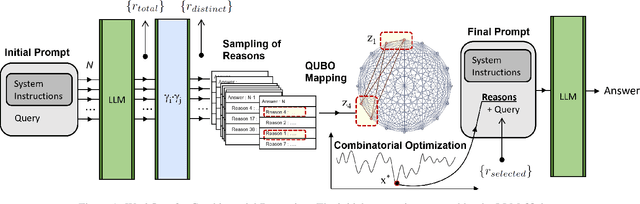
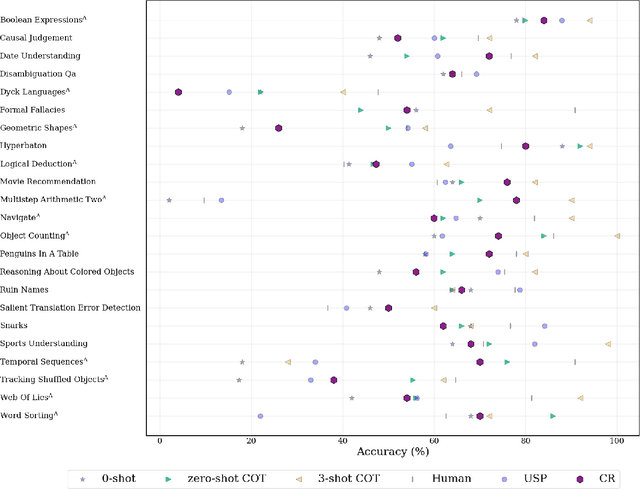
Recent Large Language Models (LLMs) have demonstrated impressive capabilities at tasks that require human intelligence and are a significant step towards human-like artificial intelligence (AI). Yet the performance of LLMs at reasoning tasks have been subpar and the reasoning capability of LLMs is a matter of significant debate. While it has been shown that the choice of the prompting technique to the LLM can alter its performance on a multitude of tasks, including reasoning, the best performing techniques require human-made prompts with the knowledge of the tasks at hand. We introduce a framework for what we call Combinatorial Reasoning (CR), a fully-automated prompting method, where reasons are sampled from an LLM pipeline and mapped into a Quadratic Unconstrained Binary Optimization (QUBO) problem. The framework investigates whether QUBO solutions can be profitably used to select a useful subset of the reasons to construct a Chain-of-Thought style prompt. We explore the acceleration of CR with specialized solvers. We also investigate the performance of simpler zero-shot strategies such as linear majority rule or random selection of reasons. Our preliminary study indicates that coupling a combinatorial solver to generative AI pipelines is an interesting avenue for AI reasoning and elucidates design principles for future CR methods.