 Add to Chrome
 Add to Firefox
 Add to Edge
Unlearnable phases of matter
Feb 11, 2026
We identify fundamental limitations in machine learning by demonstrating that non-trivial mixed-state phases of matter are computationally hard to learn. Focusing on unsupervised learning of distributions, we show that autoregressive neural networks fail to learn global properties of distributions characterized by locally indistinguishable (LI) states. We demonstrate that conditional mutual information (CMI) is a useful diagnostic for LI: we show that for classical distributions, long-range CMI of a state implies a spatially LI partner. By introducing a restricted statistical query model, we prove that nontrivial phases with long-range CMI, such as strong-to-weak spontaneous symmetry breaking phases, are hard to learn. We validate our claims by using recurrent, convolutional, and Transformer neural networks to learn the syndrome and physical distributions of toric/surface code under bit flip noise. Our findings suggest hardness of learning as a diagnostic tool for detecting mixed-state phases and transitions and error-correction thresholds, and they suggest CMI and more generally ``non-local Gibbsness'' as metrics for how hard a distribution is to learn.

Differentiable Programming of Isometric Tensor Networks
Nov 01, 2021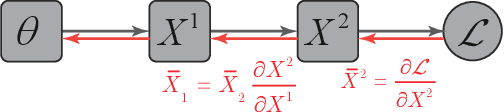
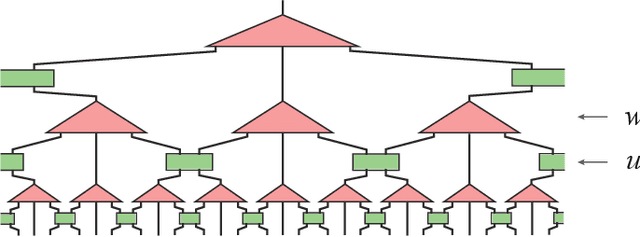
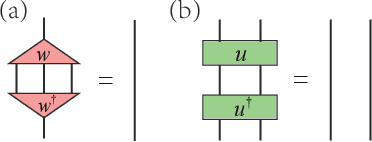
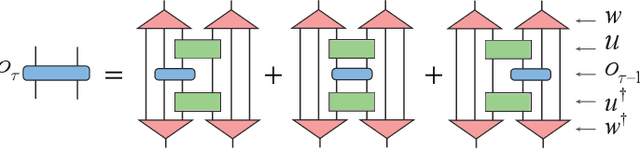
Differentiable programming is a new programming paradigm which enables large scale optimization through automatic calculation of gradients also known as auto-differentiation. This concept emerges from deep learning, and has also been generalized to tensor network optimizations. Here, we extend the differentiable programming to tensor networks with isometric constraints with applications to multiscale entanglement renormalization ansatz (MERA) and tensor network renormalization (TNR). By introducing several gradient-based optimization methods for the isometric tensor network and comparing with Evenbly-Vidal method, we show that auto-differentiation has a better performance for both stability and accuracy. We numerically tested our methods on 1D critical quantum Ising spin chain and 2D classical Ising model. We calculate the ground state energy for the 1D quantum model and internal energy for the classical model, and scaling dimensions of scaling operators and find they all agree with the theory well.
TensorNetwork: A Library for Physics and Machine Learning
May 03, 2019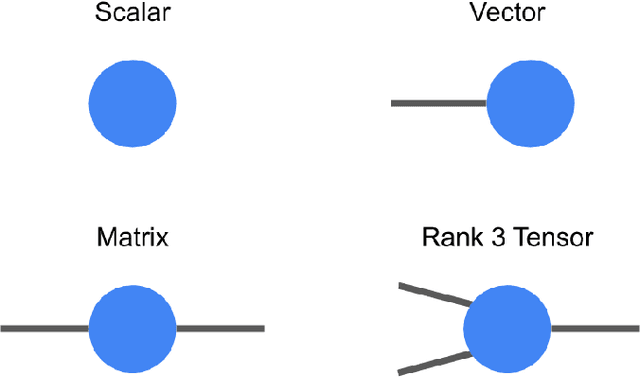
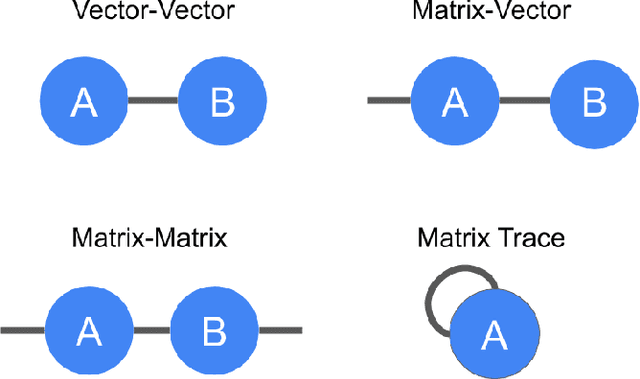
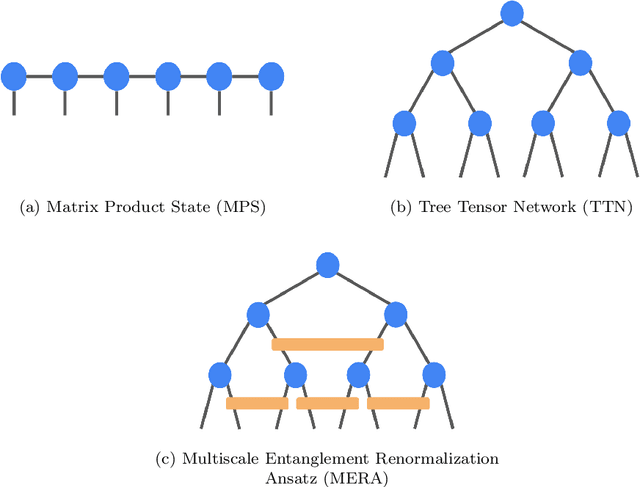
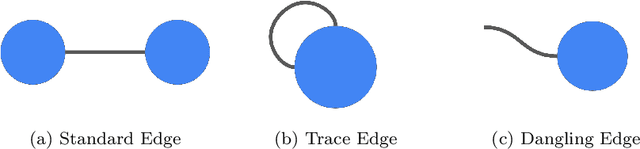
TensorNetwork is an open source library for implementing tensor network algorithms. Tensor networks are sparse data structures originally designed for simulating quantum many-body physics, but are currently also applied in a number of other research areas, including machine learning. We demonstrate the use of the API with applications both physics and machine learning, with details appearing in companion papers.