 Add to Chrome
 Add to Firefox
 Add to Edge
Spatio-Temporal Difference Guided Motion Deblurring with the Complementary Vision Sensor
Apr 12, 2026
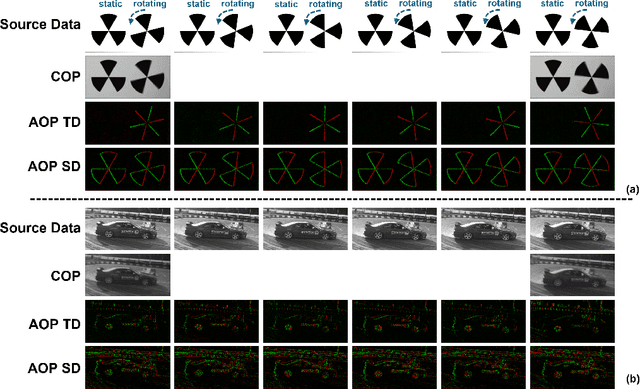
Motion blur arises when rapid scene changes occur during the exposure period, collapsing rich intra-exposure motion into a single RGB frame. Without explicit structural or temporal cues, RGB-only deblurring is highly ill-posed and often fails under extreme motion. Inspired by the human visual system, brain-inspired vision sensors introduce temporally dense information to alleviate this problem. However, event cameras still suffer from event rate saturation under rapid motion, while the event modality entangles edge features and motion cues, which limits their effectiveness. As a recent breakthrough, the complementary vision sensor (CVS), Tianmouc, captures synchronized RGB frames together with high-frame-rate, multi-bit spatial difference (SD, encoding structural edges) and temporal difference (TD, encoding motion cues) data within a single RGB exposure, offering a promising solution for RGB deblurring under extreme dynamic scenes. To fully leverage these complementary modalities, we propose Spatio-Temporal Difference Guided Deblur Net (STGDNet), which adopts a recurrent multi-branch architecture that iteratively encodes and fuses SD and TD sequences to restore structure and color details lost in blurry RGB inputs. Our method outperforms current RGB or event-based approaches in both synthetic CVS dataset and real-world evaluations. Moreover, STGDNet exhibits strong generalization capability across over 100 extreme real-world scenarios. Project page: https://tmcDeblur.github.io/

Quantitative evaluation of brain-inspired vision sensors in high-speed robotic perception
Apr 27, 2025Perception systems in robotics encounter significant challenges in high-speed and dynamic conditions when relying on traditional cameras, where motion blur can compromise spatial feature integrity and task performance. Brain-inspired vision sensors (BVS) have recently gained attention as an alternative, offering high temporal resolution with reduced bandwidth and power requirements. Here, we present the first quantitative evaluation framework for two representative classes of BVSs in variable-speed robotic sensing, including event-based vision sensors (EVS) that detect asynchronous temporal contrasts, and the primitive-based sensor Tianmouc that employs a complementary mechanism to encode both spatiotemporal changes and intensity. A unified testing protocol is established, including crosssensor calibrations, standardized testing platforms, and quality metrics to address differences in data modality. From an imaging standpoint, we evaluate the effects of sensor non-idealities, such as motion-induced distortion, on the capture of structural information. For functional benchmarking, we examine task performance in corner detection and motion estimation under different rotational speeds. Results indicate that EVS performs well in highspeed, sparse scenarios and in modestly fast, complex scenes, but exhibits performance limitations in high-speed, cluttered settings due to pixel-level bandwidth variations and event rate saturation. In comparison, Tianmouc demonstrates consistent performance across sparse and complex scenarios at various speeds, supported by its global, precise, high-speed spatiotemporal gradient samplings. These findings offer valuable insights into the applicationdependent suitability of BVS technologies and support further advancement in this area.
Technical report of a DMD-based Characterization Method for Vision Sensors
Mar 04, 2025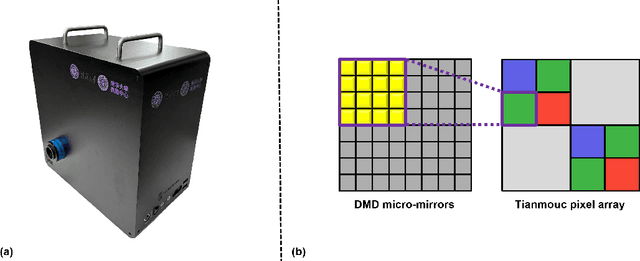
This technical report presents a novel DMD-based characterization method for vision sensors, particularly neuromorphic sensors such as event-based vision sensors (EVS) and Tianmouc, a complementary vision sensor. Traditional image sensor characterization standards, such as EMVA1288, are unsuitable for BVS due to their dynamic response characteristics. To address this, we propose a high-speed, high-precision testing system using a Digital Micromirror Device (DMD) to modulate spatial and temporal light intensity. This approach enables quantitative analysis of key parameters such as event latency, signal-to-noise ratio (SNR), and dynamic range (DR) under controlled conditions. Our method provides a standardized and reproducible testing framework, overcoming the limitations of existing evaluation techniques for neuromorphic sensors. Furthermore, we discuss the potential of this method for large-scale BVS dataset generation and conversion, paving the way for more consistent benchmarking of bio-inspired vision technologies.