 Add to Chrome
 Add to Firefox
 Add to Edge
SurgVLA-Bench: Towards Evaluating Vision-Language-Action Models for Laparoscopic Surgical Robotics
Jun 28, 2026
Vision-Language-Action (VLA) models represent a promising direction for embodied intelligence in surgical robotics. Despite the prevalence of VLA benchmarks for general robotics, standardized evaluation platforms specifically designed for surgical contexts remain absent. To address this limitation, we present SurgVLA-Bench, the first comprehensive benchmark for evaluating VLA models in laparoscopic surgical robotics. Leveraging the SurRoL simulation platform, we construct a hierarchical task taxonomy ranging from atomic actions to complete surgical procedures, complemented by a multi-dimensional evaluation framework assessing action accuracy and semantic consistency. We then systematically evaluate two representative paradigms, including autoregressive models such as OpenVLA, and flow matching models such as $π_{0}$, $π_{0.5}$, and SmolVLA. Our experiments show that autoregressive models tend to excel in semantic understanding, while flow matching models often achieve higher task precision but may face generalization trade-offs. However, even the best-performing models remain far from satisfactory, as the constrained endoscopic field of view, restricted viewing angles, and frequent occlusions persist as fundamental physical bottlenecks. The code and data are available at https://github.com/VCL-HNU/SurgVLA

Frequency-Based Patrolling with Heterogeneous Agents and Limited Communication
Feb 07, 2014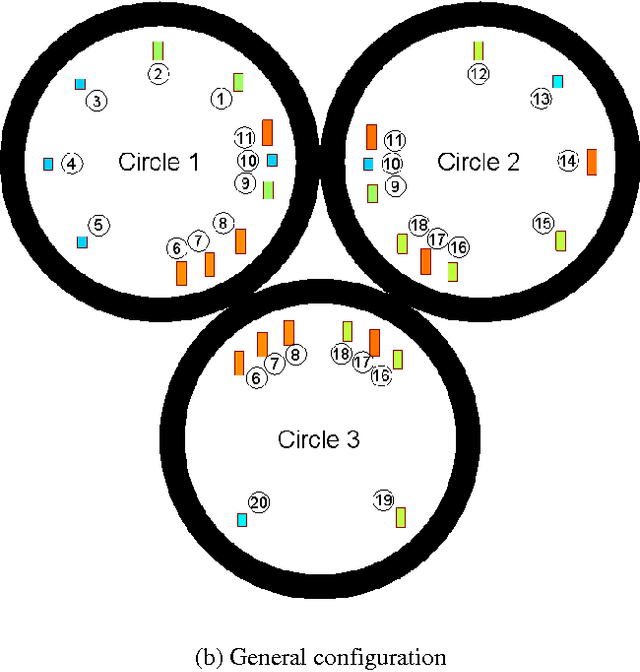
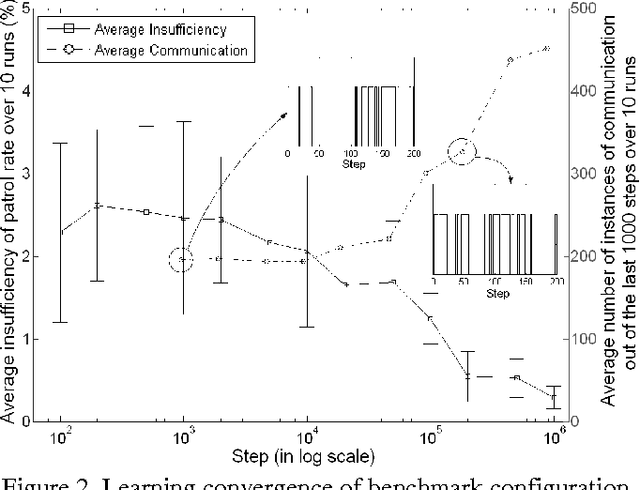
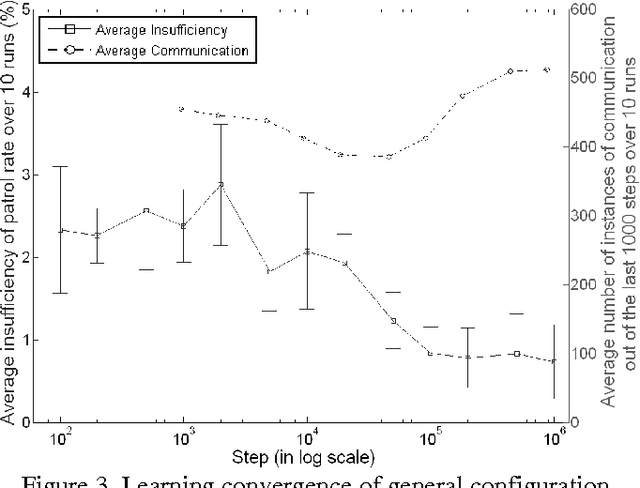
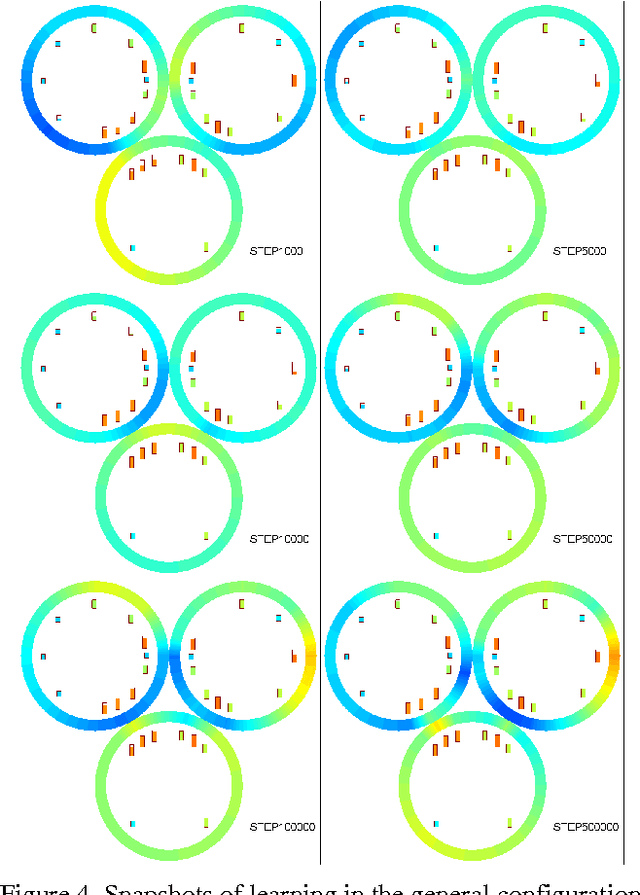
This paper investigates multi-agent frequencybased patrolling of intersecting, circle graphs under conditions where graph nodes have non-uniform visitation requirements and agents have limited ability to communicate. The task is modeled as a partially observable Markov decision process, and a reinforcement learning solution is developed. Each agent generates its own policy from Markov chains, and policies are exchanged only when agents occupy the same or adjacent nodes. This constraint on policy exchange models sparse communication conditions over large, unstructured environments. Empirical results provide perspectives on convergence properties, agent cooperation, and generalization of learned patrolling policies to new instances of the task. The emergent behavior indicates learned coordination strategies between heterogeneous agents for patrolling large, unstructured regions as well as the ability to generalize to dynamic variation in node visitation requirements.