 Add to Chrome
 Add to Firefox
 Add to Edge
Improving Collaborative Storytelling with a Multi-Agent Framework Based on Large Language Models
May 28, 2026
The topic of Co-creation, i.e., AI agents interacting with humans to generate outputs (e.g., art), has gained significant attention recently. However, most studies focus on adult-human interactions in a digital setting. This paper explores a novel ludic co-creation scenario involving children and Large Language Models (LLMs) interacting through a physical board game to create written stories. Our goal is to develop a multi-agent framework capable of producing high-quality narratives suitable for young players. At the core of our approach is an iterative Writer-Editor process in which one LLM generates stories while another evaluates them and provides feedback for refinement. Through a simulation study involving multiple LLMs, we show that this iterative interaction consistently improves the perceived quality of generated stories across successive loops. The results indicate that a small number of refinement steps may be sufficient to achieve high-quality outputs in interactive storytelling systems.

AffectAI-Capture: A Reproducible Multimodal Protocol for Small-Group Meeting Research
May 19, 2026We present AffectAI-Capture, a protocol for collecting synchronized multimodal data in four-person meeting-like interactions, combining eye tracking, wearable physiology, close-talk and room audio, multi-view video, event logging, and structured self-report. Sessions use fixed task blocks grounded in established group-interaction paradigms, while acquisition and post-processing are organized around a single authoritative event timeline and standardized outputs. We describe the experimental rationale, synchronization philosophy, data organization, and practical trade-offs. Pilot-level validation of audio quality and video synchronization has been conducted using controlled bench tests; full protocol sessions with participants remain ongoing work. The contribution is a reproducible protocol architecture linking task design, instrumentation, timing provenance, and data packaging for affective, behavioral, and meeting-analytics research.
GroupAffect-4: A Multimodal Dataset of Four-Person Collaborative Interaction
May 19, 2026Existing affective-computing, social-signal-processing, and meeting corpora capture important parts of human interaction, but they rarely support analysis of affect in co-located groups as a coupled individual, interpersonal, and group-level process. The required signals (per-participant physiology, eye movement, audio, self-report, task outcomes, and personality) are usually fragmented across separate dataset traditions. We introduce GroupAffect-4, a multimodal corpus of 40 participants in 10 four-person groups, each completing four ecologically varied collaborative tasks spanning information pooling, negotiation, idea generation, and a public-goods game. Each participant is instrumented with a wrist-worn physiology sensor, eye-tracking glasses, and a close-talk microphone; sessions include continuous affect self-reports, post-task questionnaires, task outcomes, and Big-Five personality scores, all time-aligned to a shared clock. The dataset covers over 91% of expected physiology windows and 98% of eye-tracking windows, with strong task validity confirmed by a clear affective manipulation check across the negotiation block. We define fifteen benchmarkable targets spanning three analysis levels -- within-person state, between-person traits, and group dynamics -- and report leave-one-group-out feasibility baselines establishing the dataset's evaluative scope. GroupAffect-4 is released with a BIDS-inspired structure, Croissant metadata, a datasheet, per-session quality reports, and open processing scripts. Code and processing scripts are available at https://github.com/meisamjam/GroupAffect-4; the dataset is publicly archived at https://zenodo.org/records/20037847.
Spatiotemporal Convolutions on EEG signal -- A Representation Learning Perspective on Efficient and Explainable EEG Classification with Convolutional Neural Nets
May 05, 2026Classification of EEG signals using shallow Convolutional Neural Networks (CNNs) is a prevalent and successful approach across a variety of fields. Most of these models use independent one-dimensional (1D) convolutional layers along the spatial and temporal dimensions, which are concatenated without a non-linear activation layer between. In this paper, we investigate an alternative encoding that operates a bi-dimensional (2D) spatiotemporal convolution. While 2D convolutions are numerically identical to two concatenated 1D convolutions along the two dimensions, the impact on learning is still uncertain. We test 1D and 2D CNNs and a CNN+transformer hybrid model in a low-dimensional (3-channel) and a high-dimensional (22-channel) BCI motor imagery classification task. We observe that 2D convolutions significantly reduce training time in high-dimensional tasks while maintaining performance. We investigate the root of this improvement and find no difference in spectral feature importance. However, a clear pattern emerges in representational similarity across models: 1D and 2D models yield vastly different representational geometries. Overall, we suggest an improved model with a 2D convolutional layer for faster training and inference. We also highlight the importance of architecturally-driven encoding when processing complex multivariate signals, as reflected in internal representations rather than purely in performance metrics.
High-quality generation of dynamic game content via small language models: A proof of concept
Jan 30, 2026Large language models (LLMs) offer promise for dynamic game content generation, but they face critical barriers, including narrative incoherence and high operational costs. Due to their large size, they are often accessed in the cloud, limiting their application in offline games. Many of these practical issues are solved by pivoting to small language models (SLMs), but existing studies using SLMs have resulted in poor output quality. We propose a strategy of achieving high-quality SLM generation through aggressive fine-tuning on deliberately scoped tasks with narrow context, constrained structure, or both. In short, more difficult tasks require narrower scope and higher specialization to the training corpus. Training data is synthetically generated via a DAG-based approach, grounding models in the specific game world. Such models can form the basis for agentic networks designed around the narratological framework at hand, representing a more practical and robust solution than cloud-dependent LLMs. To validate this approach, we present a proof-of-concept focusing on a single specialized SLM as the fundamental building block. We introduce a minimal RPG loop revolving around rhetorical battles of reputations, powered by this model. We demonstrate that a simple retry-until-success strategy reaches adequate quality (as defined by an LLM-as-a-judge scheme) with predictable latency suitable for real-time generation. While local quality assessment remains an open question, our results demonstrate feasibility for real-time generation under typical game engine constraints.
Evaluating Quality of Gaming Narratives Co-created with AI
Sep 04, 2025This paper proposes a structured methodology to evaluate AI-generated game narratives, leveraging the Delphi study structure with a panel of narrative design experts. Our approach synthesizes story quality dimensions from literature and expert insights, mapping them into the Kano model framework to understand their impact on player satisfaction. The results can inform game developers on prioritizing quality aspects when co-creating game narratives with generative AI.
AntiCheatPT: A Transformer-Based Approach to Cheat Detection in Competitive Computer Games
Aug 08, 2025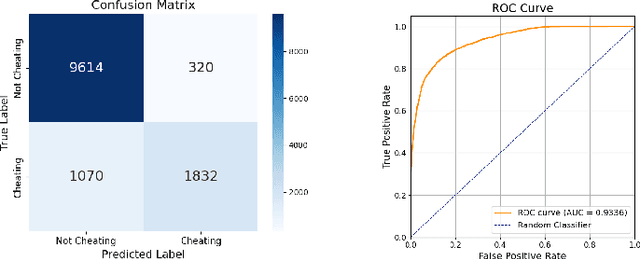
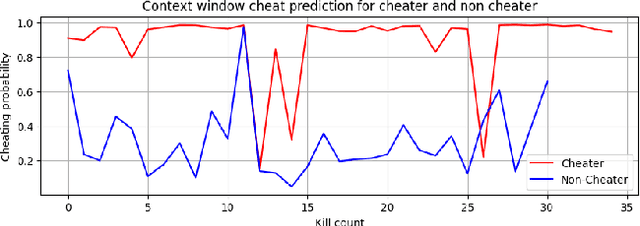
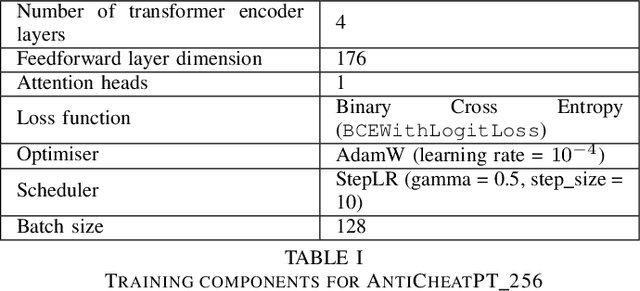
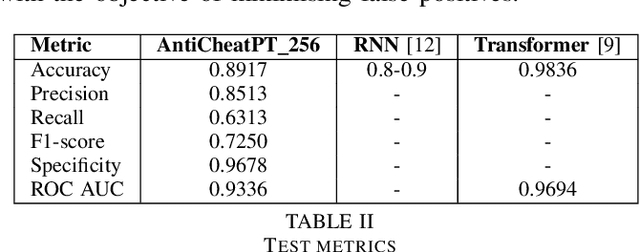
Cheating in online video games compromises the integrity of gaming experiences. Anti-cheat systems, such as VAC (Valve Anti-Cheat), face significant challenges in keeping pace with evolving cheating methods without imposing invasive measures on users' systems. This paper presents AntiCheatPT\_256, a transformer-based machine learning model designed to detect cheating behaviour in Counter-Strike 2 using gameplay data. To support this, we introduce and publicly release CS2CD: A labelled dataset of 795 matches. Using this dataset, 90,707 context windows were created and subsequently augmented to address class imbalance. The transformer model, trained on these windows, achieved an accuracy of 89.17\% and an AUC of 93.36\% on an unaugmented test set. This approach emphasizes reproducibility and real-world applicability, offering a robust baseline for future research in data-driven cheat detection.
Exploring Deep Learning Models for EEG Neural Decoding
Mar 20, 2025Neural decoding is an important method in cognitive neuroscience that aims to decode brain representations from recorded neural activity using a multivariate machine learning model. The THINGS initiative provides a large EEG dataset of 46 subjects watching rapidly shown images. Here, we test the feasibility of using this method for decoding high-level object features using recent deep learning models. We create a derivative dataset from this of living vs non-living entities test 15 different deep learning models with 5 different architectures and compare to a SOTA linear model. We show that the linear model is not able to solve the decoding task, while almost all the deep learning models are successful, suggesting that in some cases non-linear models are needed to decode neural representations. We also run a comparative study of the models' performance on individual object categories, and suggest how artificial neural networks can be used to study brain activity.
Modelling Emotions in Face-to-Face Setting: The Interplay of Eye-Tracking, Personality, and Temporal Dynamics
Mar 18, 2025Accurate emotion recognition is pivotal for nuanced and engaging human-computer interactions, yet remains difficult to achieve, especially in dynamic, conversation-like settings. In this study, we showcase how integrating eye-tracking data, temporal dynamics, and personality traits can substantially enhance the detection of both perceived and felt emotions. Seventy-three participants viewed short, speech-containing videos from the CREMA-D dataset, while being recorded for eye-tracking signals (pupil size, fixation patterns), Big Five personality assessments, and self-reported emotional states. Our neural network models combined these diverse inputs including stimulus emotion labels for contextual cues and yielded marked performance gains compared to the state-of-the-art. Specifically, perceived valence predictions reached a macro F1-score of 0.76, and models incorporating personality traits and stimulus information demonstrated significant improvements in felt emotion accuracy. These results highlight the benefit of unifying physiological, individual and contextual factors to address the subjectivity and complexity of emotional expression. Beyond validating the role of user-specific data in capturing subtle internal states, our findings inform the design of future affective computing and human-agent systems, paving the way for more adaptive and cross-individual emotional intelligence in real-world interactions.
Don't Get Too Excited -- Eliciting Emotions in LLMs
Mar 04, 2025This paper investigates the challenges of affect control in large language models (LLMs), focusing on their ability to express appropriate emotional states during extended dialogues. We evaluated state-of-the-art open-weight LLMs to assess their affective expressive range in terms of arousal and valence. Our study employs a novel methodology combining LLM-based sentiment analysis with multiturn dialogue simulations between LLMs. We quantify the models' capacity to express a wide spectrum of emotions and how they fluctuate during interactions. Our findings reveal significant variations among LLMs in their ability to maintain consistent affect, with some models demonstrating more stable emotional trajectories than others. Furthermore, we identify key challenges in affect control, including difficulties in producing and maintaining extreme emotional states and limitations in adapting affect to changing conversational contexts. These findings have important implications for the development of more emotionally intelligent AI systems and highlight the need for improved affect modelling in LLMs.