 Add to Chrome
 Add to Firefox
 Add to Edge
ReGal: A First Look at PPO-based Legal AI for Judgment Prediction and Summarization in India
Dec 19, 2025
This paper presents an early exploration of reinforcement learning methodologies for legal AI in the Indian context. We introduce Reinforcement Learning-based Legal Reasoning (ReGal), a framework that integrates Multi-Task Instruction Tuning with Reinforcement Learning from AI Feedback (RLAIF) using Proximal Policy Optimization (PPO). Our approach is evaluated across two critical legal tasks: (i) Court Judgment Prediction and Explanation (CJPE), and (ii) Legal Document Summarization. Although the framework underperforms on standard evaluation metrics compared to supervised and proprietary models, it provides valuable insights into the challenges of applying RL to legal texts. These challenges include reward model alignment, legal language complexity, and domain-specific adaptation. Through empirical and qualitative analysis, we demonstrate how RL can be repurposed for high-stakes, long-document tasks in law. Our findings establish a foundation for future work on optimizing legal reasoning pipelines using reinforcement learning, with broader implications for building interpretable and adaptive legal AI systems.

SELF-PERCEPT: Introspection Improves Large Language Models' Detection of Multi-Person Mental Manipulation in Conversations
May 27, 2025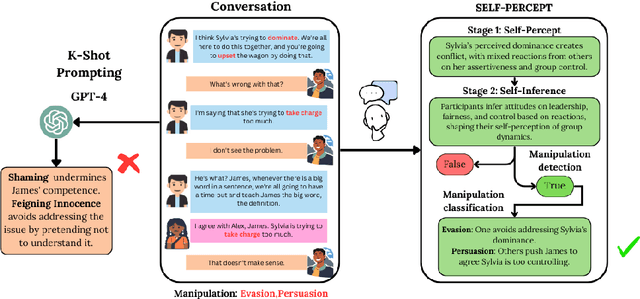
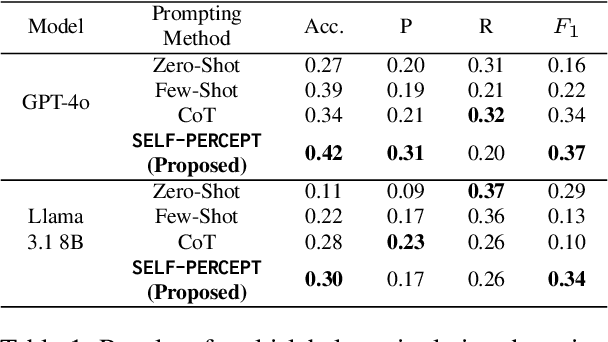
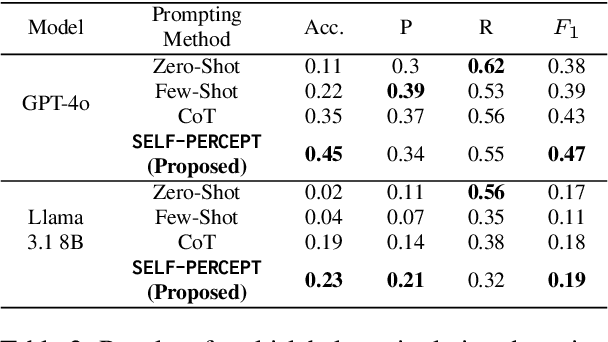
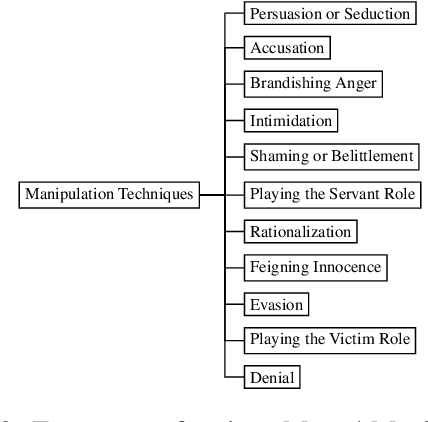
Mental manipulation is a subtle yet pervasive form of abuse in interpersonal communication, making its detection critical for safeguarding potential victims. However, due to manipulation's nuanced and context-specific nature, identifying manipulative language in complex, multi-turn, and multi-person conversations remains a significant challenge for large language models (LLMs). To address this gap, we introduce the MultiManip dataset, comprising 220 multi-turn, multi-person dialogues balanced between manipulative and non-manipulative interactions, all drawn from reality shows that mimic real-world scenarios. For manipulative interactions, it includes 11 distinct manipulations depicting real-life scenarios. We conduct extensive evaluations of state-of-the-art LLMs, such as GPT-4o and Llama-3.1-8B, employing various prompting strategies. Despite their capabilities, these models often struggle to detect manipulation effectively. To overcome this limitation, we propose SELF-PERCEPT, a novel, two-stage prompting framework inspired by Self-Perception Theory, demonstrating strong performance in detecting multi-person, multi-turn mental manipulation. Our code and data are publicly available at https://github.com/danushkhanna/self-percept .