 Add to Chrome
 Add to Firefox
 Add to Edge
Mechanistic Behavior Editing of Language Models
Oct 05, 2024
Large Language Models trained on web-scale text acquire language generation abilities that can solve a wide range of tasks, particularly when task knowledge is refined into the generative prior using in-context examples. However, spurious features learned from noisy data hinder their generalizability. Supervised finetuning can introduce task specificity, but introduce data inefficiency. Prior studies indicate that (i) noisy neural circuitries coexist with generalizable ones within LLMs, and (ii) finetuning typically enhances (or suppresses) existing abilities without introducing newer ones. Building upon these, we propose TaRot, a novel method for task adaptation. TaRot intervenes in the neural circuitries using learnable rotation matrices that are optimized using Bayesian Optimization, on labelled samples in the order of standard few-shot prompting examples. Experiments on multiple classification and generation tasks using LLMs of varying sizes reveal the efficacy of TaRot, improving upon both zero- as well as few-shot performance, with average improvements (across models and tasks) of 23.81% and 11.15%, respectively. The source code is available at https://github.com/joykirat18/TaRot

Hate Personified: Investigating the role of LLMs in content moderation
Oct 03, 2024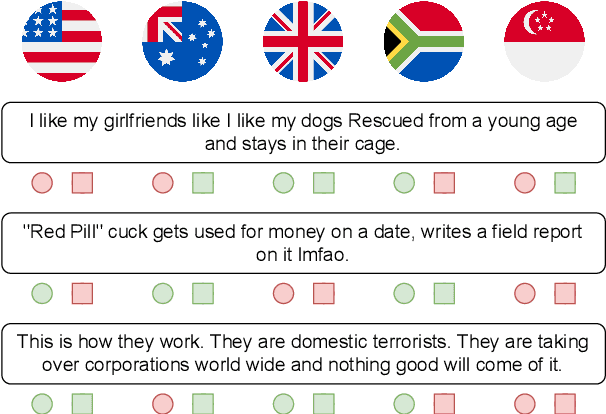
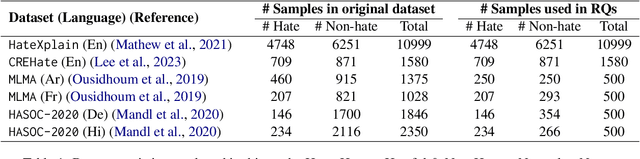
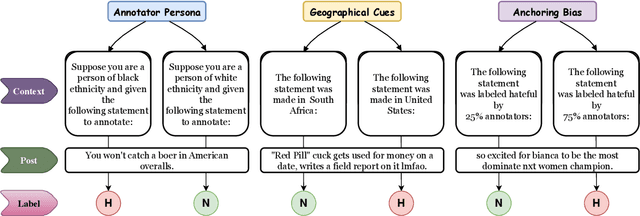
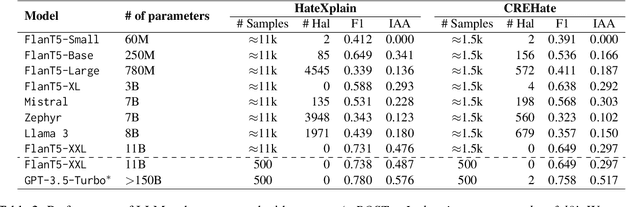
For subjective tasks such as hate detection, where people perceive hate differently, the Large Language Model's (LLM) ability to represent diverse groups is unclear. By including additional context in prompts, we comprehensively analyze LLM's sensitivity to geographical priming, persona attributes, and numerical information to assess how well the needs of various groups are reflected. Our findings on two LLMs, five languages, and six datasets reveal that mimicking persona-based attributes leads to annotation variability. Meanwhile, incorporating geographical signals leads to better regional alignment. We also find that the LLMs are sensitive to numerical anchors, indicating the ability to leverage community-based flagging efforts and exposure to adversaries. Our work provides preliminary guidelines and highlights the nuances of applying LLMs in culturally sensitive cases.
POSIX: A Prompt Sensitivity Index For Large Language Models
Oct 03, 2024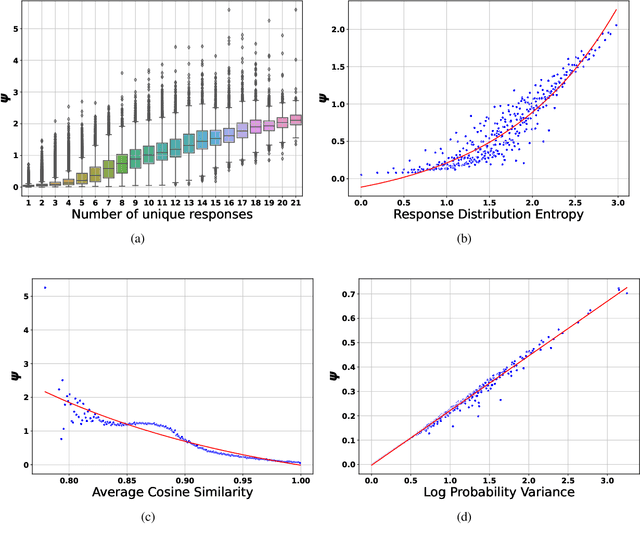
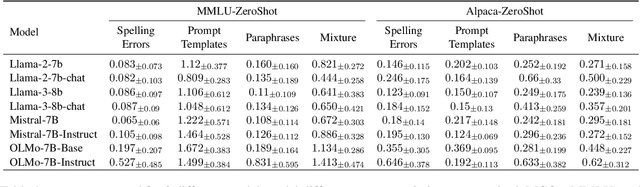
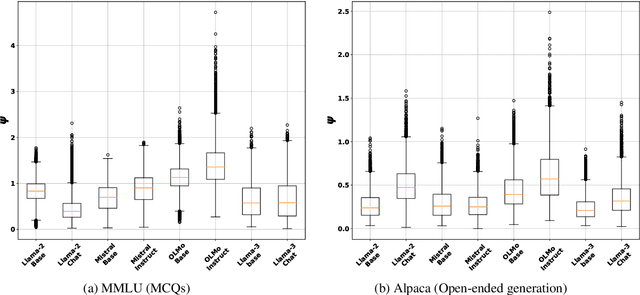
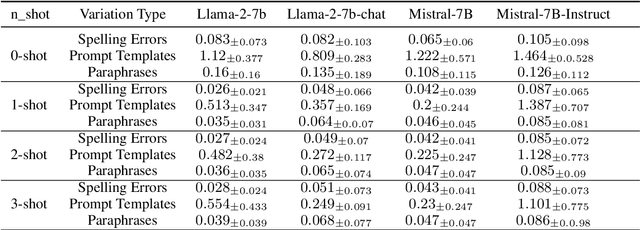
Despite their remarkable capabilities, Large Language Models (LLMs) are found to be surprisingly sensitive to minor variations in prompts, often generating significantly divergent outputs in response to minor variations in the prompts, such as spelling errors, alteration of wording or the prompt template. However, while assessing the quality of an LLM, the focus often tends to be solely on its performance on downstream tasks, while very little to no attention is paid to prompt sensitivity. To fill this gap, we propose POSIX - a novel PrOmpt Sensitivity IndeX as a reliable measure of prompt sensitivity, thereby offering a more comprehensive evaluation of LLM performance. The key idea behind POSIX is to capture the relative change in loglikelihood of a given response upon replacing the corresponding prompt with a different intent-preserving prompt. We provide thorough empirical evidence demonstrating the efficacy of POSIX in capturing prompt sensitivity and subsequently use it to measure and thereby compare prompt sensitivity of various open-source LLMs. We find that merely increasing the parameter count or instruction tuning does not necessarily reduce prompt sensitivity whereas adding some few-shot exemplars, even just one, almost always leads to significant decrease in prompt sensitivity. We also find that alterations to prompt template lead to the highest sensitivity in the case of MCQtype tasks, whereas paraphrasing results in the highest sensitivity in open-ended generation tasks. The code for reproducing our results is open-sourced at https://github.com/kowndinyarenduchintala/POSIX.
Large Language Model Predicts Above Normal All India Summer Monsoon Rainfall in 2024
Sep 25, 2024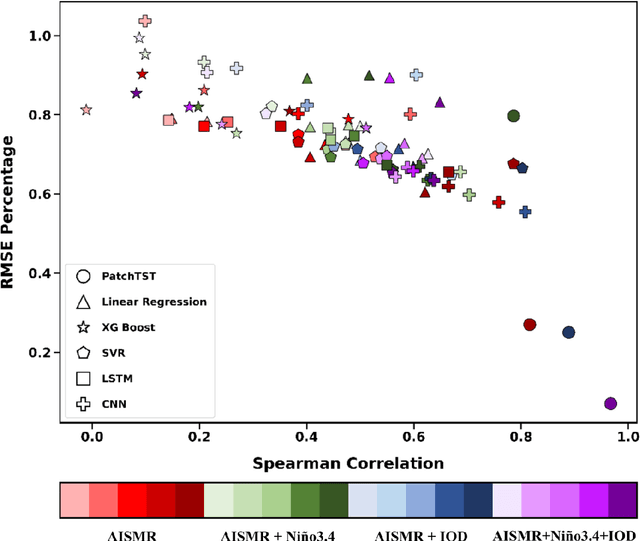
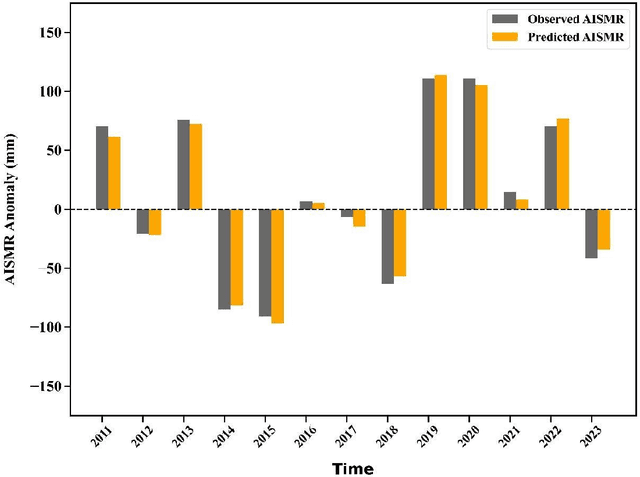
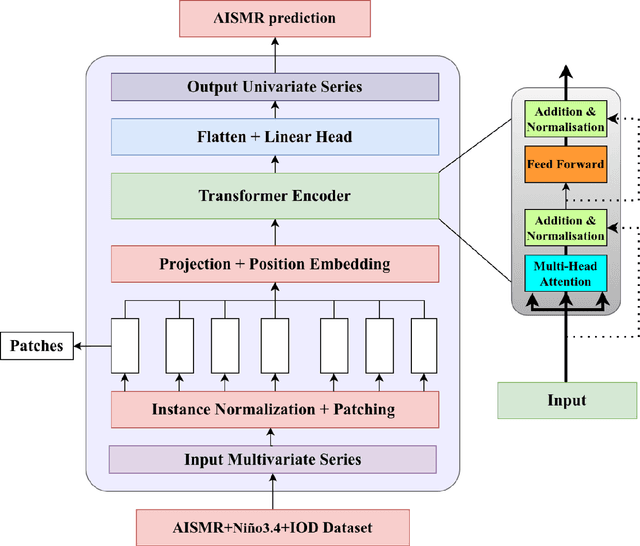
Reliable prediction of the All India Summer Monsoon Rainfall (AISMR) is pivotal for informed policymaking for the country, impacting the lives of billions of people. However, accurate simulation of AISMR has been a persistent challenge due to the complex interplay of various muti-scale factors and the inherent variability of the monsoon system. This research focuses on adapting and fine-tuning the latest LLM model, PatchTST, to accurately predict AISMR with a lead time of three months. The fine-tuned PatchTST model, trained with historical AISMR data, the Ni\~no3.4 index, and categorical Indian Ocean Dipole values, outperforms several popular neural network models and statistical models. This fine-tuned LLM model exhibits an exceptionally low RMSE percentage of 0.07% and a Spearman correlation of 0.976. This is particularly impressive, since it is nearly 80% more accurate than the best-performing NN models. The model predicts an above-normal monsoon for the year 2024, with an accumulated rainfall of 921.6 mm in the month of June-September for the entire country.
Temporally Consistent Factuality Probing for Large Language Models
Sep 21, 2024The prolific use of Large Language Models (LLMs) as an alternate knowledge base requires them to be factually consistent, necessitating both correctness and consistency traits for paraphrased queries. Recently, significant attempts have been made to benchmark datasets and metrics to evaluate LLMs for these traits. However, structural simplicity (subject-relation-object) and contemporary association in their query formulation limit the broader definition of factuality and consistency. In this study, we introduce TeCFaP, a novel Temporally Consistent Factuality Probe task to expand the consistent factuality probe in the temporal dimension. To this end, we propose TEMP-COFAC, a high-quality dataset of prefix-style English query paraphrases. Subsequently, we extend the definitions of existing metrics to represent consistent factuality across temporal dimension. We experiment with a diverse set of LLMs and find most of them performing poorly on TeCFaP. Next, we propose a novel solution CoTSeLF (Consistent-Time-Sensitive Learning Framework) combining multi-task instruction tuning (MT-IT) with consistent-time-sensitive reinforcement learning (CTSRL) to improve temporally consistent factuality in LLMs. Our experiments demonstrate the efficacy of CoTSeLF over several baselines.
Can LLMs replace Neil deGrasse Tyson? Evaluating the Reliability of LLMs as Science Communicators
Sep 21, 2024Large Language Models (LLMs) and AI assistants driven by these models are experiencing exponential growth in usage among both expert and amateur users. In this work, we focus on evaluating the reliability of current LLMs as science communicators. Unlike existing benchmarks, our approach emphasizes assessing these models on scientific questionanswering tasks that require a nuanced understanding and awareness of answerability. We introduce a novel dataset, SCiPS-QA, comprising 742 Yes/No queries embedded in complex scientific concepts, along with a benchmarking suite that evaluates LLMs for correctness and consistency across various criteria. We benchmark three proprietary LLMs from the OpenAI GPT family and 13 open-access LLMs from the Meta Llama-2, Llama-3, and Mistral families. While most open-access models significantly underperform compared to GPT-4 Turbo, our experiments identify Llama-3-70B as a strong competitor, often surpassing GPT-4 Turbo in various evaluation aspects. We also find that even the GPT models exhibit a general incompetence in reliably verifying LLM responses. Moreover, we observe an alarming trend where human evaluators are deceived by incorrect responses from GPT-4 Turbo.
Step-by-Step Unmasking for Parameter-Efficient Fine-tuning of Large Language Models
Aug 27, 2024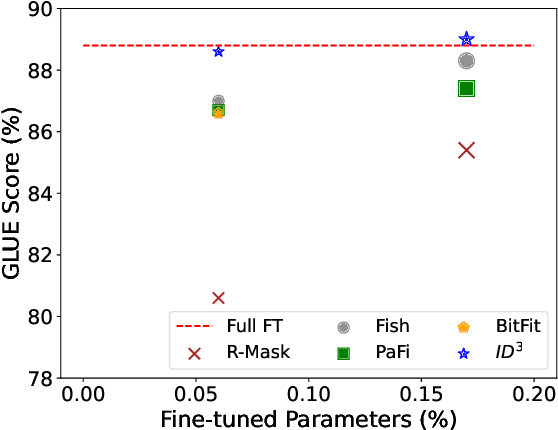
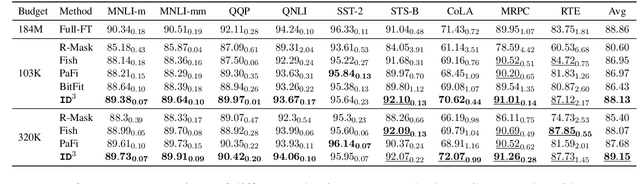
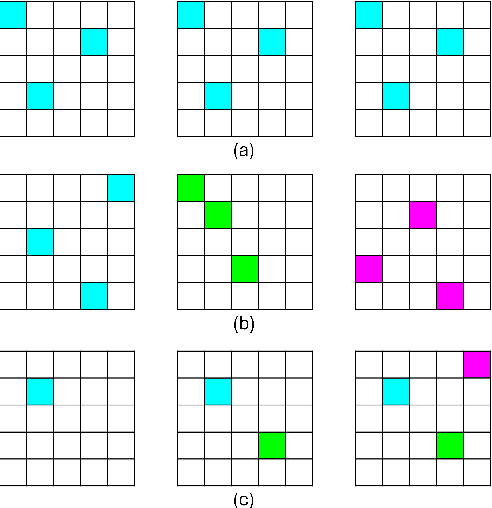

Fine-tuning large language models (LLMs) on downstream tasks requires substantial computational resources. A class of parameter-efficient fine-tuning (PEFT) aims to mitigate these computational challenges by selectively fine-tuning only a small fraction of the model parameters. Although computationally efficient, these techniques often fail to match the performance of fully fine-tuned models, primarily due to inherent biases introduced during parameter selection. Traditional selective PEFT techniques use a fixed set of parameters based on a predefined budget (a process also known as unmasking), failing to capture parameter importance dynamically and often ending up exceeding the budget. We introduce $\text{ID}^3$, a novel selective PEFT method that calculates parameter importance continually and dynamically unmasks parameters by balancing exploration and exploitation in parameter selection. Our empirical study on 15 tasks spanning natural language understanding and generative tasks demonstrates the effectiveness of our method compared to fixed-masking-based PEFT techniques. We analytically show that $\text{ID}^3$ reduces the number of gradient updates by a factor of two, enhancing computational efficiency. $\text{ID}^3$ is robust to random initialization of neurons and, therefore, can be seamlessly integrated into existing additive and reparametrization-based PEFT modules such as adapters and LoRA for dynamic sparsification.
Multilingual Needle in a Haystack: Investigating Long-Context Behavior of Multilingual Large Language Models
Aug 19, 2024While recent large language models (LLMs) demonstrate remarkable abilities in responding to queries in diverse languages, their ability to handle long multilingual contexts is unexplored. As such, a systematic evaluation of the long-context capabilities of LLMs in multilingual settings is crucial, specifically in the context of information retrieval. To address this gap, we introduce the MultiLingual Needle-in-a-Haystack (MLNeedle) test, designed to assess a model's ability to retrieve relevant information (the needle) from a collection of multilingual distractor texts (the haystack). This test serves as an extension of the multilingual question-answering task, encompassing both monolingual and cross-lingual retrieval. We evaluate four state-of-the-art LLMs on MLNeedle. Our findings reveal that model performance can vary significantly with language and needle position. Specifically, we observe that model performance is the lowest when the needle is (i) in a language outside the English language family and (ii) located in the middle of the input context. Furthermore, although some models claim a context size of $8k$ tokens or greater, none demonstrate satisfactory cross-lingual retrieval performance as the context length increases. Our analysis provides key insights into the long-context behavior of LLMs in multilingual settings to guide future evaluation protocols. To our knowledge, this is the first study to investigate the multilingual long-context behavior of LLMs.
Crowd Intelligence for Early Misinformation Prediction on Social Media
Aug 08, 2024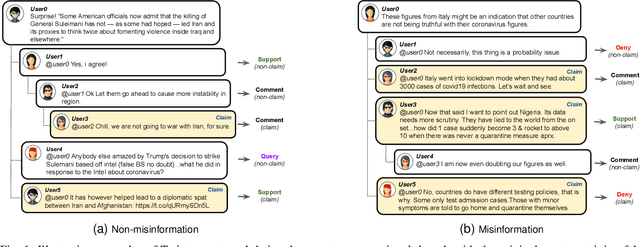
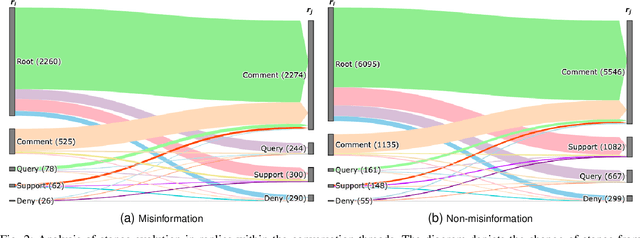
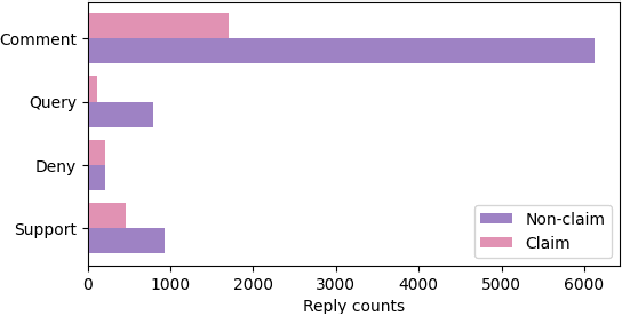

Misinformation spreads rapidly on social media, causing serious damage by influencing public opinion, promoting dangerous behavior, or eroding trust in reliable sources. It spreads too fast for traditional fact-checking, stressing the need for predictive methods. We introduce CROWDSHIELD, a crowd intelligence-based method for early misinformation prediction. We hypothesize that the crowd's reactions to misinformation reveal its accuracy. Furthermore, we hinge upon exaggerated assertions/claims and replies with particular positions/stances on the source post within a conversation thread. We employ Q-learning to capture the two dimensions -- stances and claims. We utilize deep Q-learning due to its proficiency in navigating complex decision spaces and effectively learning network properties. Additionally, we use a transformer-based encoder to develop a comprehensive understanding of both content and context. This multifaceted approach helps ensure the model pays attention to user interaction and stays anchored in the communication's content. We propose MIST, a manually annotated misinformation detection Twitter corpus comprising nearly 200 conversation threads with more than 14K replies. In experiments, CROWDSHIELD outperformed ten baseline systems, achieving an improvement of ~4% macro-F1 score. We conduct an ablation study and error analysis to validate our proposed model's performance. The source code and dataset are available at https://github.com/LCS2-IIITD/CrowdShield.git.
PerSEval: Assessing Personalization in Text Summarizers
Jun 29, 2024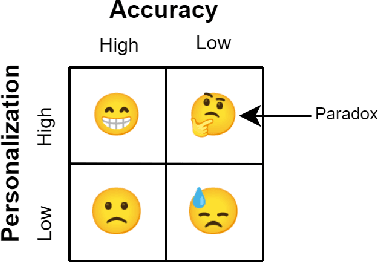


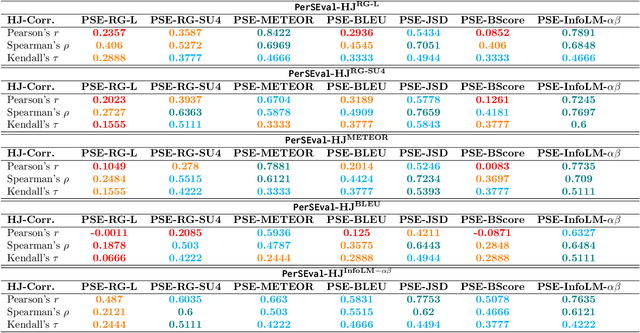
Personalized summarization models cater to individuals' subjective understanding of saliency, as represented by their reading history and current topics of attention. Existing personalized text summarizers are primarily evaluated based on accuracy measures such as BLEU, ROUGE, and METEOR. However, a recent study argued that accuracy measures are inadequate for evaluating the degree of personalization of these models and proposed EGISES, the first metric to evaluate personalized text summaries. It was suggested that accuracy is a separate aspect and should be evaluated standalone. In this paper, we challenge the necessity of an accuracy leaderboard, suggesting that relying on accuracy-based aggregated results might lead to misleading conclusions. To support this, we delve deeper into EGISES, demonstrating both theoretically and empirically that it measures the degree of responsiveness, a necessary but not sufficient condition for degree-of-personalization. We subsequently propose PerSEval, a novel measure that satisfies the required sufficiency condition. Based on the benchmarking of ten SOTA summarization models on the PENS dataset, we empirically establish that -- (i) PerSEval is reliable w.r.t human-judgment correlation (Pearson's r = 0.73; Spearman's $\rho$ = 0.62; Kendall's $\tau$ = 0.42), (ii) PerSEval has high rank-stability, (iii) PerSEval as a rank-measure is not entailed by EGISES-based ranking, and (iv) PerSEval can be a standalone rank-measure without the need of any aggregated ranking.