 Add to Chrome
 Add to Firefox
 Add to Edge
Enabling Federated Inference via Unsupervised Consensus Embedding
May 07, 2026
Cooperative inference across independently deployed machine learning models is increasingly desirable in distributed environments, as there is a growing need to leverage multiple models while keeping their data and model parameters private. However, existing cooperative frameworks typically rely on sharing input data, model parameters, or a common encoder, which limits their applicability in privacy-sensitive or cross-organizational settings. To address this challenge, we propose Consensus Embedding-based Federated Inference (CE-FI), a framework that enables pretrained models to cooperate at inference time without sharing model parameters or raw inputs and without assuming a common encoder. CE-FI introduces two components: a Consensus Embedding (CE) layer that maps heterogeneous intermediate representations into a common embedding space, and a Cooperative Output (CO) layer that produces predictions from these embeddings. Both layers are trained using shared unlabeled data only, so the cooperative stage does not require additional labeled data. Experiments on image classification benchmarks -- CIFAR-10 and CIFAR-100 -- under diverse non-IID conditions show that CE-FI consistently outperforms solo inference and performs comparably to conventional methods that require stronger sharing assumptions. Additional evaluations on text and time-series tasks indicate applicability beyond image classification, although performance depends on the ensemble strategy. Further analysis identifies representation alignment as the primary bottleneck.

Spatiotemporal Hidden-State Dynamics as a Signature of Internal Reasoning in Large Language Models
May 03, 2026Large reasoning models (LRMs) generate extended solutions, yet it remains unclear whether these traces reflect substantive internal computation or merely verbosity and overthinking. Although recent hidden-state analyses suggest that internal representations carry correctness-related signals, their coarse aggregations may obscure the token and layer structure underlying reasoning computation. We investigate hidden-state transitions across decoding steps and layers, and identify a distinct spatiotemporal pattern in LRMs: successful trajectories exhibit broad temporal dynamics with localized layer-wise concentration, while this structure is weaker in non-reasoning models and knowledge-heavy domains. We formalize this characteristic as Spatiotemporal Amplitude of Latent Transition (StALT), a training-free trajectory statistic that summarizes temporal changes between adjacent tokens weighted by within-token layer saliency. Across diverse models and benchmarks, StALT reliably separates correct from incorrect trajectories in reasoning-intensive regimes, providing a competitive label-free correctness signal alongside strong output-space and length-based baselines. Intervention analyses further show that this spatiotemporal amplitude responds systematically to manipulations that increase or reduce the demand for internal reasoning, supporting its association with latent reasoning dynamics in LRMs. These findings provide empirical evidence that LRMs exhibit measurable hidden-state dynamics and offer a practical probe for understanding internal computation beyond output-based evaluation.
Soft-Label Caching and Sharpening for Communication-Efficient Federated Distillation
May 01, 2025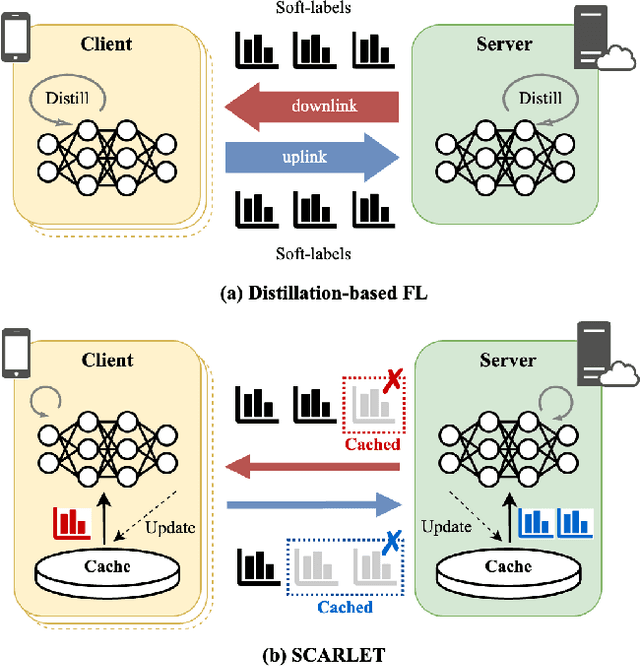
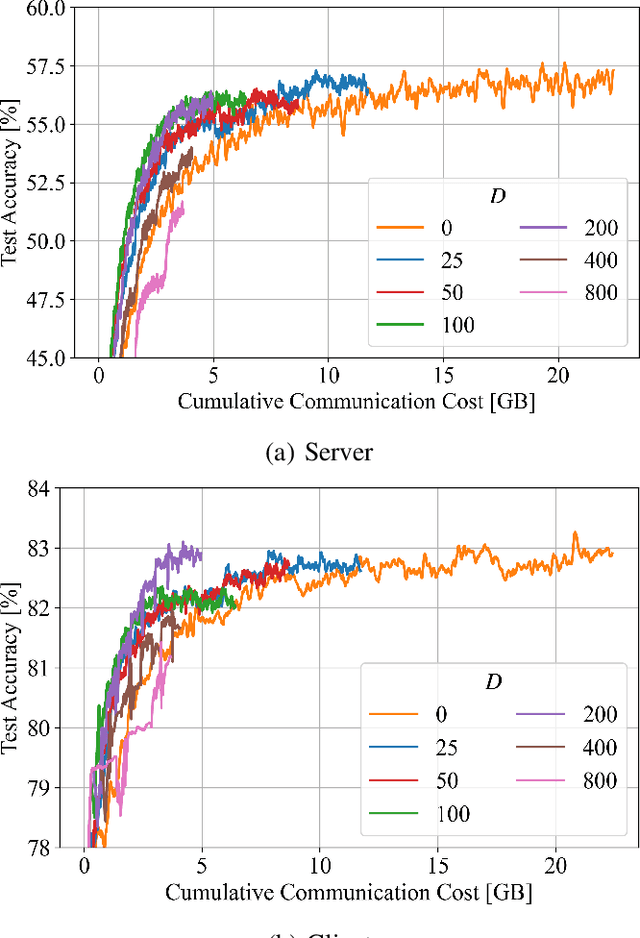
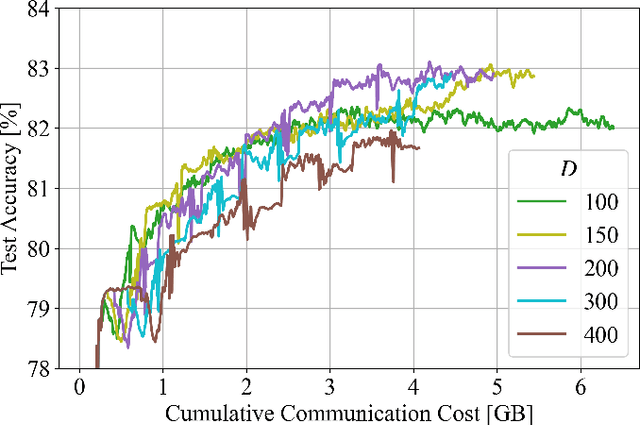
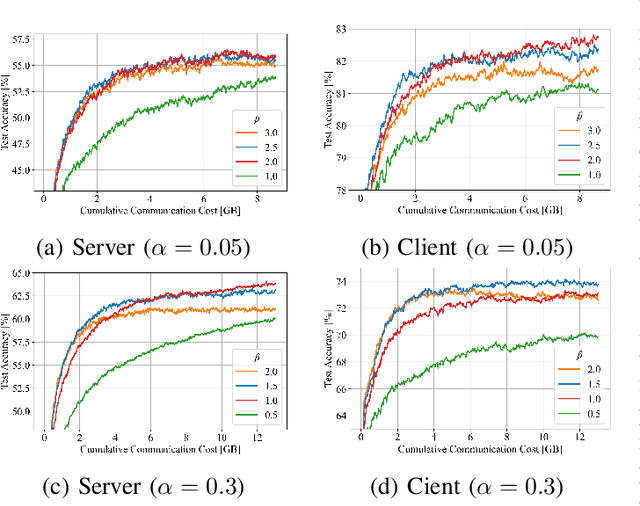
Federated Learning (FL) enables collaborative model training across decentralized clients, enhancing privacy by keeping data local. Yet conventional FL, relying on frequent parameter-sharing, suffers from high communication overhead and limited model heterogeneity. Distillation-based FL approaches address these issues by sharing predictions (soft-labels) instead, but they often involve redundant transmissions across communication rounds, reducing efficiency. We propose SCARLET, a novel framework integrating synchronized soft-label caching and an enhanced Entropy Reduction Aggregation (Enhanced ERA) mechanism. SCARLET minimizes redundant communication by reusing cached soft-labels, achieving up to 50% reduction in communication costs compared to existing methods while maintaining accuracy. Enhanced ERA can be tuned to adapt to non-IID data variations, ensuring robust aggregation and performance in diverse client scenarios. Experimental evaluations demonstrate that SCARLET consistently outperforms state-of-the-art distillation-based FL methods in terms of accuracy and communication efficiency. The implementation of SCARLET is publicly available at https://github.com/kitsuyaazuma/SCARLET.