 Add to Chrome
 Add to Firefox
 Add to Edge
BlazeFL: Fast and Deterministic Federated Learning Simulation
Apr 04, 2026
Federated learning (FL) research increasingly relies on single-node simulations with hundreds or thousands of virtual clients, making both efficiency and reproducibility essential. Yet parallel client training often introduces nondeterminism through shared random state and scheduling variability, forcing researchers to trade throughput for reproducibility or to implement custom control logic within complex frameworks. We present BlazeFL, a lightweight framework for single-node FL simulation that alleviates this trade-off through free-threaded shared-memory execution and deterministic randomness management. BlazeFL uses thread-based parallelism with in-memory parameter exchange between the server and clients, avoiding serialization and inter-process communication overhead. To support deterministic execution, BlazeFL assigns isolated random number generator (RNG) streams to clients. Under a fixed software/hardware stack, and when stochastic operators consume BlazeFL-managed generators, this design yields bitwise-identical results across repeated high-concurrency runs in both thread-based and process-based modes. In CIFAR-10 image-classification experiments, BlazeFL substantially reduces execution time relative to a widely used open-source baseline, achieving up to 3.1$\times$ speedup on communication-dominated workloads while preserving a lightweight dependency footprint. Our open-source implementation is available at: https://github.com/kitsuyaazuma/blazefl.

Soft-Label Caching and Sharpening for Communication-Efficient Federated Distillation
May 01, 2025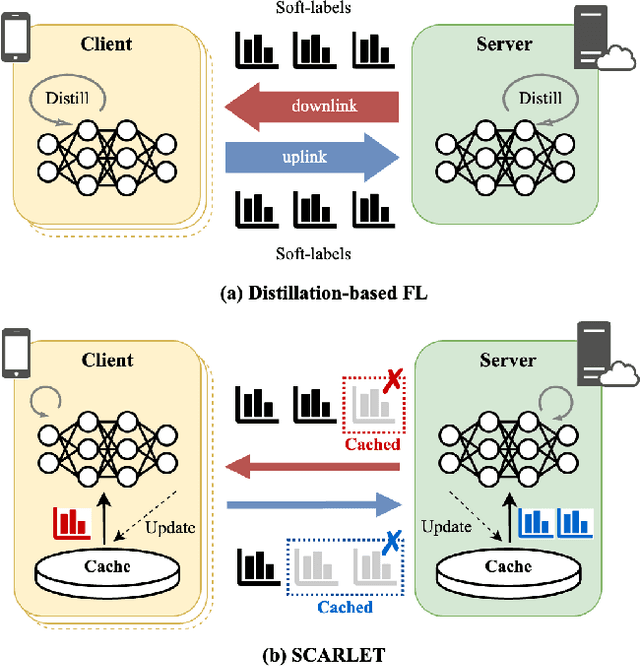
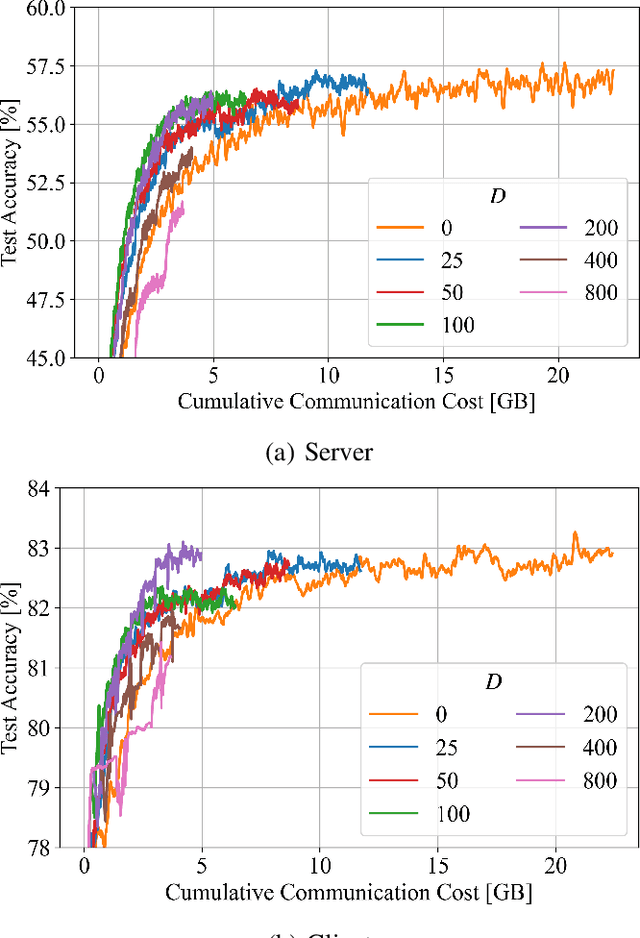
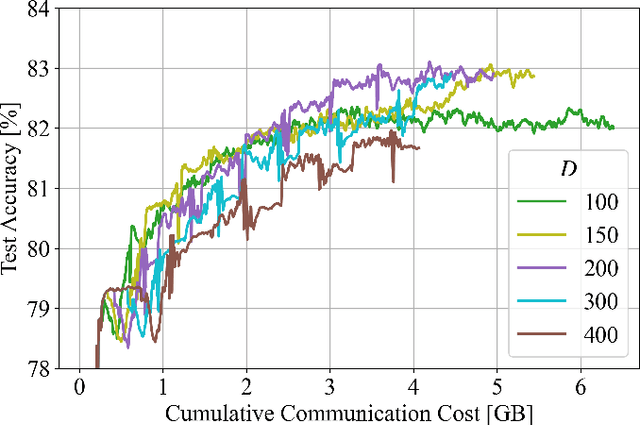
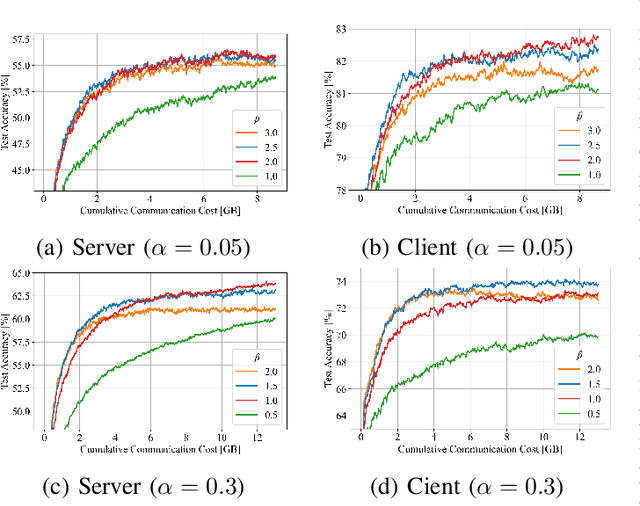
Federated Learning (FL) enables collaborative model training across decentralized clients, enhancing privacy by keeping data local. Yet conventional FL, relying on frequent parameter-sharing, suffers from high communication overhead and limited model heterogeneity. Distillation-based FL approaches address these issues by sharing predictions (soft-labels) instead, but they often involve redundant transmissions across communication rounds, reducing efficiency. We propose SCARLET, a novel framework integrating synchronized soft-label caching and an enhanced Entropy Reduction Aggregation (Enhanced ERA) mechanism. SCARLET minimizes redundant communication by reusing cached soft-labels, achieving up to 50% reduction in communication costs compared to existing methods while maintaining accuracy. Enhanced ERA can be tuned to adapt to non-IID data variations, ensuring robust aggregation and performance in diverse client scenarios. Experimental evaluations demonstrate that SCARLET consistently outperforms state-of-the-art distillation-based FL methods in terms of accuracy and communication efficiency. The implementation of SCARLET is publicly available at https://github.com/kitsuyaazuma/SCARLET.