 Add to Chrome
 Add to Firefox
 Add to Edge
DrugRAG: Enhancing Pharmacy LLM Performance Through A Novel Retrieval-Augmented Generation Pipeline
Dec 16, 2025
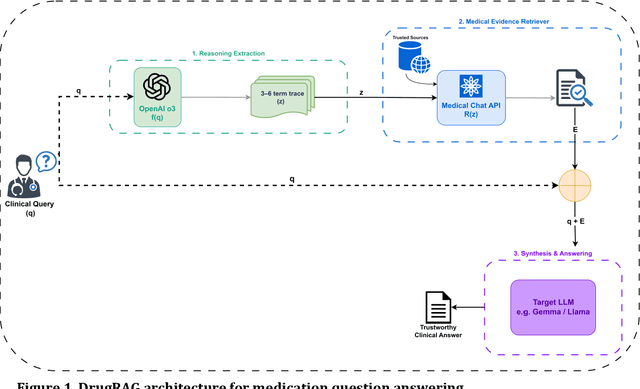
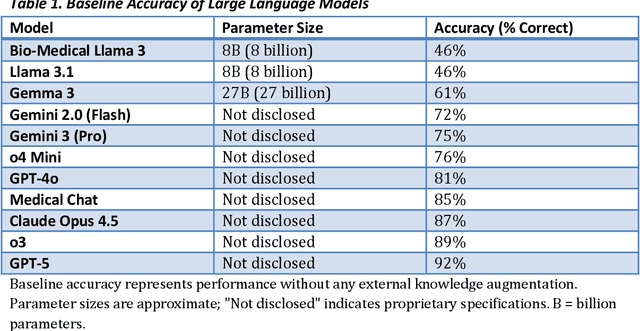
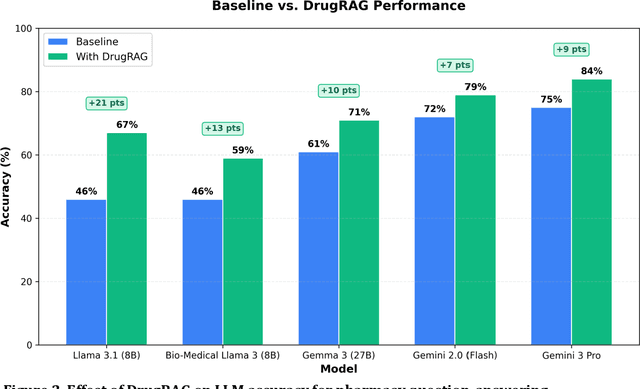
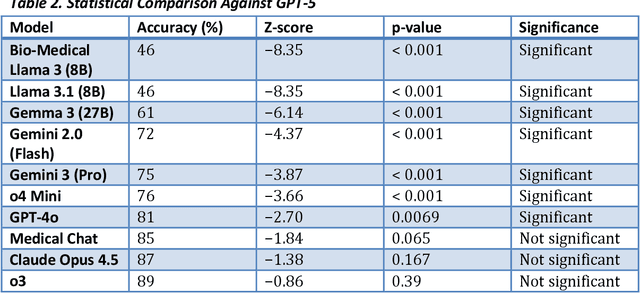
Objectives: To evaluate large language model (LLM) performance on pharmacy licensure-style question-answering (QA) tasks and develop an external knowledge integration method to improve their accuracy. Methods: We benchmarked eleven existing LLMs with varying parameter sizes (8 billion to 70+ billion) using a 141-question pharmacy dataset. We measured baseline accuracy for each model without modification. We then developed a three-step retrieval-augmented generation (RAG) pipeline, DrugRAG, that retrieves structured drug knowledge from validated sources and augments model prompts with evidence-based context. This pipeline operates externally to the models, requiring no changes to model architecture or parameters. Results: Baseline accuracy ranged from 46% to 92%, with GPT-5 (92%) and o3 (89%) achieving the highest scores. Models with fewer than 8 billion parameters scored below 50%. DrugRAG improved accuracy across all tested models, with gains ranging from 7 to 21 percentage points (e.g., Gemma 3 27B: 61% to 71%, Llama 3.1 8B: 46% to 67%) on the 141-item benchmark. Conclusion: We demonstrate that external structured drug knowledge integration through DrugRAG measurably improves LLM accuracy on pharmacy tasks without modifying the underlying models. This approach provides a practical pipeline for enhancing pharmacy-focused AI applications with evidence-based information.

CovidCTNet: An Open-Source Deep Learning Approach to Identify Covid-19 Using CT Image
May 16, 2020Coronavirus disease 2019 (Covid-19) is highly contagious with limited treatment options. Early and accurate diagnosis of Covid-19 is crucial in reducing the spread of the disease and its accompanied mortality. Currently, detection by reverse transcriptase polymerase chain reaction (RT-PCR) is the gold standard of outpatient and inpatient detection of Covid-19. RT-PCR is a rapid method, however, its accuracy in detection is only ~70-75%. Another approved strategy is computed tomography (CT) imaging. CT imaging has a much higher sensitivity of ~80-98%, but similar accuracy of 70%. To enhance the accuracy of CT imaging detection, we developed an open-source set of algorithms called CovidCTNet that successfully differentiates Covid-19 from community-acquired pneumonia (CAP) and other lung diseases. CovidCTNet increases the accuracy of CT imaging detection to 90% compared to radiologists (70%). The model is designed to work with heterogeneous and small sample sizes independent of the CT imaging hardware. In order to facilitate the detection of Covid-19 globally and assist radiologists and physicians in the screening process, we are releasing all algorithms and parametric details in an open-source format. Open-source sharing of our CovidCTNet enables developers to rapidly improve and optimize services, while preserving user privacy and data ownership.