 Add to Chrome
 Add to Firefox
 Add to Edge
Fixed-Point Reasoners: Stable and Adaptive Deep Looped Transformers
Jun 16, 2026
Looped architectures provide an inductive bias toward learning step-by-step procedures for tasks that require compositional reasoning. The number of effective layers reached by looping determines the quality of the solution these models find. Like deep architectures, looped architectures are prone to a signal propagation problem induced by depth as the halting decision is postponed. In this paper, we address this signal propagation issue using pre-norm layers and residual scaling. Building on these architectural modifications, we propose FPRM, a Transformer-based Fixed-Point Reasoning Model that uses fixed-point convergence as an end-to-end halting mechanism in a looped architecture. We show that fixed-point halting allows FPRM to adapt its compute to task difficulty. FPRM is effective on common reasoning benchmarks, namely Sudoku, Maze, state-tracking, and ARC-AGI.

AlphaQ: Calibration-Free Bit Allocation for Mixture-of-Experts Quantization
Jun 03, 2026Mixture-of-Experts (MoE) architectures scale model capacity through sparse expert activation, but their deployment remains memory-bound because all expert weights must reside in memory. Mixed-precision quantization can substantially reduce this footprint by assigning different bit-widths to different experts. Existing approaches, however, typically rely on calibration data to estimate expert importance and determine bit allocation. For frontier MoE LLMs, the original training data, and hence the true training distribution, is proprietary and inaccessible. As a result, calibration sets are inevitably imperfect surrogates, and this can misestimate expert utilization and lead to suboptimal bit allocation. Motivated by the substantial cross-expert quality variability observed in modern MoE models, and by the success of Heavy-Tailed Self-Regularization (HT-SR) theory at predicting neural network model quality without access to training or testing data, we propose AlphaQ, a calibration-free bit-allocation method for MoE quantization. AlphaQ draws on HT-SR theory and follows a simple principle: experts with more heavy-tailed weight spectra are typically better trained and hence should receive higher bit-widths, while experts with weaker heavy-tailed structure can be quantized more aggressively. AlphaQ operationalizes this principle by measuring expert-wise spectral heavy-tailedness and solving a budget-constrained optimization problem that minimizes total quantization error under a global bit-budget constraint. Across several MoE models, AlphaQ consistently outperforms calibration-based baselines under matched bit budgets. Notably, on Qwen1.5-MoE, AlphaQ achieves near full-precision accuracy with an average expert precision of only 3.5 bits, while delivering more than 4$\times$ memory compression. Our code is available at https://github.com/Superone77/AlphaQ.
Low-Pass Flow Matching
Jun 01, 2026Flow Matching typically relies on white noise sources, a choice often misaligned with the power spectra of natural data, which tend to decay with frequency. To address this, we introduce Low-Pass Flow Matching, a variant of Flow Matching based on an operator-modulated interpolant. This formulation induces a time-varying spectral bias that transitions from the source spectrum to a frequency-decaying bias as the path approaches the data. We validate our method on unconditional image generation tasks, including the scientific Galaxy10 dataset. Empirically, we show that our method is particularly effective when paired with adaptive ODE solvers, where it improves or preserves sample quality while substantially reducing sampling cost compared to standard baselines.
The Key to State Reduction in Linear Attention: A Rank-based Perspective
Feb 04, 2026Linear attention offers a computationally efficient yet expressive alternative to softmax attention. However, recent empirical results indicate that the state of trained linear attention models often exhibits a low-rank structure, suggesting that these models underexploit their capacity in practice. To illuminate this phenomenon, we provide a theoretical analysis of the role of rank in linear attention, revealing that low effective rank can affect retrieval error by amplifying query noise. In addition to these theoretical insights, we conjecture that the low-rank states can be substantially reduced post-training with only minimal performance degradation, yielding faster and more memory-efficient models. To this end, we propose a novel hardware-aware approach that structurally prunes key and query matrices, reducing the state size while retaining compatibility with existing CUDA kernels. We adapt several existing pruning strategies to fit our framework and, building on our theoretical analysis, propose a novel structured pruning method based on a rank-revealing QR decomposition. Our empirical results, evaluated across models of varying sizes and on various downstream tasks, demonstrate the effectiveness of our state reduction framework. We highlight that our framework enables the removal of 50% of the query and key channels at only a marginal increase in perplexity. The code for this project can be found at https://github.com/camail-official/LinearAttentionPruning.
Learning to Dissipate Energy in Oscillatory State-Space Models
May 17, 2025State-space models (SSMs) are a class of networks for sequence learning that benefit from fixed state size and linear complexity with respect to sequence length, contrasting the quadratic scaling of typical attention mechanisms. Inspired from observations in neuroscience, Linear Oscillatory State-Space models (LinOSS) are a recently proposed class of SSMs constructed from layers of discretized forced harmonic oscillators. Although these models perform competitively, leveraging fast parallel scans over diagonal recurrent matrices and achieving state-of-the-art performance on tasks with sequence length up to 50k, LinOSS models rely on rigid energy dissipation ("forgetting") mechanisms that are inherently coupled to the timescale of state evolution. As forgetting is a crucial mechanism for long-range reasoning, we demonstrate the representational limitations of these models and introduce Damped Linear Oscillatory State-Space models (D-LinOSS), a more general class of oscillatory SSMs that learn to dissipate latent state energy on multiple timescales. We analyze the spectral distribution of the model's recurrent matrices and prove that the SSM layers exhibit stable dynamics under simple, flexible parameterizations. D-LinOSS consistently outperforms previous LinOSS methods on long-range learning tasks, without introducing additional complexity, and simultaneously reduces the hyperparameter search space by 50%.
Low Stein Discrepancy via Message-Passing Monte Carlo
Mar 27, 2025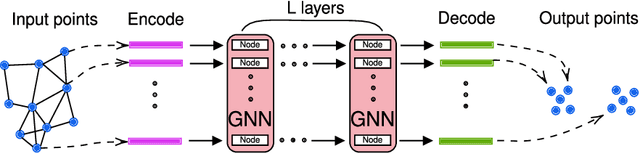
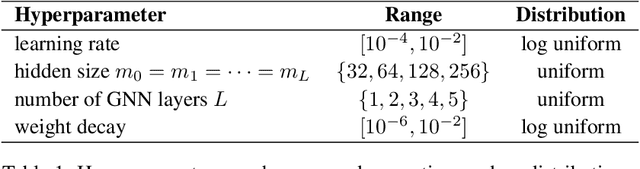
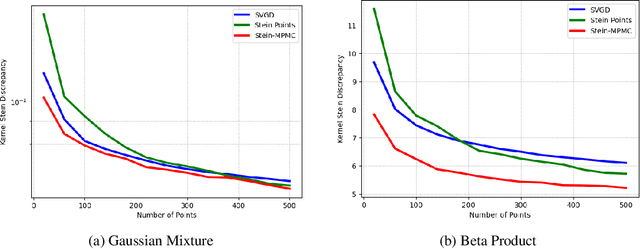
Message-Passing Monte Carlo (MPMC) was recently introduced as a novel low-discrepancy sampling approach leveraging tools from geometric deep learning. While originally designed for generating uniform point sets, we extend this framework to sample from general multivariate probability distributions with known probability density function. Our proposed method, Stein-Message-Passing Monte Carlo (Stein-MPMC), minimizes a kernelized Stein discrepancy, ensuring improved sample quality. Finally, we show that Stein-MPMC outperforms competing methods, such as Stein Variational Gradient Descent and (greedy) Stein Points, by achieving a lower Stein discrepancy.
Relaxed Equivariance via Multitask Learning
Oct 23, 2024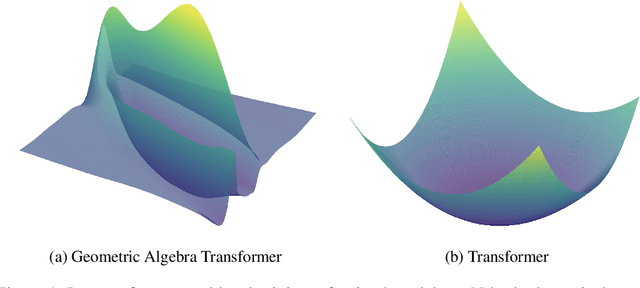

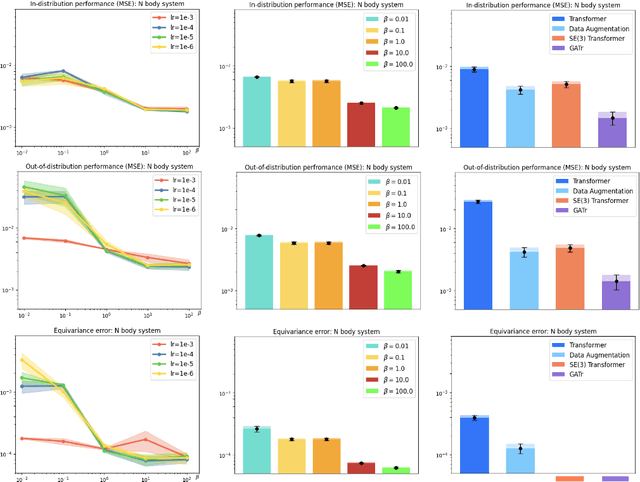

Incorporating equivariance as an inductive bias into deep learning architectures to take advantage of the data symmetry has been successful in multiple applications, such as chemistry and dynamical systems. In particular, roto-translations are crucial for effectively modeling geometric graphs and molecules, where understanding the 3D structures enhances generalization. However, equivariant models often pose challenges due to their high computational complexity. In this paper, we introduce REMUL, a training procedure for approximating equivariance with multitask learning. We show that unconstrained models (which do not build equivariance into the architecture) can learn approximate symmetries by minimizing an additional simple equivariance loss. By formulating equivariance as a new learning objective, we can control the level of approximate equivariance in the model. Our method achieves competitive performance compared to equivariant baselines while being $10 \times$ faster at inference and $2.5 \times$ at training.
Improving Efficiency of Sampling-based Motion Planning via Message-Passing Monte Carlo
Oct 04, 2024Sampling-based motion planning methods, while effective in high-dimensional spaces, often suffer from inefficiencies due to irregular sampling distributions, leading to suboptimal exploration of the configuration space. In this paper, we propose an approach that enhances the efficiency of these methods by utilizing low-discrepancy distributions generated through Message-Passing Monte Carlo (MPMC). MPMC leverages Graph Neural Networks (GNNs) to generate point sets that uniformly cover the space, with uniformity assessed using the the $\cL_p$-discrepancy measure, which quantifies the irregularity of sample distributions. By improving the uniformity of the point sets, our approach significantly reduces computational overhead and the number of samples required for solving motion planning problems. Experimental results demonstrate that our method outperforms traditional sampling techniques in terms of planning efficiency.
Oscillatory State-Space Models
Oct 04, 2024We propose Linear Oscillatory State-Space models (LinOSS) for efficiently learning on long sequences. Inspired by cortical dynamics of biological neural networks, we base our proposed LinOSS model on a system of forced harmonic oscillators. A stable discretization, integrated over time using fast associative parallel scans, yields the proposed state-space model. We prove that LinOSS produces stable dynamics only requiring nonnegative diagonal state matrix. This is in stark contrast to many previous state-space models relying heavily on restrictive parameterizations. Moreover, we rigorously show that LinOSS is universal, i.e., it can approximate any continuous and causal operator mapping between time-varying functions, to desired accuracy. In addition, we show that an implicit-explicit discretization of LinOSS perfectly conserves the symmetry of time reversibility of the underlying dynamics. Together, these properties enable efficient modeling of long-range interactions, while ensuring stable and accurate long-horizon forecasting. Finally, our empirical results, spanning a wide range of time-series tasks from mid-range to very long-range classification and regression, as well as long-horizon forecasting, demonstrate that our proposed LinOSS model consistently outperforms state-of-the-art sequence models. Notably, LinOSS outperforms Mamba by nearly 2x and LRU by 2.5x on a sequence modeling task with sequences of length 50k.
Message-Passing Monte Carlo: Generating low-discrepancy point sets via Graph Neural Networks
May 23, 2024

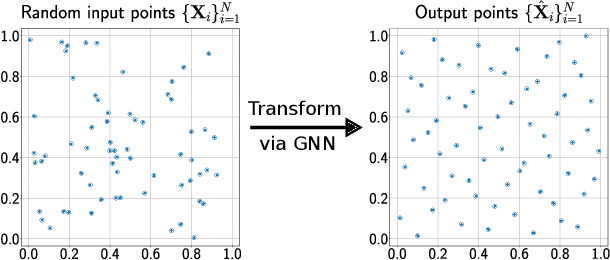

Discrepancy is a well-known measure for the irregularity of the distribution of a point set. Point sets with small discrepancy are called low-discrepancy and are known to efficiently fill the space in a uniform manner. Low-discrepancy points play a central role in many problems in science and engineering, including numerical integration, computer vision, machine perception, computer graphics, machine learning, and simulation. In this work, we present the first machine learning approach to generate a new class of low-discrepancy point sets named Message-Passing Monte Carlo (MPMC) points. Motivated by the geometric nature of generating low-discrepancy point sets, we leverage tools from Geometric Deep Learning and base our model on Graph Neural Networks. We further provide an extension of our framework to higher dimensions, which flexibly allows the generation of custom-made points that emphasize the uniformity in specific dimensions that are primarily important for the particular problem at hand. Finally, we demonstrate that our proposed model achieves state-of-the-art performance superior to previous methods by a significant margin. In fact, MPMC points are empirically shown to be either optimal or near-optimal with respect to the discrepancy for every dimension and the number of points for which the optimal discrepancy can be determined.