 Add to Chrome
 Add to Firefox
 Add to Edge
A Bayesian Approach to Low-Discrepancy Subset Selection
Feb 16, 2026
Low-discrepancy designs play a central role in quasi-Monte Carlo methods and are increasingly influential in other domains such as machine learning, robotics and computer graphics, to name a few. In recent years, one such low-discrepancy construction method called subset selection has received a lot of attention. Given a large population, one optimally selects a small low-discrepancy subset with respect to a discrepancy-based objective. Versions of this problem are known to be NP-hard. In this text, we establish, for the first time, that the subset selection problem with respect to kernel discrepancies is also NP-hard. Motivated by this intractability, we propose a Bayesian Optimization procedure for the subset selection problem utilizing the recent notion of deep embedding kernels. We demonstrate the performance of the BO algorithm to minimize discrepancy measures and note that the framework is broadly applicable any design criteria.

Low Stein Discrepancy via Message-Passing Monte Carlo
Mar 27, 2025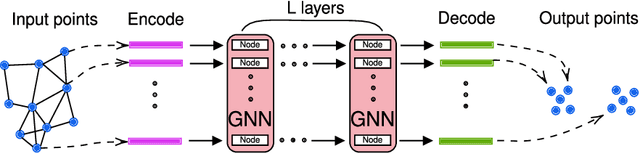
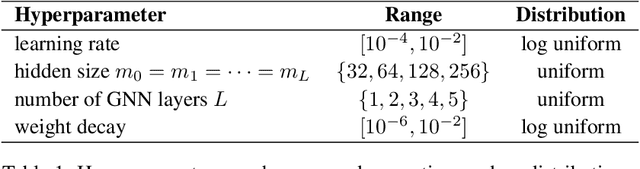
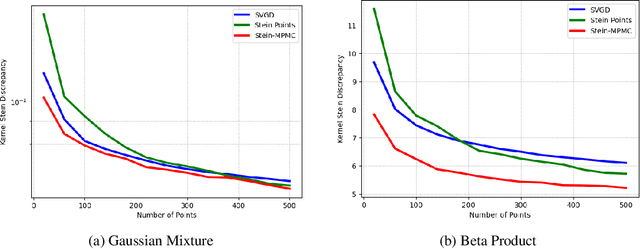
Message-Passing Monte Carlo (MPMC) was recently introduced as a novel low-discrepancy sampling approach leveraging tools from geometric deep learning. While originally designed for generating uniform point sets, we extend this framework to sample from general multivariate probability distributions with known probability density function. Our proposed method, Stein-Message-Passing Monte Carlo (Stein-MPMC), minimizes a kernelized Stein discrepancy, ensuring improved sample quality. Finally, we show that Stein-MPMC outperforms competing methods, such as Stein Variational Gradient Descent and (greedy) Stein Points, by achieving a lower Stein discrepancy.
Message-Passing Monte Carlo: Generating low-discrepancy point sets via Graph Neural Networks
May 23, 2024

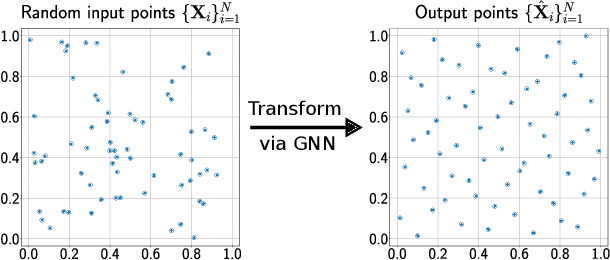

Discrepancy is a well-known measure for the irregularity of the distribution of a point set. Point sets with small discrepancy are called low-discrepancy and are known to efficiently fill the space in a uniform manner. Low-discrepancy points play a central role in many problems in science and engineering, including numerical integration, computer vision, machine perception, computer graphics, machine learning, and simulation. In this work, we present the first machine learning approach to generate a new class of low-discrepancy point sets named Message-Passing Monte Carlo (MPMC) points. Motivated by the geometric nature of generating low-discrepancy point sets, we leverage tools from Geometric Deep Learning and base our model on Graph Neural Networks. We further provide an extension of our framework to higher dimensions, which flexibly allows the generation of custom-made points that emphasize the uniformity in specific dimensions that are primarily important for the particular problem at hand. Finally, we demonstrate that our proposed model achieves state-of-the-art performance superior to previous methods by a significant margin. In fact, MPMC points are empirically shown to be either optimal or near-optimal with respect to the discrepancy for every dimension and the number of points for which the optimal discrepancy can be determined.