 Add to Chrome
 Add to Firefox
 Add to Edge
TEVI: Text-Conditioned Editing of Visual Representations via Sparse Autoencoders for Improved Vision-Language Alignment
Jun 05, 2026
Vision-language models such as CLIP are highly useful for diverse tasks due to their shared image-text embedding space. Despite this, the image and text embeddings are often poorly aligned, affecting downstream performance. Recent work has shown that this can be attributed to an information imbalance: images contain more information than their captions describe. In this work, we propose TEVI, a framework that uses captions as a signal for what to retain from image embeddings. Specifically, we use sparse autoencoders to disentangle image embeddings and train a masking module to selectively reconstruct the embedding based on a given caption. In a controlled setup with synthetic captions, we show that TEVI is effective at preserving caption-described attributes while discarding others. By applying TEVI to CLIP models trained on natural images, we further achieve improved retrieval performance across coarse-grained short-caption (MS COCO, Flickr) and fine-grained long-caption (IIW, DOCCI) benchmarks, with stronger gains on richer captions, and improved robustness on the RoCOCO benchmark.

Discover-then-Name: Task-Agnostic Concept Bottlenecks via Automated Concept Discovery
Jul 19, 2024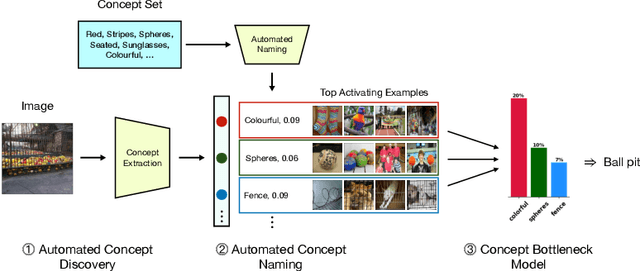

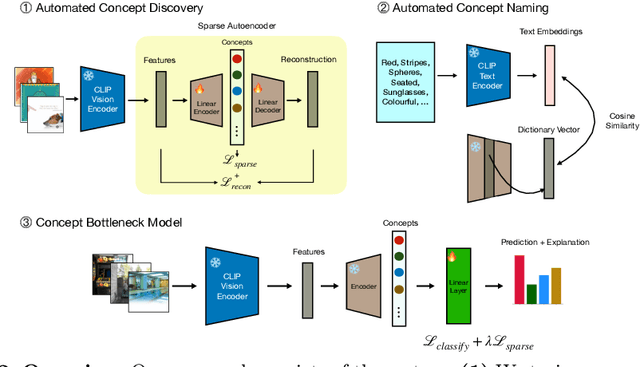

Concept Bottleneck Models (CBMs) have recently been proposed to address the 'black-box' problem of deep neural networks, by first mapping images to a human-understandable concept space and then linearly combining concepts for classification. Such models typically require first coming up with a set of concepts relevant to the task and then aligning the representations of a feature extractor to map to these concepts. However, even with powerful foundational feature extractors like CLIP, there are no guarantees that the specified concepts are detectable. In this work, we leverage recent advances in mechanistic interpretability and propose a novel CBM approach -- called Discover-then-Name-CBM (DN-CBM) -- that inverts the typical paradigm: instead of pre-selecting concepts based on the downstream classification task, we use sparse autoencoders to first discover concepts learnt by the model, and then name them and train linear probes for classification. Our concept extraction strategy is efficient, since it is agnostic to the downstream task, and uses concepts already known to the model. We perform a comprehensive evaluation across multiple datasets and CLIP architectures and show that our method yields semantically meaningful concepts, assigns appropriate names to them that make them easy to interpret, and yields performant and interpretable CBMs. Code available at https://github.com/neuroexplicit-saar/discover-then-name.