 Add to Chrome
 Add to Firefox
 Add to Edge
Federated Multi-Task Clustering
Dec 30, 2025
Spectral clustering has emerged as one of the most effective clustering algorithms due to its superior performance. However, most existing models are designed for centralized settings, rendering them inapplicable in modern decentralized environments. Moreover, current federated learning approaches often suffer from poor generalization performance due to reliance on unreliable pseudo-labels, and fail to capture the latent correlations amongst heterogeneous clients. To tackle these limitations, this paper proposes a novel framework named Federated Multi-Task Clustering (i.e.,FMTC), which intends to learn personalized clustering models for heterogeneous clients while collaboratively leveraging their shared underlying structure in a privacy-preserving manner. More specifically, the FMTC framework is composed of two main components: client-side personalized clustering module, which learns a parameterized mapping model to support robust out-of-sample inference, bypassing the need for unreliable pseudo-labels; and server-side tensorial correlation module, which explicitly captures the shared knowledge across all clients. This is achieved by organizing all client models into a unified tensor and applying a low-rank regularization to discover their common subspace. To solve this joint optimization problem, we derive an efficient, privacy-preserving distributed algorithm based on the Alternating Direction Method of Multipliers, which decomposes the global problem into parallel local updates on clients and an aggregation step on the server. To the end, several extensive experiments on multiple real-world datasets demonstrate that our proposed FMTC framework significantly outperforms various baseline and state-of-the-art federated clustering algorithms.

Edge-Cloud Collaborative Motion Planning for Autonomous Driving with Large Language Models
Aug 19, 2024Integrating large language models (LLMs) into autonomous driving enhances personalization and adaptability in open-world scenarios. However, traditional edge computing models still face significant challenges in processing complex driving data, particularly regarding real-time performance and system efficiency. To address these challenges, this study introduces EC-Drive, a novel edge-cloud collaborative autonomous driving system with data drift detection capabilities. EC-Drive utilizes drift detection algorithms to selectively upload critical data, including new obstacles and traffic pattern changes, to the cloud for processing by GPT-4, while routine data is efficiently managed by smaller LLMs on edge devices. This approach not only reduces inference latency but also improves system efficiency by optimizing communication resource use. Experimental validation confirms the system's robust processing capabilities and practical applicability in real-world driving conditions, demonstrating the effectiveness of this edge-cloud collaboration framework. Our data and system demonstration will be released at https://sites.google.com/view/ec-drive.
Continual Learning with Diffusion-based Generative Replay for Industrial Streaming Data
Jun 22, 2024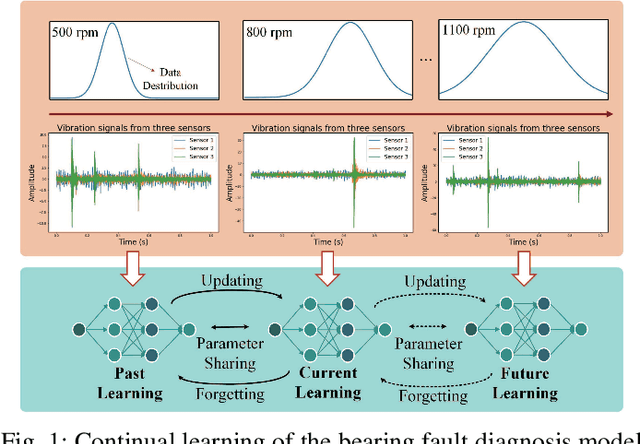
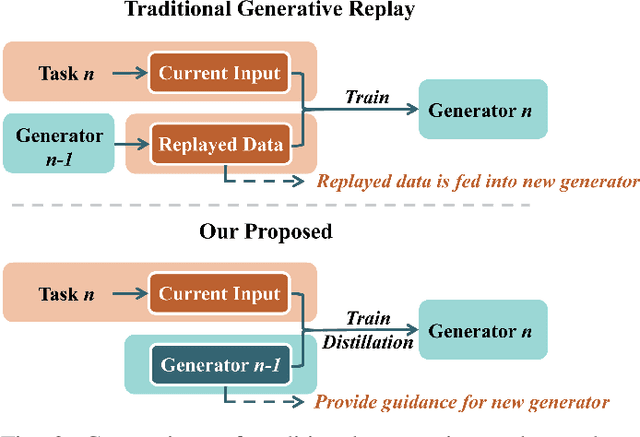

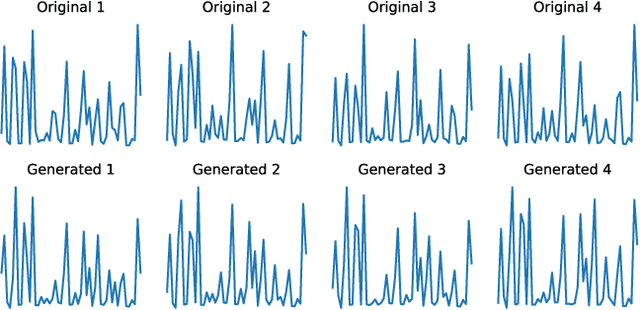
The Industrial Internet of Things (IIoT) integrates interconnected sensors and devices to support industrial applications, but its dynamic environments pose challenges related to data drift. Considering the limited resources and the need to effectively adapt models to new data distributions, this paper introduces a Continual Learning (CL) approach, i.e., Distillation-based Self-Guidance (DSG), to address challenges presented by industrial streaming data via a novel generative replay mechanism. DSG utilizes knowledge distillation to transfer knowledge from the previous diffusion-based generator to the updated one, improving both the stability of the generator and the quality of reproduced data, thereby enhancing the mitigation of catastrophic forgetting. Experimental results on CWRU, DSA, and WISDM datasets demonstrate the effectiveness of DSG. DSG outperforms the state-of-the-art baseline in accuracy, demonstrating improvements ranging from 2.9% to 5.0% on key datasets, showcasing its potential for practical industrial applications.