 Add to Chrome
 Add to Firefox
 Add to Edge
Can We Trust Item Response Theory for AI Evaluation?
Jul 16, 2026
AI benchmarks increasingly leverage item-level statistical models, particularly item response theory (IRT), to estimate model capabilities, rank systems, select informative examples, and diagnose benchmark quality. However, AI benchmark data often departs from the data regime of human testing, for which standard IRT estimation tools were originally developed: benchmarks typically involve fewer evaluated models, far more items, and capability distributions that may be skewed, clustered, or multimodal. We examine how these regime mismatches challenge the reliability of IRT modeling for AI evaluation. Using item parameters and capability distributions derived from six widely used LLM benchmarks, we simulate response matrices under three common IRT models and compare four estimation tools used in recent benchmark studies: marginal maximum likelihood, Markov chain Monte Carlo, variational inference, and a neural pseudo-Siamese estimator. Across 18,000 simulation conditions, we systematically evaluate computational feasibility, scalability, and the reliability of IRT inferences about model rankings, predicted performance, and item characteristics. Results show that classical estimators can become infeasible in large benchmark settings, whereas scalable estimators can produce unreliable item-level and ranking inferences with small or nonnormally distributed model sets. This study identifies when latent trait models reliably support or risk distorting AI benchmarking claims, and what sample sizes and diagnostics are needed for trustworthy use.

Evaluating NLG Evaluation Metrics: A Measurement Theory Perspective
May 24, 2023We address the fundamental challenge in Natural Language Generation (NLG) model evaluation, the design and validation of evaluation metrics. Recognizing the limitations of existing metrics and issues with human judgment, we propose using measurement theory, the foundation of test design, as a framework for conceptualizing and evaluating the validity and reliability of NLG evaluation metrics. This approach offers a systematic method for defining "good" metrics, developing robust metrics, and assessing metric performance. In this paper, we introduce core concepts in measurement theory in the context of NLG evaluation and key methods to evaluate the performance of NLG metrics. Through this framework, we aim to promote the design, evaluation, and interpretation of valid and reliable metrics, ultimately contributing to the advancement of robust and effective NLG models in real-world settings.
ProcData: An R Package for Process Data Analysis
Jun 09, 2020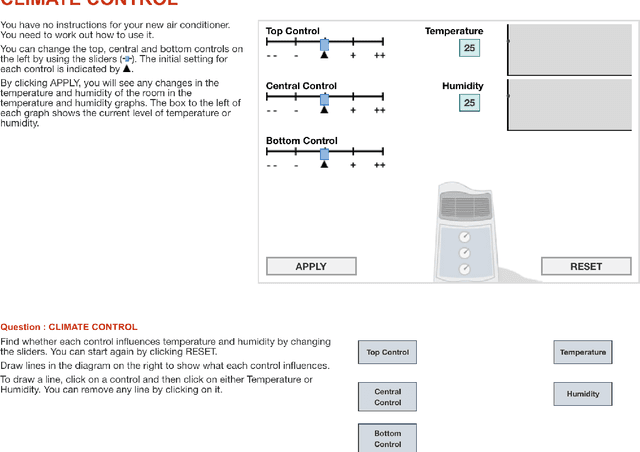
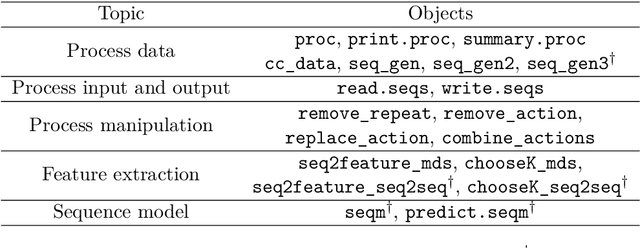

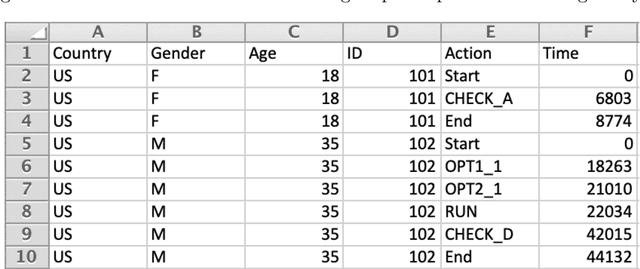
Process data refer to data recorded in the log files of computer-based items. These data, represented as timestamped action sequences, keep track of respondents' response processes of solving the items. Process data analysis aims at enhancing educational assessment accuracy and serving other assessment purposes by utilizing the rich information contained in response processes. The R package ProcData presented in this article is designed to provide tools for processing, describing, and analyzing process data. We define an S3 class "proc" for organizing process data and extend generic methods summary and print for class "proc". Two feature extraction methods for process data are implemented in the package for compressing information in the irregular response processes into regular numeric vectors. ProcData also provides functions for fitting and making predictions from a neural-network-based sequence model. These functions call relevant functions in package keras for constructing and training neural networks. In addition, several response process generators and a real dataset of response processes of the climate control item in the 2012 Programme for International Student Assessment are included in the package.