 Add to Chrome
 Add to Firefox
 Add to Edge
Outer-Momentum Restarting in High-Dimensional Two-Phase Optimization
May 27, 2026
Communication-efficient distributed optimizers such as DiLoCo reduce synchronization costs by letting workers perform many local updates before aggregating their progress with an outer momentum optimizer. Recent theory suggests that the outer optimizer acts on an effective spectrum induced by the inner optimization loop, and that the choice of outer momentum controls how progress from local updates is accumulated across communication rounds. We study periodic restarting of the outer momentum as a simple complementary mechanism for controlling this outer memory. In a linearized squared-loss model where prediction-space residuals evolve under the empirical NTK, we derive a mode-wise restart contraction showing that resets exploit phase cancellation by discarding stale momentum while preserving inner-loop progress. Toy experiments verify the predicted contraction behavior, and language-model pretraining experiments show that periodic restarts widen the stable range of outer learning rates and momentum values across communication periods.

Pearls from Pebbles: Improved Confidence Functions for Auto-labeling
Apr 24, 2024

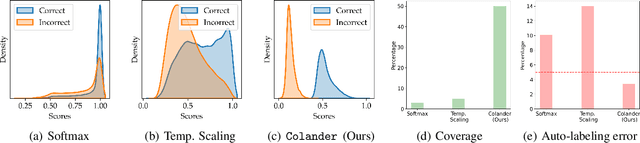

Auto-labeling is an important family of techniques that produce labeled training sets with minimum manual labeling. A prominent variant, threshold-based auto-labeling (TBAL), works by finding a threshold on a model's confidence scores above which it can accurately label unlabeled data points. However, many models are known to produce overconfident scores, leading to poor TBAL performance. While a natural idea is to apply off-the-shelf calibration methods to alleviate the overconfidence issue, such methods still fall short. Rather than experimenting with ad-hoc choices of confidence functions, we propose a framework for studying the \emph{optimal} TBAL confidence function. We develop a tractable version of the framework to obtain \texttt{Colander} (Confidence functions for Efficient and Reliable Auto-labeling), a new post-hoc method specifically designed to maximize performance in TBAL systems. We perform an extensive empirical evaluation of our method \texttt{Colander} and compare it against methods designed for calibration. \texttt{Colander} achieves up to 60\% improvements on coverage over the baselines while maintaining auto-labeling error below $5\%$ and using the same amount of labeled data as the baselines.