 Add to Chrome
 Add to Firefox
 Add to Edge
Deliberate Practice: Learning Robot Skills under a Budget
Aug 13, 2026
We consider the problem of autonomously learning robot skills under a limited practice budget for sequential tasks. We propose an active skill learning algorithm, \emph{Deliberate Practice (DP)}, that computes a provably \emph{budget-optimal} allocation---practicing skills that maximize expected cumulative reward while being learnable within the budget. DP estimates both the time needed to master skills and the cumulative reward of the task plans that the skills unlock. Computing a budget-optimal allocation is challenging as it requires reasoning about combinatorially many skill plans over a large practice budget. Our key contribution is a bilinear program that can compute this exactly using off-the-shelf solvers. Through simulated and real-world experiments on long-horizon manipulation tasks, we show that our approach allows robots to optimally use limited practice time to acquire useful policies and improve long-horizon planning.

DreamControl-v2: Simpler and Scalable Autonomous Humanoid Skills via Trainable Guided Diffusion Priors
Mar 31, 2026Developing robust autonomous loco-manipulation skills for humanoids remains an open problem in robotics. While RL has been applied successfully to legged locomotion, applying it to complex, interaction-rich manipulation tasks is harder given long-horizon planning challenges for manipulation. A recent approach along these lines is DreamControl, which addresses these issues by leveraging off-the-shelf human motion diffusion models as a generative prior to guide RL policies during training. In this paper, we investigate the impact of DreamControl's motion prior and propose an improved framework that trains a guided diffusion model directly in the humanoid robot's motion space, aggregating diverse human and robot datasets into a unified embodiment space. We demonstrate that our approach captures a wider range of skills due to the larger training data mixture and establishes a more automated pipeline by removing the need for manual filtering interventions. Furthermore, we show that scaling the generation of reference trajectories is important for achieving robust downstream RL policies. We validate our approach through extensive experiments in simulation and on a real Unitree-G1.
MotionGlot: A Multi-Embodied Motion Generation Model
Oct 22, 2024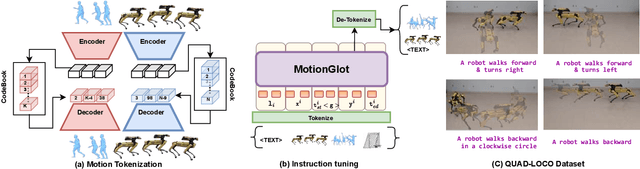
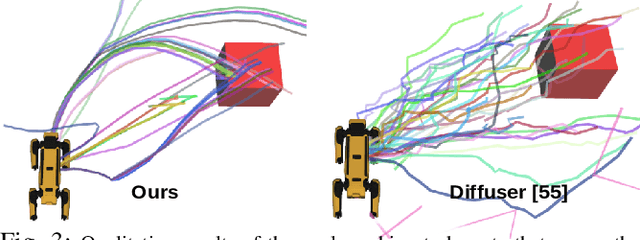
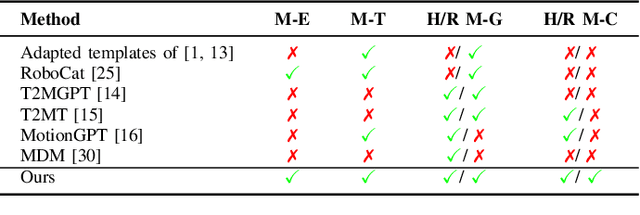
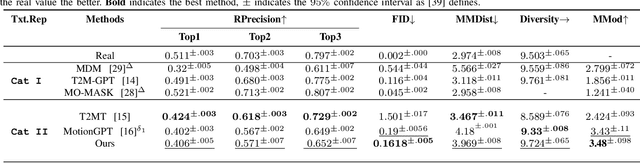
This paper introduces MotionGlot, a model that can generate motion across multiple embodiments with different action dimensions, such as quadruped robots and human bodies. By leveraging the well-established training procedures commonly used in large language models (LLMs), we introduce an instruction-tuning template specifically designed for motion-related tasks. Our approach demonstrates that the principles underlying LLM training can be successfully adapted to learn a wide range of motion generation tasks across multiple embodiments with different action dimensions. We demonstrate the various abilities of MotionGlot on a set of 6 tasks and report an average improvement of 35.3% across tasks. Additionally, we contribute two new datasets: (1) a dataset of expert-controlled quadruped locomotion with approximately 48,000 trajectories paired with direction-based text annotations, and (2) a dataset of over 23,000 situational text prompts for human motion generation tasks. Finally, we conduct hardware experiments to validate the capabilities of our system in real-world applications.