 Add to Chrome
 Add to Firefox
 Add to Edge
DreamControl-v2: Simpler and Scalable Autonomous Humanoid Skills via Trainable Guided Diffusion Priors
Mar 31, 2026
Developing robust autonomous loco-manipulation skills for humanoids remains an open problem in robotics. While RL has been applied successfully to legged locomotion, applying it to complex, interaction-rich manipulation tasks is harder given long-horizon planning challenges for manipulation. A recent approach along these lines is DreamControl, which addresses these issues by leveraging off-the-shelf human motion diffusion models as a generative prior to guide RL policies during training. In this paper, we investigate the impact of DreamControl's motion prior and propose an improved framework that trains a guided diffusion model directly in the humanoid robot's motion space, aggregating diverse human and robot datasets into a unified embodiment space. We demonstrate that our approach captures a wider range of skills due to the larger training data mixture and establishes a more automated pipeline by removing the need for manual filtering interventions. Furthermore, we show that scaling the generation of reference trajectories is important for achieving robust downstream RL policies. We validate our approach through extensive experiments in simulation and on a real Unitree-G1.

DreamControl: Human-Inspired Whole-Body Humanoid Control for Scene Interaction via Guided Diffusion
Sep 17, 2025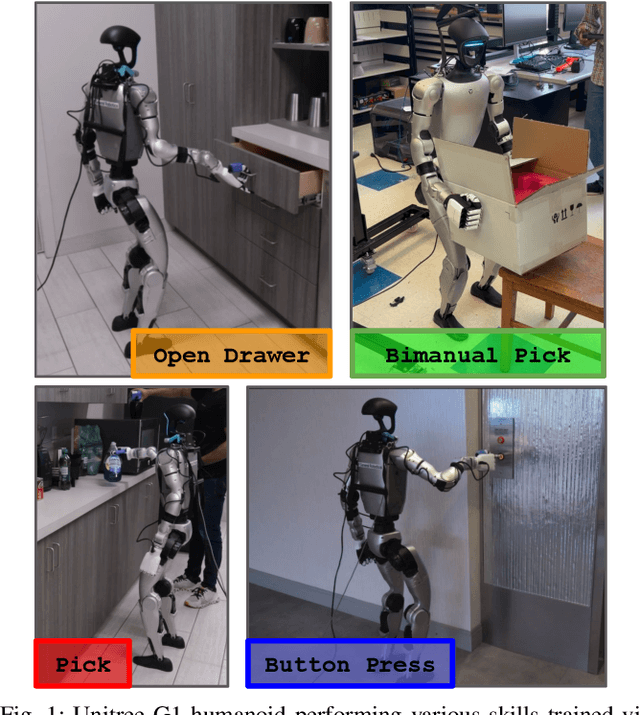
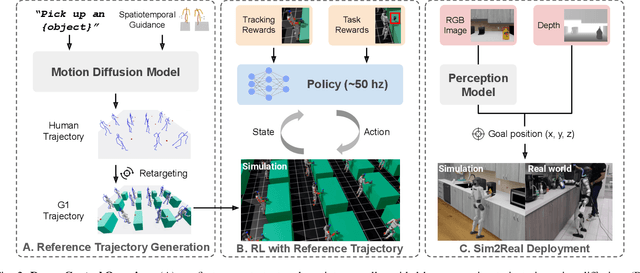
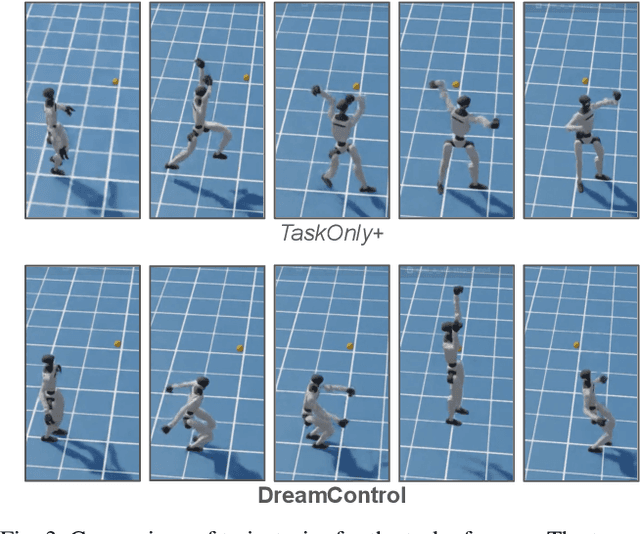
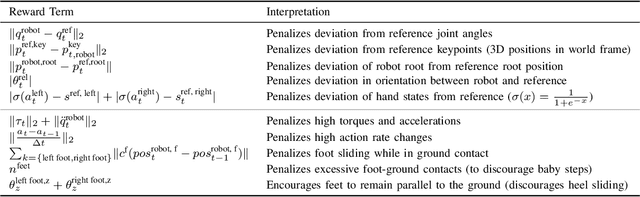
We introduce DreamControl, a novel methodology for learning autonomous whole-body humanoid skills. DreamControl leverages the strengths of diffusion models and Reinforcement Learning (RL): our core innovation is the use of a diffusion prior trained on human motion data, which subsequently guides an RL policy in simulation to complete specific tasks of interest (e.g., opening a drawer or picking up an object). We demonstrate that this human motion-informed prior allows RL to discover solutions unattainable by direct RL, and that diffusion models inherently promote natural looking motions, aiding in sim-to-real transfer. We validate DreamControl's effectiveness on a Unitree G1 robot across a diverse set of challenging tasks involving simultaneous lower and upper body control and object interaction.