 Add to Chrome
 Add to Firefox
 Add to Edge
MicroZoom: Structure-Preserving Detail Synthesis at Extreme Scale
Jul 27, 2026
We introduce MicroZoom, a generative framework for gigapixel image synthesis at the microscopic scale. Given a standard photograph and a sparse set of consumer-grade microscope close-ups, MicroZoom synthesizes a seamless, gigapixel-resolution image grounded in the material character of the real references, enabling exploratory visualization of microscopic texture across the full spatial extent of an object. Our goal is plausible synthesis, not exact reconstruction. We focus on full-image, reference-based, extreme-scale super-resolution at magnification levels of up to 350x, a setting that introduces two major challenges: (1) recovering texture-specific detail from highly lossy inputs near ambiguous material boundaries, and (2) preserving correct large-scale pattern structure, such as the repeating geometry of a fabric weave, across millions of local predictions. We address these with a two-stage cascaded design, where the first stage recovers global pattern coherence and the second refines local texture detail, supplemented by a segmentation mask to guide synthesis at ambiguous boundaries. We verify our approach on a collection of self-captured everyday objects and demonstrate globally coherent, materially grounded gigapixel imagery.

Online Neural Space Time Memory for Dynamic Novel View Synthesis
Jul 16, 2026Online novel view synthesis from multi-view streaming videos faces a fundamental trade-off: maintaining a persistent, long-horizon memory to reconstruct temporarily occluded regions while operating under strict real-time constraints. While Test-Time Training (TTT) offers a powerful memory mechanism, standard models mandate gradient-based memory updates at every frame to adapt to the changing motion in dynamic scenes. The computational cost of heavy memory updates precludes real-time application and can lead to instability over long contexts. Given that memory updates are more demanding than memory application and video content is largely redundant, we propose to decouple the frequencies of these two processes. Our approach performs periodic memory updates while applying the memory on a per-frame basis, using cross-view attention to manage deformations between the prior memory state and the current frame. To lock in the historical context, we introduce two critical mechanisms: an auxiliary Memory Loss that forces persistent internalization of the scene, and a Memory Caching strategy that regularizes active weights against catastrophic drift. Our method demonstrates real-time, state-of-the-art performance on scenes with dynamic human motion as well as minute-scale online memorization.
GarmentZoom: Generating Zoomable Images from Garment Listings
Jun 28, 2026Online product listings for garments often include an overview photo and a close-up to show garment details. However, each photo focuses on either field of view or garment detail, forcing users to alternate between views and breaking browsing continuity. We present GarmentZoom, a system that enhances the full-view photo to match the fidelity of its accompanying close-up, enabling seamless zoom-and-pan exploration. Unlike standard reference-based super-resolution, our setting involves close-up references that are spatially unaligned with the full view, and scale factors that vary substantially across garments 3-20$\times$. Prior work typically relies on alignment to transfer details or requires per-instance fine-tuning to memorize them. Instead, we train a single model that supports a continuous range of scales across diverse garments. Our approach synthesizes details without requiring spatial alignment and matches the quality of per-instance methods with a fraction of the training cost.
UltraZoom: Generating Gigapixel Images from Regular Photos
Jun 16, 2025We present UltraZoom, a system for generating gigapixel-resolution images of objects from casually captured inputs, such as handheld phone photos. Given a full-shot image (global, low-detail) and one or more close-ups (local, high-detail), UltraZoom upscales the full image to match the fine detail and scale of the close-up examples. To achieve this, we construct a per-instance paired dataset from the close-ups and adapt a pretrained generative model to learn object-specific low-to-high resolution mappings. At inference, we apply the model in a sliding window fashion over the full image. Constructing these pairs is non-trivial: it requires registering the close-ups within the full image for scale estimation and degradation alignment. We introduce a simple, robust method for getting registration on arbitrary materials in casual, in-the-wild captures. Together, these components form a system that enables seamless pan and zoom across the entire object, producing consistent, photorealistic gigapixel imagery from minimal input.
Generating Fit Check Videos with a Handheld Camera
May 29, 2025Self-captured full-body videos are popular, but most deployments require mounted cameras, carefully-framed shots, and repeated practice. We propose a more convenient solution that enables full-body video capture using handheld mobile devices. Our approach takes as input two static photos (front and back) of you in a mirror, along with an IMU motion reference that you perform while holding your mobile phone, and synthesizes a realistic video of you performing a similar target motion. We enable rendering into a new scene, with consistent illumination and shadows. We propose a novel video diffusion-based model to achieve this. Specifically, we propose a parameter-free frame generation strategy, as well as a multi-reference attention mechanism, that effectively integrate appearance information from both the front and back selfies into the video diffusion model. Additionally, we introduce an image-based fine-tuning strategy to enhance frame sharpness and improve the generation of shadows and reflections, achieving a more realistic human-scene composition.
MusicInfuser: Making Video Diffusion Listen and Dance
Mar 18, 2025We introduce MusicInfuser, an approach for generating high-quality dance videos that are synchronized to a specified music track. Rather than attempting to design and train a new multimodal audio-video model, we show how existing video diffusion models can be adapted to align with musical inputs by introducing lightweight music-video cross-attention and a low-rank adapter. Unlike prior work requiring motion capture data, our approach fine-tunes only on dance videos. MusicInfuser achieves high-quality music-driven video generation while preserving the flexibility and generative capabilities of the underlying models. We introduce an evaluation framework using Video-LLMs to assess multiple dimensions of dance generation quality. The project page and code are available at https://susunghong.github.io/MusicInfuser.
Constrained Diffusion Implicit Models
Nov 01, 2024
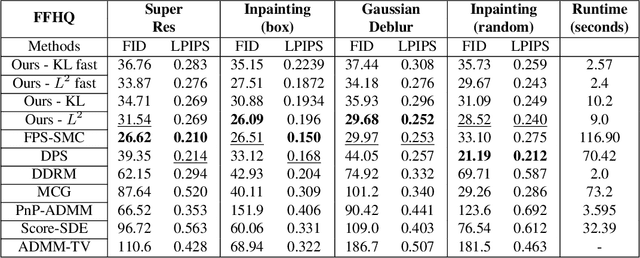
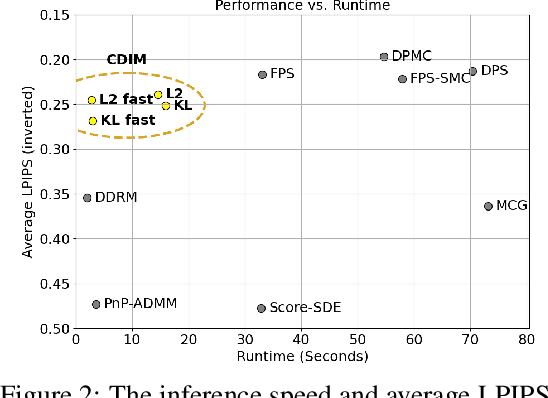
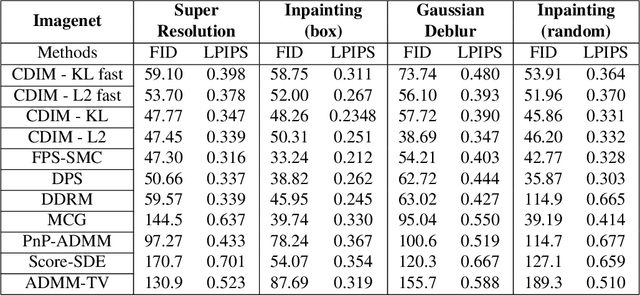
This paper describes an efficient algorithm for solving noisy linear inverse problems using pretrained diffusion models. Extending the paradigm of denoising diffusion implicit models (DDIM), we propose constrained diffusion implicit models (CDIM) that modify the diffusion updates to enforce a constraint upon the final output. For noiseless inverse problems, CDIM exactly satisfies the constraints; in the noisy case, we generalize CDIM to satisfy an exact constraint on the residual distribution of the noise. Experiments across a variety of tasks and metrics show strong performance of CDIM, with analogous inference acceleration to unconstrained DDIM: 10 to 50 times faster than previous conditional diffusion methods. We demonstrate the versatility of our approach on many problems including super-resolution, denoising, inpainting, deblurring, and 3D point cloud reconstruction.
Inverse Painting: Reconstructing The Painting Process
Sep 30, 2024
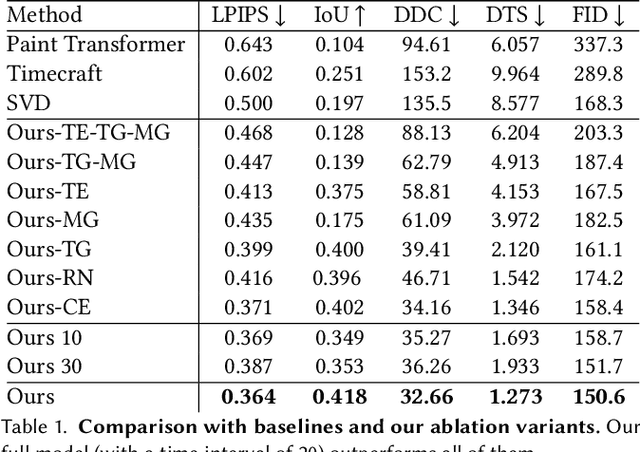
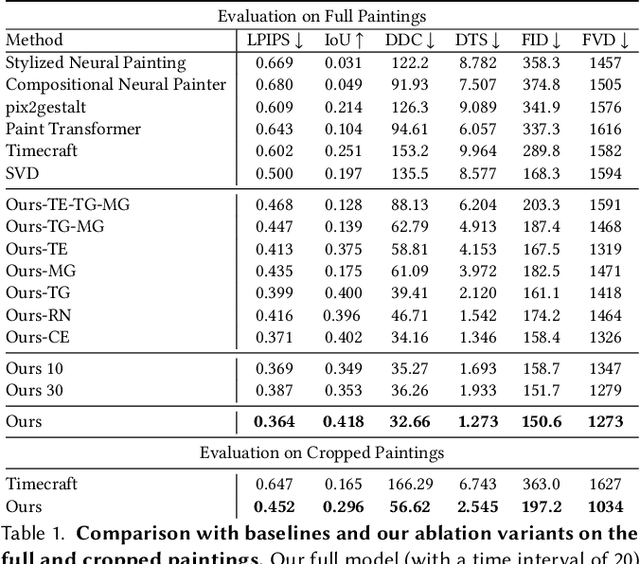

Given an input painting, we reconstruct a time-lapse video of how it may have been painted. We formulate this as an autoregressive image generation problem, in which an initially blank "canvas" is iteratively updated. The model learns from real artists by training on many painting videos. Our approach incorporates text and region understanding to define a set of painting "instructions" and updates the canvas with a novel diffusion-based renderer. The method extrapolates beyond the limited, acrylic style paintings on which it has been trained, showing plausible results for a wide range of artistic styles and genres.
Generative Inbetweening: Adapting Image-to-Video Models for Keyframe Interpolation
Aug 27, 2024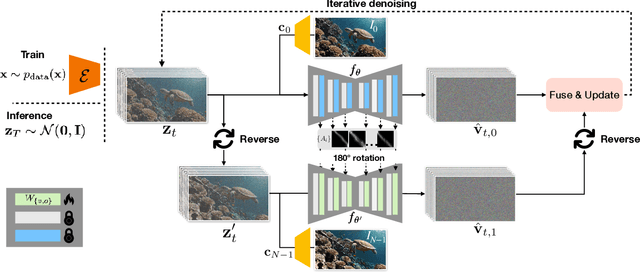
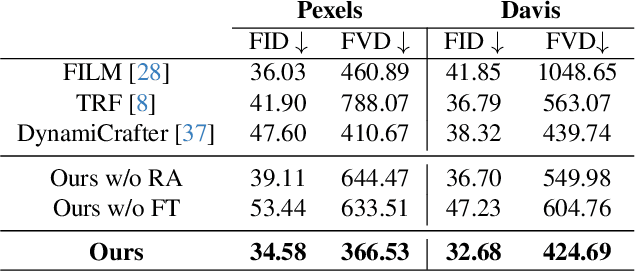
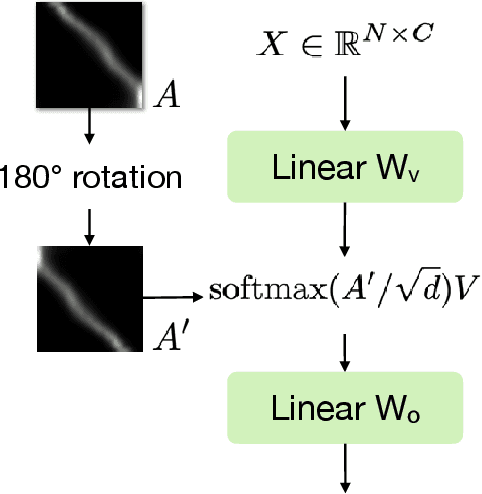
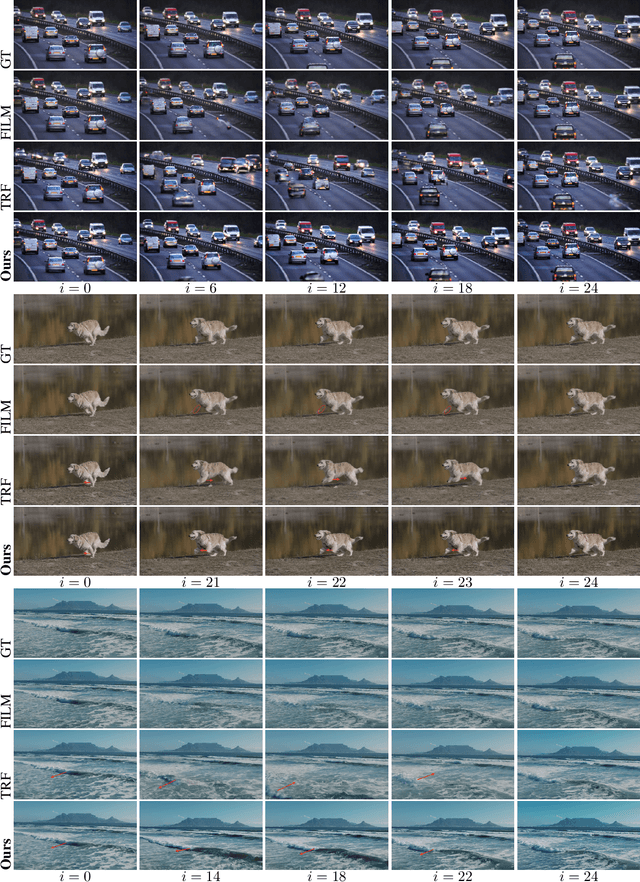
We present a method for generating video sequences with coherent motion between a pair of input key frames. We adapt a pretrained large-scale image-to-video diffusion model (originally trained to generate videos moving forward in time from a single input image) for key frame interpolation, i.e., to produce a video in between two input frames. We accomplish this adaptation through a lightweight fine-tuning technique that produces a version of the model that instead predicts videos moving backwards in time from a single input image. This model (along with the original forward-moving model) is subsequently used in a dual-directional diffusion sampling process that combines the overlapping model estimates starting from each of the two keyframes. Our experiments show that our method outperforms both existing diffusion-based methods and traditional frame interpolation techniques.
Infinite Texture: Text-guided High Resolution Diffusion Texture Synthesis
May 13, 2024


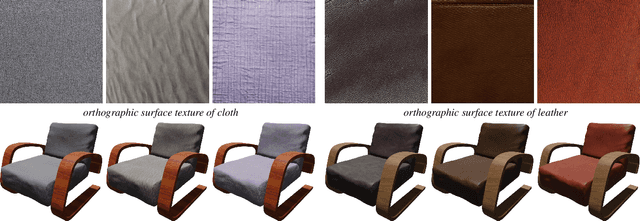
We present Infinite Texture, a method for generating arbitrarily large texture images from a text prompt. Our approach fine-tunes a diffusion model on a single texture, and learns to embed that statistical distribution in the output domain of the model. We seed this fine-tuning process with a sample texture patch, which can be optionally generated from a text-to-image model like DALL-E 2. At generation time, our fine-tuned diffusion model is used through a score aggregation strategy to generate output texture images of arbitrary resolution on a single GPU. We compare synthesized textures from our method to existing work in patch-based and deep learning texture synthesis methods. We also showcase two applications of our generated textures in 3D rendering and texture transfer.