 Add to Chrome
 Add to Firefox
 Add to Edge
XPR: An Extensible Cross-Platform Point-Based Differentiable Renderer
Jun 10, 2026
Point-based differentiable rendering underpins modern 3D reconstruction, novel-view synthesis, and learning-based graphics pipelines, but developing new rendering methods often requires extensive low-level implementation, hardware-specific kernels, and manually written backward passes. This limits rapid prototyping, reproducibility, exploration, and deployment, especially across diverse hardware platforms. This paper presents XPR, an extensible cross-platform framework for point-based differentiable rendering. XPR introduces a high-level programming interface that separates method-specific logic from the shared rendering pipeline, allowing users to implement new methods in a few lines of code. Its pipeline decomposes rendering into modular, statically shaped parallel operations that can be lowered by a cross-platform compiler to GPUs, TPUs, CPUs, and other ML accelerators. We demonstrate implementations of 3DGS, 3DGUT, and LinPrim, with only a few 100s lines of Python code, each of which can be compiled to a range of hardware platforms with the XLA compiler. These results show that XPR enables fast experimentation and portable execution for emerging point-based differentiable rendering systems.

Analysis of Distributed Optimization Algorithms on a Real Processing-In-Memory System
Apr 10, 2024
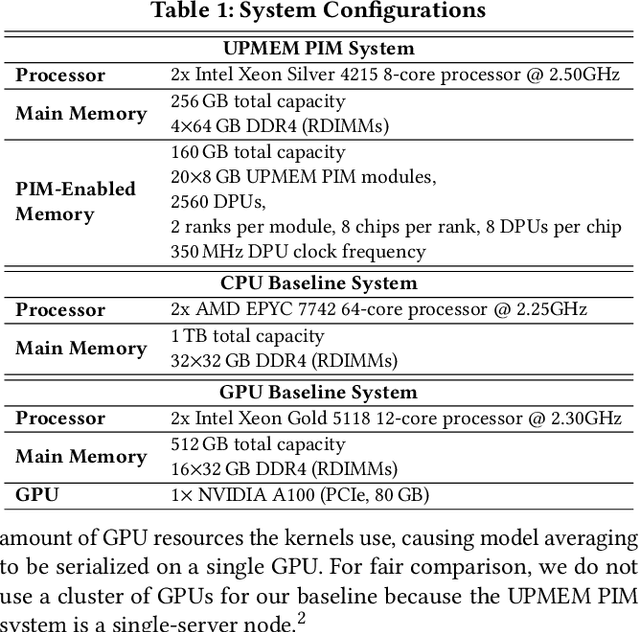

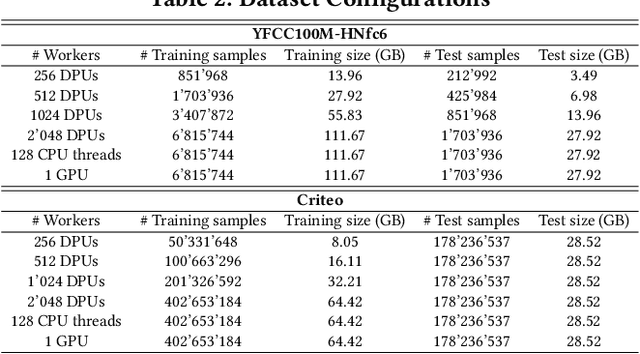
Machine Learning (ML) training on large-scale datasets is a very expensive and time-consuming workload. Processor-centric architectures (e.g., CPU, GPU) commonly used for modern ML training workloads are limited by the data movement bottleneck, i.e., due to repeatedly accessing the training dataset. As a result, processor-centric systems suffer from performance degradation and high energy consumption. Processing-In-Memory (PIM) is a promising solution to alleviate the data movement bottleneck by placing the computation mechanisms inside or near memory. Our goal is to understand the capabilities and characteristics of popular distributed optimization algorithms on real-world PIM architectures to accelerate data-intensive ML training workloads. To this end, we 1) implement several representative centralized distributed optimization algorithms on UPMEM's real-world general-purpose PIM system, 2) rigorously evaluate these algorithms for ML training on large-scale datasets in terms of performance, accuracy, and scalability, 3) compare to conventional CPU and GPU baselines, and 4) discuss implications for future PIM hardware and the need to shift to an algorithm-hardware codesign perspective to accommodate decentralized distributed optimization algorithms. Our results demonstrate three major findings: 1) Modern general-purpose PIM architectures can be a viable alternative to state-of-the-art CPUs and GPUs for many memory-bound ML training workloads, when operations and datatypes are natively supported by PIM hardware, 2) the importance of carefully choosing the optimization algorithm that best fit PIM, and 3) contrary to popular belief, contemporary PIM architectures do not scale approximately linearly with the number of nodes for many data-intensive ML training workloads. To facilitate future research, we aim to open-source our complete codebase.