 Add to Chrome
 Add to Firefox
 Add to Edge
Forecast Collapse in Time-Series Foundation Models
Aug 14, 2026
When forecasting hourly returns for 1,000 US equities, we observe an unexpected phenomenon: predictions become nearly flat and show poor stock ranking, as measured by cross-sectional correlation. We call this forecast collapse. Surprisingly, the phenomenon largely disappears when forecasting trading volume under the same setting. We investigate forecast collapse across time-series foundation models (TSFMs), twelve deep-learning forecasting models, and 97 public benchmark configurations, and find that it is closely tied to target predictability. We identify two distinct reasons behind it: low predictability limits the amplitude of calibrated point forecasts, while per-series objectives leave cross-series structure unidentified. These findings reveal a calibration-ranking tradeoff: optimizing squared error leads to flat predictions, whereas directly optimizing cross-sectional correlation improves ranking but can inflate forecast amplitude by more than an order of magnitude. To address this tradeoff, we introduce CalibRank, a simple objective that balances calibration and ranking. On Finance1K, CalibRank nearly triples cross-sectional correlation while keeping amplitude close to the target, and improves correlation on all tested models. Our results reveal a blind spot in conventional time-series evaluation: per-series metrics can hide failures in cross-series structure needed by downstream decisions.

Hybrid Self-evolving Structured Memory for GUI Agents
Mar 11, 2026The remarkable progress of vision-language models (VLMs) has enabled GUI agents to interact with computers in a human-like manner. Yet real-world computer-use tasks remain difficult due to long-horizon workflows, diverse interfaces, and frequent intermediate errors. Prior work equips agents with external memory built from large collections of trajectories, but relies on flat retrieval over discrete summaries or continuous embeddings, falling short of the structured organization and self-evolving characteristics of human memory. Inspired by the brain, we propose Hybrid Self-evolving Structured Memory (HyMEM), a graph-based memory that couples discrete high-level symbolic nodes with continuous trajectory embeddings. HyMEM maintains a graph structure to support multi-hop retrieval, self-evolution via node update operations, and on-the-fly working-memory refreshing during inference. Extensive experiments show that HyMEM consistently improves open-source GUI agents, enabling 7B/8B backbones to match or surpass strong closed-source models; notably, it boosts Qwen2.5-VL-7B by +22.5% and outperforms Gemini2.5-Pro-Vision and GPT-4o.
Transformer Is Inherently a Causal Learner
Jan 09, 2026We reveal that transformers trained in an autoregressive manner naturally encode time-delayed causal structures in their learned representations. When predicting future values in multivariate time series, the gradient sensitivities of transformer outputs with respect to past inputs directly recover the underlying causal graph, without any explicit causal objectives or structural constraints. We prove this connection theoretically under standard identifiability conditions and develop a practical extraction method using aggregated gradient attributions. On challenging cases such as nonlinear dynamics, long-term dependencies, and non-stationary systems, this approach greatly surpasses the performance of state-of-the-art discovery algorithms, especially as data heterogeneity increases, exhibiting scaling potential where causal accuracy improves with data volume and heterogeneity, a property traditional methods lack. This unifying view lays the groundwork for a future paradigm where causal discovery operates through the lens of foundation models, and foundation models gain interpretability and enhancement through the lens of causality.
A Proof of Concept for OTFS Resilience in Doubly-Selective Channels by GPU-Enabled Real-Time SDR
Sep 22, 2023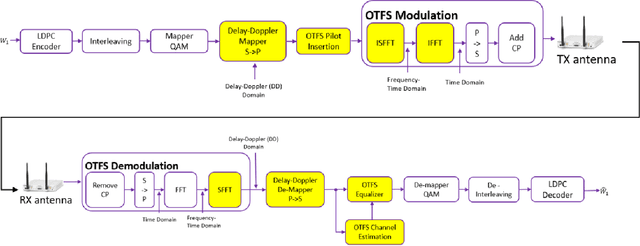
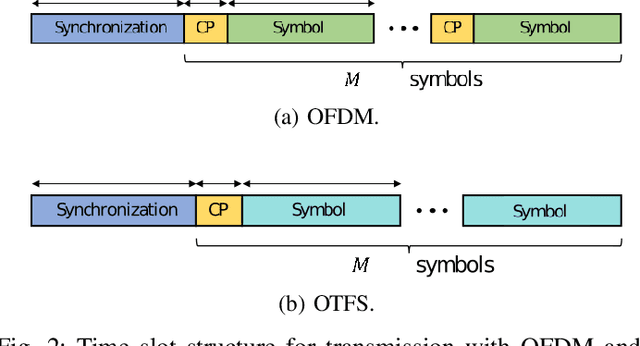
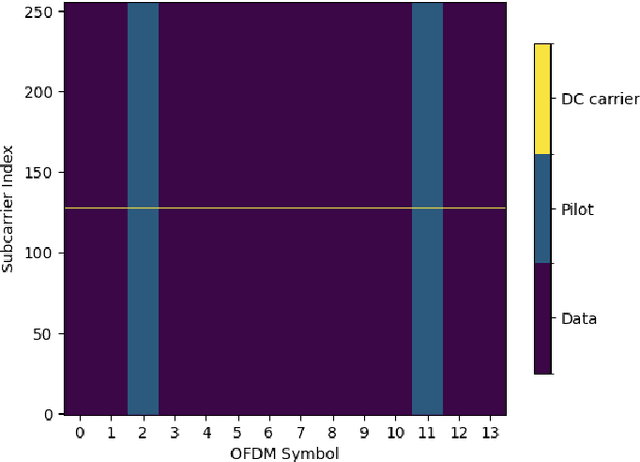
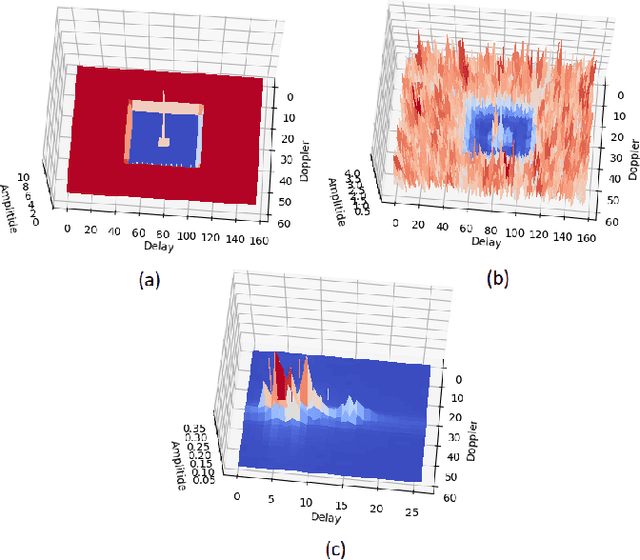
Orthogonal time frequency space (OTFS) is a modulation technique which is robust against the disruptive effects of doubly-selective channels. In this paper, we perform an experimental study of OTFS by a real-time software defined radio (SDR) setup. Our SDR consists of a Graphical Processing Unit (GPU) for signal processing programmed using Sionna and TensorFlow, and Universal Software Radio Peripheral (USRP) devices for air interface. We implement a low-latency transceiver structure for OTFS and investigate its performance under various Doppler values. By comparing the performance of OTFS with Orthogonal Frequency Division Multiplexing (OFDM), we demonstrate that OTFS is highly robust against the disruptive effects of doubly-selective channels in a real-time experimental setup.