 Add to Chrome
 Add to Firefox
 Add to Edge
On Runlength Limited Codes for BICM Systems
Jul 22, 2026
We study the use of runlength-limited (RLL) block codes in bit-interleaved coded modulation (BICM) systems. In this setting, the RLL code acts as the symbol mapper, whose assignment between input bits and RLL symbols is critical for performance. In this work, we aim at optimizing the assignment scheme of RLL codes. One of the main applications of RLL codes is the mitigation of intersymbol interference (ISI) in systems with coarse quantization. However, channel memory and quantization nonlinearity complicate information theoretic analysis. To enable analytical treatment, we consider a block channel with 1-bit analog-to-digital conversion, modeling the transmission of a single RLL code block. For this channel, we investigate the relationship between the achievable rate in BICM systems-termed BICM capacity-and the RLL code's assignment scheme. Focusing on low signal-to-noise ratios (SNRs), we derive the optimization problem yielding the optimal assignment scheme. By looking at asymptotically large block-lengths, we infer a practical optimization strategy for RLL codes with finite block-length and channels with inter-block interference. Further, we extend this optimization to two-state RLL (TS-RLL) codes, which offer higher code rates than state independent RLL codes. We demonstrate that optimized TS-RLL codes exhibit significant performance improvements over literature counterparts.

Comparing Iterative and Least-Squares Based Phase Noise Tracking in Receivers with 1-bit Quantization and Oversampling
Sep 12, 2023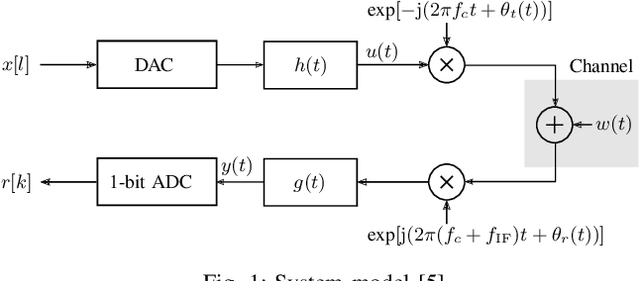
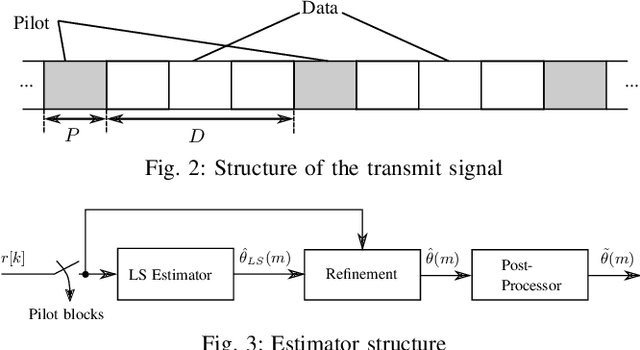
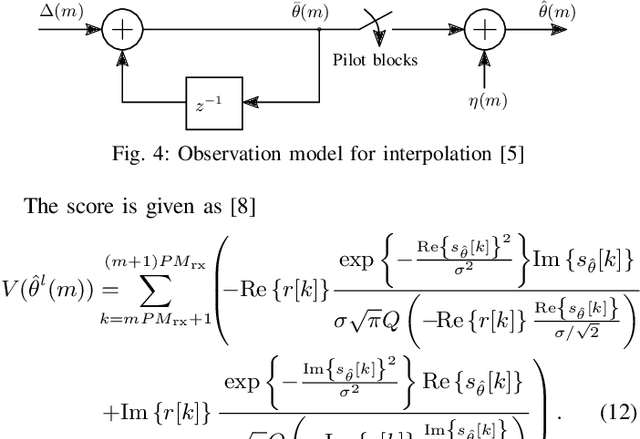
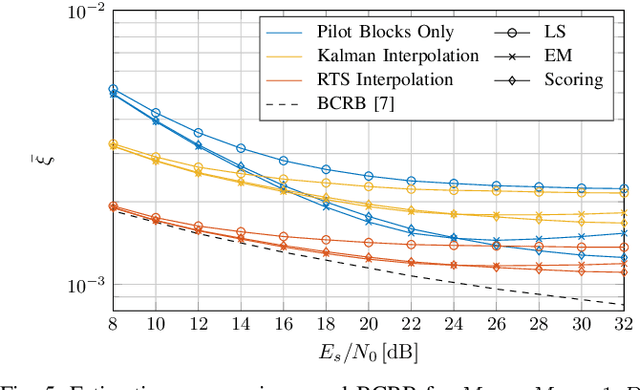
High data rates require vast bandwidths, that can be found in the sub-THz band, and high sampling frequencies, which are predicted to lead to a problematically high analog-to-digital converter (ADC) power consumption. It was proposed to use 1-bit ADCs to mitigate this problem. Moreover, oscillator phase noise is predicted to be especially high at sub-THz carrier frequencies. For synchronization the phase must be tracked based on 1-bit quantized observations. We study iterative data-aided phase estimation, i.e., the expectation-maximization and the Fisher-scoring algorithm, compared to least-squares (LS) phase estimation. For phase interpolation at the data symbols, we consider the Kalman filter and the Rauch-Tung-Striebel algorithm. Compared to LS estimation, iterative phase noise tracking leads to a significantly lower estimation error variance at high signal-to-noise ratios. However, its benefit for the spectral efficiency using zero-crossing modulation (ZXM) is limited to marginal gains for high faster-than-Nyquist signaling factors, i.e., higher order ZXM modulation.
Waveforms for sub-THz 6G: Design Guidelines
Jun 15, 2023
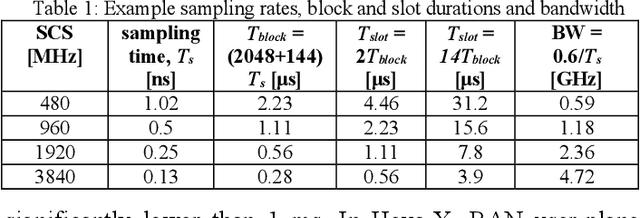


The projected sub-THz (100 - 300 GHz) part of the upcoming 6G standard will require a careful design of the waveform and choice of slot structure. Not only that the design of the physical layer for 6G will be driven by ambitious system performance requirements, but also hardware limitations, specific to sub-THz frequencies, pose a fundamental design constraint for the waveform. In this contribution, general guidelines for the waveform design are given, together with a non-exhaustive list of exemplary waveforms that can be used to meet the design requirements.