 Add to Chrome
 Add to Firefox
 Add to Edge
Impact of deployment on energy efficiency of sub-THz transmission
Apr 16, 2026
Sub-THz bands are promising high bandwidth and data rates, and in the recent years the device technologies made large progress and provided a multitude of transceiver, power amplifier (PA) and phased array devices supporting the frequency bands above 100 GHz. The more painful aspect of sub-THz transmission is the increased power consumption, caused by the large data rates and the related data conversion and processing effort, and on the analog side the low achievable PA efficiency and the reduced achievable output power. When planning a deployment of sub-THz communication systems, the target coverage and throughput can be achieved with a variety of scenarios, which will be different with respect to locations and number of base stations and system architectures. Although leading to similar performance, they will differ significantly in the overall power consumption. With an accurate power consumption model, including also baseband (BB) processing functionality, and system level simulations for different hybrid beamforming and MIMO schemes the related variations in power consumption in relation to a given performance are evaluated. This paper shows the critical design aspects for energy efficient sub-THz deployments by highlighting the sub- THz specific trade-offs between different number of BS with different transmit powers but also changing number of BB units and RF chains.

Constellation Shaping under Phase Noise Impairment for Sub-THz Communications
Nov 21, 2023The large untapped spectrum in the sub-THz allows for ultra-high throughput communication to realize many seemingly impossible applications in 6G. One of the challenges in radio communications in sub-THz is the hardware impairments. Specifically, phase noise is one key hardware impairment, which is accentuated as we increase the frequency and bandwidth. Furthermore, the modest output power of the sub-THz power amplifier demands limits on peak to average power ratio (PAPR) signal design. Single carrier frequency domain equalization (SC-FDE) waveform has been identified as a suitable candidate for sub-THz, although some challenges such as phase noise and PAPR still remain to be tackled. In this work, we design a phase noise robust, low PAPR SC-FDE waveform by geometrically shaping the constellation under practical conditions. We formulate the waveform optimization problem in its augmented Lagrangian form and use a back-propagation-inspired technique to obtain a constellation design that is numerically robust to phase noise, while maintaining a low PAPR.
Waveforms for sub-THz 6G: Design Guidelines
Jun 15, 2023
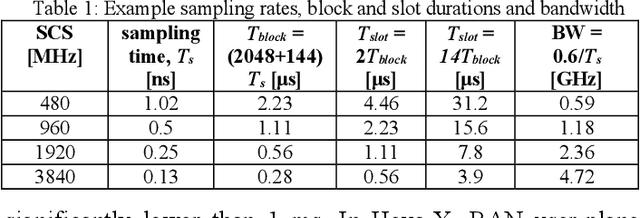


The projected sub-THz (100 - 300 GHz) part of the upcoming 6G standard will require a careful design of the waveform and choice of slot structure. Not only that the design of the physical layer for 6G will be driven by ambitious system performance requirements, but also hardware limitations, specific to sub-THz frequencies, pose a fundamental design constraint for the waveform. In this contribution, general guidelines for the waveform design are given, together with a non-exhaustive list of exemplary waveforms that can be used to meet the design requirements.