 Add to Chrome
 Add to Firefox
 Add to Edge
Quantization Limitations of Leakage Suppression in Self-Calibrating Monostatic Integrated Sensing and Communication MIMO Systems
Jun 10, 2026
Power leaking directly from transmitting into receiving radio-frequency chains is a key challenge in the realization of monostatic sensing applications with multi-antenna communication front-ends, to which a promising solution is digitally precoding transmitted signals for improved leakage suppression. While digital transmit precodings perform well in theory, real-world deployments typically exhibit severely degraded leakage suppression. This work investigates quantization noise as a primary factor limiting the performance of such precoding schemes. A closed-form solution predicting the impact of quantization noise on the performance of arbitrary digital joint leakage estimation and leakage suppression precodings is derived, numerically analyzed, and validated in a hardware testbed.

Energy-Efficient Mobile Communications using an Adaptive Gearbox-PHY under Hardware Constraints
Apr 15, 2026Future mobile networks must achieve substantial improvements in energy efficiency to offset the anticipated traffic growth. Despite this requirement, many discussions regarding physical layer design remain primarily focused on peak data rates and spectral efficiency, even though typical network operation is dominated by low-data-rate regimes. To address this mismatch, the Gearbox-PHY was proposed as an energy-efficient physical layer architecture that dynamically switches between modulation schemes and their associated analog front ends in order to adapt to varying operating requirements. This paper quantifies the achievable energy savings by jointly modeling front end power consumption and hardware-aware spectral efficiency to formulate an energy-per-bit minimization problem. To move beyond idealized assumptions, non-ideal hardware effects, including oscillator phase noise and limited quantizer resolution, are incorporated. These impairments simultaneously affect power consumption and achievable spectral efficiency, thereby introducing trade-offs between front end complexity, hardware non-linearities, spectral efficiency, and energy efficiency. Numerical results demonstrate that the Gearbox-PHY enables significant energy savings, particularly at low data rates. Evaluations with spatially distributed users confirm that gains of up to two orders of magnitude persist in a cellular deployment scenario.
Comparing Iterative and Least-Squares Based Phase Noise Tracking in Receivers with 1-bit Quantization and Oversampling
Sep 12, 2023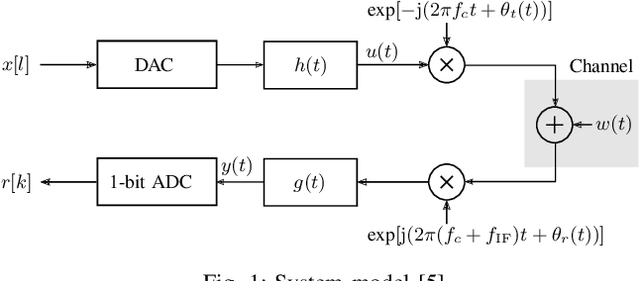
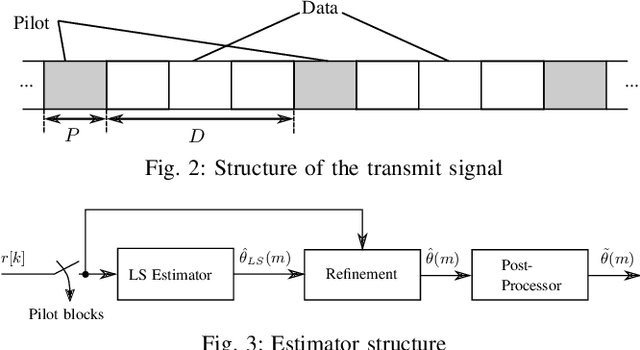
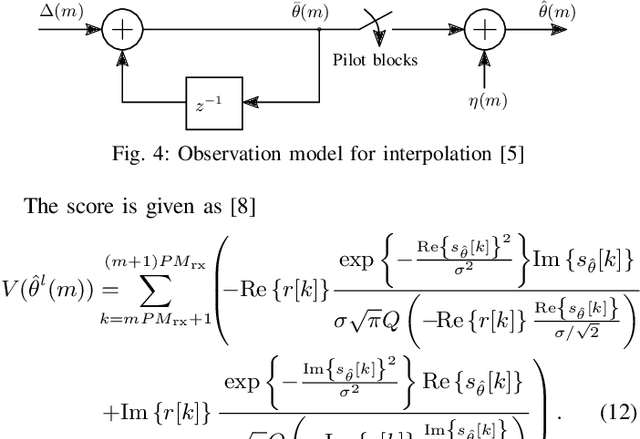
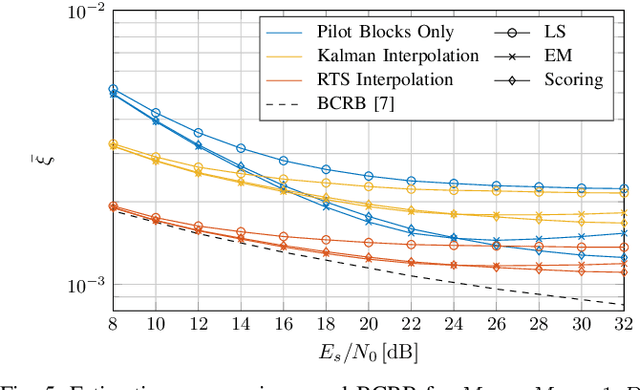
High data rates require vast bandwidths, that can be found in the sub-THz band, and high sampling frequencies, which are predicted to lead to a problematically high analog-to-digital converter (ADC) power consumption. It was proposed to use 1-bit ADCs to mitigate this problem. Moreover, oscillator phase noise is predicted to be especially high at sub-THz carrier frequencies. For synchronization the phase must be tracked based on 1-bit quantized observations. We study iterative data-aided phase estimation, i.e., the expectation-maximization and the Fisher-scoring algorithm, compared to least-squares (LS) phase estimation. For phase interpolation at the data symbols, we consider the Kalman filter and the Rauch-Tung-Striebel algorithm. Compared to LS estimation, iterative phase noise tracking leads to a significantly lower estimation error variance at high signal-to-noise ratios. However, its benefit for the spectral efficiency using zero-crossing modulation (ZXM) is limited to marginal gains for high faster-than-Nyquist signaling factors, i.e., higher order ZXM modulation.