 Add to Chrome
 Add to Firefox
 Add to Edge
Deep learning methods for inverse problems using connections between proximal operators and Hamilton-Jacobi equations
Dec 29, 2025
Inverse problems are important mathematical problems that seek to recover model parameters from noisy data. Since inverse problems are often ill-posed, they require regularization or incorporation of prior information about the underlying model or unknown variables. Proximal operators, ubiquitous in nonsmooth optimization, are central to this because they provide a flexible and convenient way to encode priors and build efficient iterative algorithms. They have also recently become key to modern machine learning methods, e.g., for plug-and-play methods for learned denoisers and deep neural architectures for learning priors of proximal operators. The latter was developed partly due to recent work characterizing proximal operators of nonconvex priors as subdifferential of convex potentials. In this work, we propose to leverage connections between proximal operators and Hamilton-Jacobi partial differential equations (HJ PDEs) to develop novel deep learning architectures for learning the prior. In contrast to other existing methods, we learn the prior directly without recourse to inverting the prior after training. We present several numerical results that demonstrate the efficiency of the proposed method in high dimensions.

Momentum-based minimization of the Ginzburg-Landau functional on Euclidean spaces and graphs
Dec 31, 2024
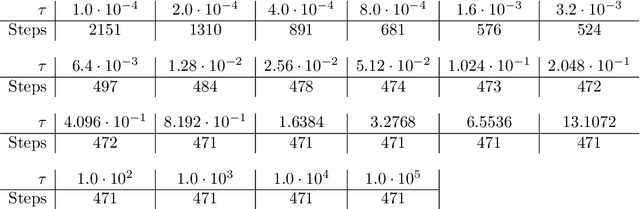
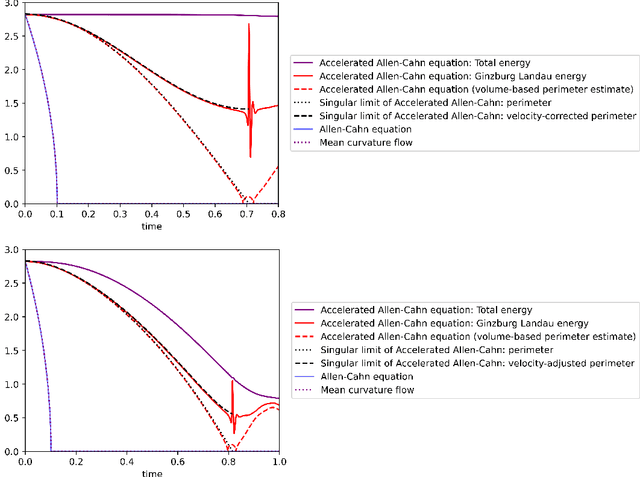
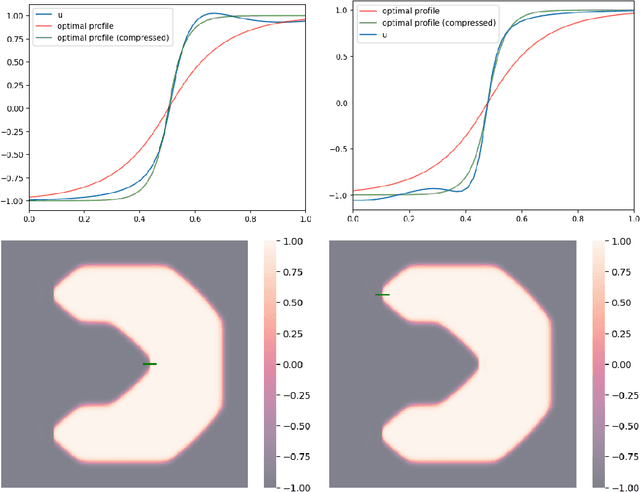
We study the momentum-based minimization of a diffuse perimeter functional on Euclidean spaces and on graphs with applications to semi-supervised classification tasks in machine learning. While the gradient flow in the task at hand is a parabolic partial differential equation, the momentum-method corresponds to a damped hyperbolic PDE, leading to qualitatively and quantitatively different trajectories. Using a convex-concave splitting-based FISTA-type time discretization, we demonstrate empirically that momentum can lead to faster convergence if the time step size is large but not too large. With large time steps, the PDE analysis offers only limited insight into the geometric behavior of solutions and typical hyperbolic phenomena like loss of regularity are not be observed in sample simulations.
Contextual Evaluation of Large Language Models for Classifying Tropical and Infectious Diseases
Sep 13, 2024While large language models (LLMs) have shown promise for medical question answering, there is limited work focused on tropical and infectious disease-specific exploration. We build on an opensource tropical and infectious diseases (TRINDs) dataset, expanding it to include demographic and semantic clinical and consumer augmentations yielding 11000+ prompts. We evaluate LLM performance on these, comparing generalist and medical LLMs, as well as LLM outcomes to human experts. We demonstrate through systematic experimentation, the benefit of contextual information such as demographics, location, gender, risk factors for optimal LLM response. Finally we develop a prototype of TRINDs-LM, a research tool that provides a playground to navigate how context impacts LLM outputs for health.