 Add to Chrome
 Add to Firefox
 Add to Edge
The Interplay of Data Structure and Imbalance in the Learning Dynamics of Diffusion Models
May 07, 2026
Real-world datasets are inherently heterogeneous, yet how per-class structural differences and sampling imbalance shape the training dynamics of diffusion models-and potentially exacerbate disparities-remains poorly understood. While models typically transition from an initial phase of generalization to memorizing the training set, existing theory assumes homogeneous data, leaving open how class imbalance and heterogeneity reshape these dynamics. In this work, we develop a high-dimensional analytical framework to study class-dependent learning in score-based diffusion models. Analyzing a random-features model trained on Gaussian mixtures, we derive the feature-covariance spectrum to characterize per-class generalization and memorization times. We reveal the explicit hierarchy governing these dynamics: class variance is the primary determinant of learning order-consistently favoring higher-variance classes-while centroid geometry plays a secondary role. Sampling imbalance acts as a modulator that can reverse this ordering and, under strong imbalance, forces minority classes to acquire distinct, delayed speciation times during backward diffusion. Together, these results suggest that diffusion models can memorize some classes while others remain insufficiently learned. We validate our theoretical predictions empirically using U-Net models trained on Fashion MNIST.

Provably Efficient Exploration in Reward Machines with Low Regret
Dec 26, 2024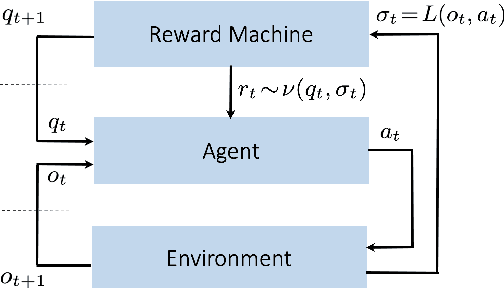
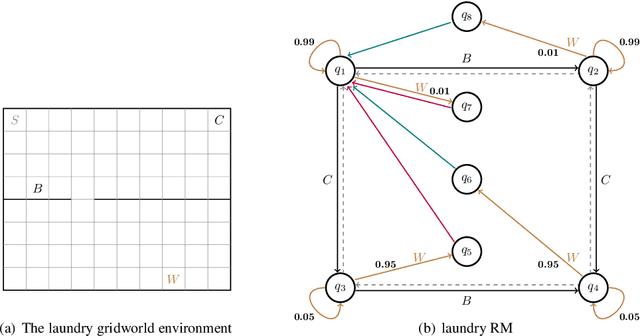
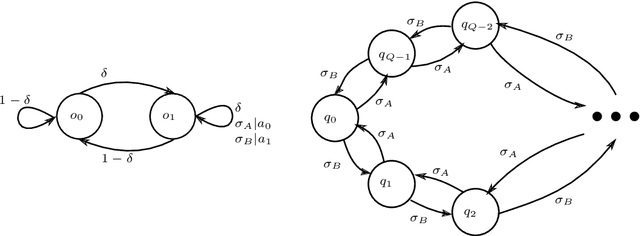
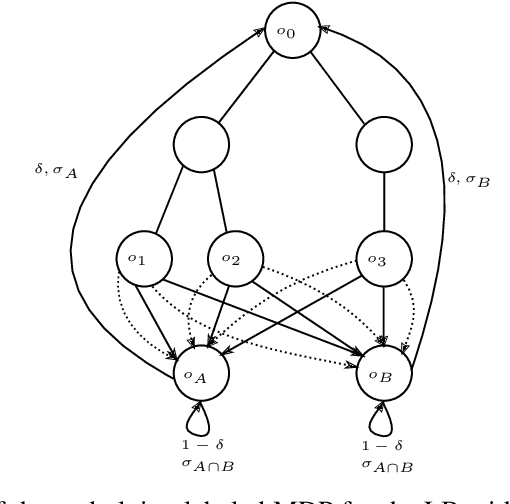
We study reinforcement learning (RL) for decision processes with non-Markovian reward, in which high-level knowledge of the task in the form of reward machines is available to the learner. We consider probabilistic reward machines with initially unknown dynamics, and investigate RL under the average-reward criterion, where the learning performance is assessed through the notion of regret. Our main algorithmic contribution is a model-based RL algorithm for decision processes involving probabilistic reward machines that is capable of exploiting the structure induced by such machines. We further derive high-probability and non-asymptotic bounds on its regret and demonstrate the gain in terms of regret over existing algorithms that could be applied, but obliviously to the structure. We also present a regret lower bound for the studied setting. To the best of our knowledge, the proposed algorithm constitutes the first attempt to tailor and analyze regret specifically for RL with probabilistic reward machines.