 Add to Chrome
 Add to Firefox
 Add to Edge
Agentra: A Supervisable Multi-Agent Framework for Enterprise Intrusion Response
Jun 18, 2026
Enterprise intrusion response still depends on static playbooks and analyst-driven triage, creating delay between alert generation and containment. We present Agentra, a supervisable multi-agent Intrusion Response System (IRS) framework that converts alerts from IDS, EDR, and XDR platforms into structured incident response plans grounded in MITRE ATT&CK, MITRE D3FEND, and NIST CSF 2.0. Agentra decomposes response reasoning across role-scoped agents, validates proposed plans through a bounded Planner--Validator review loop, screens retrieved threat intelligence through a Moderator security gateway, gates actions through an Action Catalog and risk score, and records decisions in an append-only audit log. We evaluate Agentra against a static OASIS CACAO v2.0 cyber-playbook baseline on a 120-event corpus drawn from ThreatHunter-Playbook, Splunk BOTSv3, and DARPA OpTC. The strongest configuration improves FP-aware IRS F1 from 0.61 to 0.84 and restores the projected harmful-action rate to the static baseline level of 0.0% after Planner-only configurations introduce unsafe overreaction. These results indicate that multi-agent response planning can improve ontology-grounded IRS coverage while preserving analyst approval and auditability.

An Intrusion Response System utilizing Deep Q-Networks and System Partitions
Feb 16, 2022
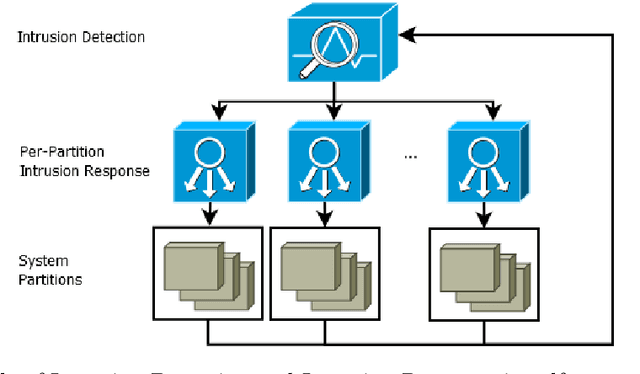
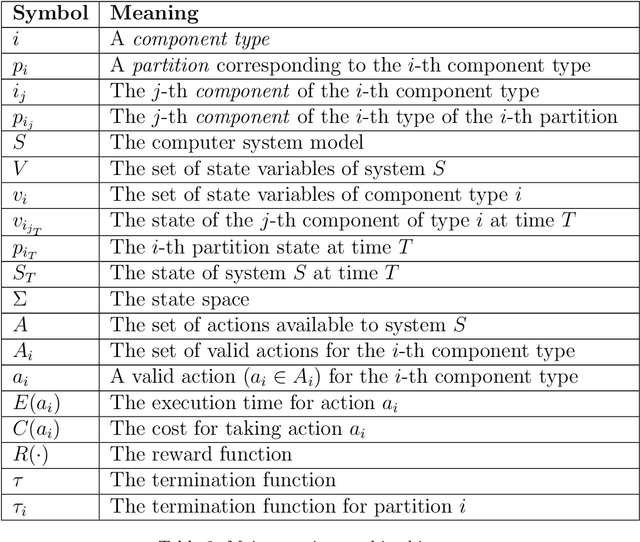
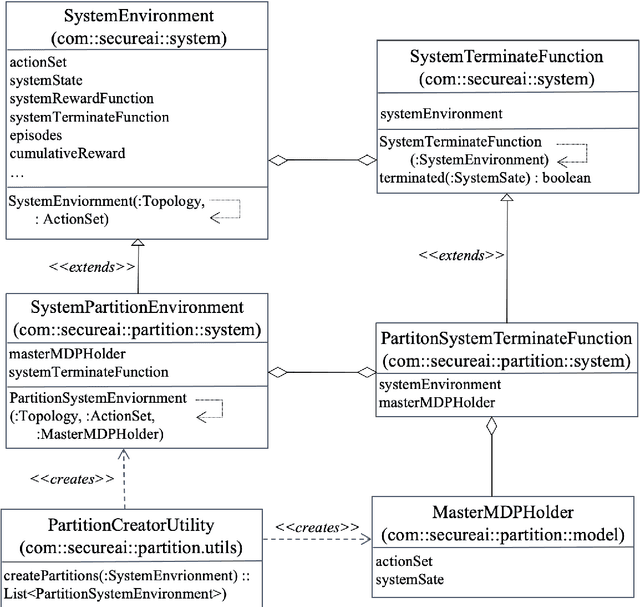
Intrusion Response is a relatively new field of research. Recent approaches for the creation of Intrusion Response Systems (IRSs) use Reinforcement Learning (RL) as a primary technique for the optimal or near-optimal selection of the proper countermeasure to take in order to stop or mitigate an ongoing attack. However, most of them do not consider the fact that systems can change over time or, in other words, that systems exhibit a non-stationary behavior. Furthermore, stateful approaches, such as those based on RL, suffer the curse of dimensionality, due to a state space growing exponentially with the size of the protected system. In this paper, we introduce and develop an IRS software prototype, named irs-partition. It leverages the partitioning of the protected system and Deep Q-Networks to address the curse of dimensionality by supporting a multi-agent formulation. Furthermore, it exploits transfer learning to follow the evolution of non-stationary systems.