 Add to Chrome
 Add to Firefox
 Add to Edge
Improving action classification with brain-inspired deep networks
Dec 08, 2025
Action recognition is also key for applications ranging from robotics to healthcare monitoring. Action information can be extracted from the body pose and movements, as well as from the background scene. However, the extent to which deep neural networks (DNNs) make use of information about the body and information about the background remains unclear. Since these two sources of information may be correlated within a training dataset, DNNs might learn to rely predominantly on one of them, without taking full advantage of the other. Unlike DNNs, humans have domain-specific brain regions selective for perceiving bodies, and regions selective for perceiving scenes. The present work tests whether humans are thus more effective at extracting information from both body and background, and whether building brain-inspired deep network architectures with separate domain-specific streams for body and scene perception endows them with more human-like performance. We first demonstrate that DNNs trained using the HAA500 dataset perform almost as accurately on versions of the stimuli that show both body and background and on versions of the stimuli from which the body was removed, but are at chance-level for versions of the stimuli from which the background was removed. Conversely, human participants (N=28) can recognize the same set of actions accurately with all three versions of the stimuli, and perform significantly better on stimuli that show only the body than on stimuli that show only the background. Finally, we implement and test a novel architecture patterned after domain specificity in the brain with separate streams to process body and background information. We show that 1) this architecture improves action recognition performance, and 2) its accuracy across different versions of the stimuli follows a pattern that matches more closely the pattern of accuracy observed in human participants.

Learning Socio-Temporal Graphs for Multi-Agent Trajectory Prediction
Dec 22, 2023
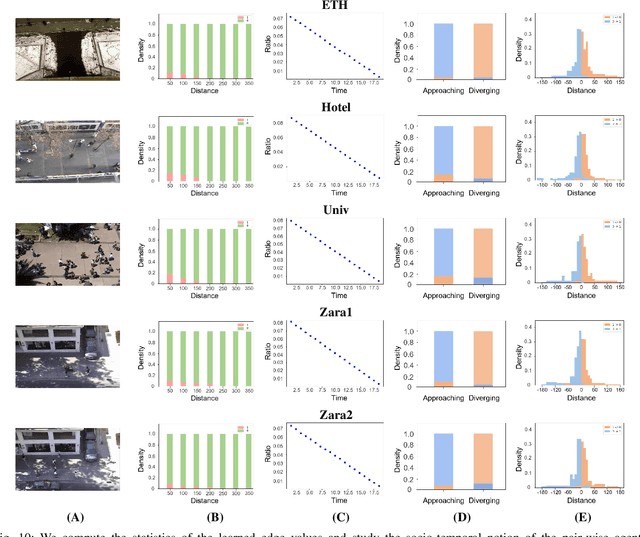
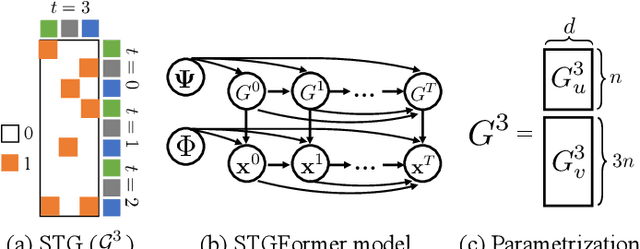

In order to predict a pedestrian's trajectory in a crowd accurately, one has to take into account her/his underlying socio-temporal interactions with other pedestrians consistently. Unlike existing work that represents the relevant information separately, partially, or implicitly, we propose a complete representation for it to be fully and explicitly captured and analyzed. In particular, we introduce a Directed Acyclic Graph-based structure, which we term Socio-Temporal Graph (STG), to explicitly capture pair-wise socio-temporal interactions among a group of people across both space and time. Our model is built on a time-varying generative process, whose latent variables determine the structure of the STGs. We design an attention-based model named STGformer that affords an end-to-end pipeline to learn the structure of the STGs for trajectory prediction. Our solution achieves overall state-of-the-art prediction accuracy in two large-scale benchmark datasets. Our analysis shows that a person's past trajectory is critical for predicting another person's future path. Our model learns this relationship with a strong notion of socio-temporal localities. Statistics show that utilizing this information explicitly for prediction yields a noticeable performance gain with respect to the trajectory-only approaches.